
Different Migration Paths from LTE to 5G: NSA vs SA Explained with EPC and 5GC
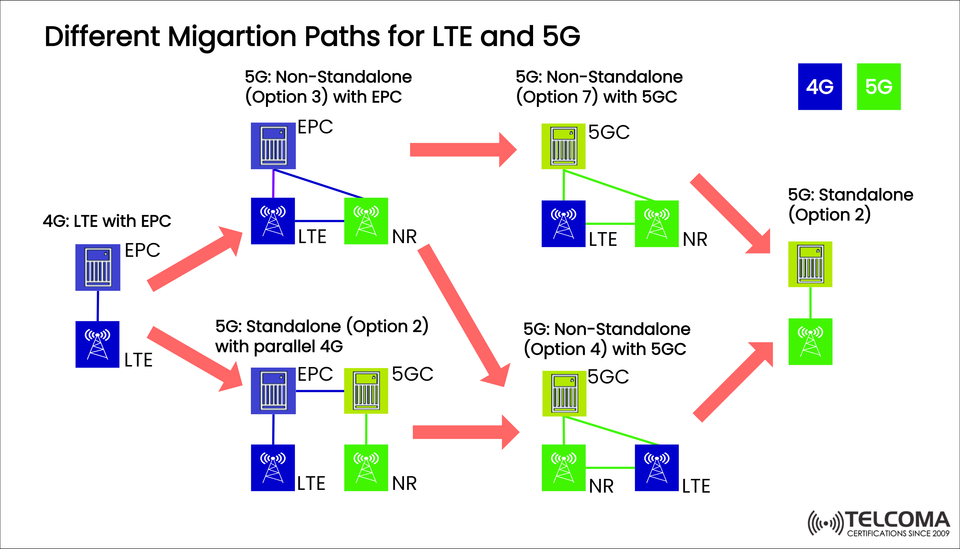

📡 A Little Migration Path Knowledge Going From LTE to 5G
For telecom operators that are moving toward 5G, determining the right migration path from LTE to 5G is significant. The migration from 4G LTE with EPC to full 5G standalone with 5GC has multiple standardized migration paths. The migration paths to 5G ensure continuity of service, the ability to be backward compatible, and the possibility to rollout some 5G features.
The image above depicts the 3GPP standardized migration paths- NSA and SA- utilized to deploy 5G while still using LTE.
🧭 Concepts and Terms
To set the table for the migration paths, here are the core components:
LTE (Long-Term Evolution): 4G RAN
NR (New Radio): 5G radio interface
EPC (Evolved Packet Core): 4G core network
5GC (5G Core): Cloud-native 5G network core
NSA (Non-Standalone): 5G NR used with existing LTE
SA (Standalone): Full 5G network with NR and 5GC
🔀 LTE to 5G Migration Paths: The Options
The image provides six main migration paths telecom operators can choose from. Here is the background and the paths depicted in order:
Option Time Migration Type Description
4G: LTE with EPC Baseline System based on 4G LTE and using an EPC
Option 3 (NSA) 5G NR with EPC 5G NR added to LTE where the EPC remains as an anchor
Option 7 (NSA) LTE with5GC LTE 5G aware as 5GC is used with EPC
The image depicts a 2G, 3G, or 4G network used to configure 5G planes. The service can be live on the 5G NR, the serve will be on the 4G, still connected to the 4G. The 4G circle will be notified as LTE updates to 5G.
🚀 Insights on Migration Strategy
Every migration has strategic trade-offs contingent on operator's pre-existing infrastructure, business-model, and spectrum resources.
✅ Option 3 (NSA with EPC)
Quick Deployment: Leverages EPC Already Owned
Low Cost, Fast Onboarding
LTE anchor for the control plane.
✅ Option 7 (NSA with 5GC)
A Transitional Option: Connecting LTE to 5G Core
Preparing the network for SA evolution.
✅ Option 2 (SA and Parallel 4G)
Slow Transition: 5G standalone build alongside 4G.
Best suited for greenfield operators.
✅ Option 4 (NSA with 5GC)
An Intermediate Step: 5G NR is dependent upon the LTE network, however the 5GC is utilized.
Gives the operator the ability to move to full standalone.
✅ Option 2 (Standalone Final)
Fully functional 5G Network: Ultra-Low Latency, Network slicing, URLLC
Does not use 4G as a dependency.
⚙️ Selection Criteria for Operators
Operators should consider:
Spectrum availability (mid-band and mmWave in particular)
Maturity of the device ecosystem.
Core network readiness to support 5GC.
Customer demand and vertical use case emphasis (i.e., eMBB, URLLC, mMTC).
🧠 Pro Tip: Build for SA from the Start
It is possible for operators to take some early engagements utilizing NSA options (and therefore launching early), however, like a scab on a cut, the lasting benefits will be obtained through Standalone 5G (the Option 2). Standalone 5G enables advanced capabilities such as:
Network Slicing.
End to End QoS.
Ultra Reliable Low Latency Communications (URLCC).
Edge Computing Compatibility.
"📚 Conclusion: A Phased Journey Towards Real 5G
5G Migration is a journey; not a leap. For operators who are transitioning to 5G, there are a number of pathways defined by 3GPP and as such they will be able to incorporate multimodal 5G capabilities at their own pace. Operators can follow a NSA (Option 3/4/7) path or Standalone path (Option 2) to deliver scalable high performance 5G services and maintain continuity from LTE.
Each phase has a purpose depending on market requirements, available spectrum, and the maturity of the network infrastructure. The most important objective is that operators choose a phased path that meets their acceptable threshold for speed, cost efficiency and future proofing.
📈 Migration Paths Summary Table
The table below provides a high-level comparison of the strategic options and highlights to help visualize your options.
Migration Path Core Network Radio Access Use Case Pros Cons
LTE with EPC EPC LTE Legacy 4G Widely deployed Limited 5G backhaul
NSA Option 3 EPC LTE + NR eMBB Fast 5G with LTE Not full 5G experience
NSA Option 7 5GC LTE + NR Intermediate Good transition to SA 5G Some complexity dual stacks
NSA Option 4 5GC NR + LTE Transitional Uses 5GC with support of LTE May require forced device upgrade
SA Option 2 (with 4G) 5GC Independent NR & LTE Phased rollout Independent networks upgrade High cost of dual networks
SA Option 2 (final) 5GC NR only Full 5G Allows slicing, URLLC, automation Expensive cost of deployment"
🛠 Applications for 5G Migration in the Real World
Here's how operators take these migration paths in the real world:
Urban high-demand areas: NSA Option 3 or Option 4 with LTE for coverage anchor
Private enterprise networks: Direct option 2 SA for use cases like smart factories
Rural areas: gradual NSA adoption with EPC and transition to Option 7 in the future
Greenfield operators: immediate deployment using Option 2 SA for cloud-native builds
🔮 Future Outlook: 5G Migration is Not the End
The migration process does not stop at Option 2. This will set the stage for innovations leveraging:
6G-readiness
AI-powered network automation
Federated slicing across operators
Satellite-5G hybrid networks
Operators investing wisely in today's building flexible, standards-based migration will enable new monetization opportunities and advantages over competitors tomorrow.
📈 Migration Paths Recap Table
To aid in your visualization of strategic option comparisons, here's a summary:
- Migration Path Core Network Radio Access Use Case Pros Cons
- LTE with EPC EPC LTE Legacy 4G Widely deployed Limited 5G support
- NSA Option 3 EPC LTE + NR eMBB Fastest 5G rollout at limited cost using
- LTE No full 5G benefits
- NSA Option 7 5GC LTE + NR Intermediate Prepares the network for SA 5G More complexity required due to balancing dual-stack