
Different Migration Paths from LTE to 5G: Standalone and Non-Standalone Explained

5G and LTE Migration Paths: A Complete Overview
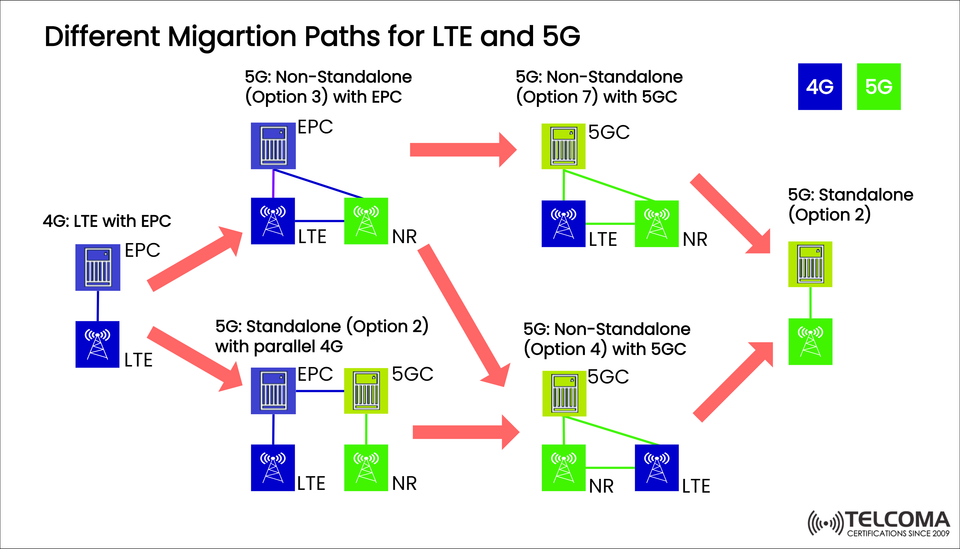
There is no single migration from LTE (4G) to 5G; it is an evolutionary journey with different paths of involvement. Each path includes a variety of deployment options that considers performance, cost, and existing infrastructure. The image above demonstrates the various migration paths from LTE to 5G, including SA [Standalone] and NSA [Non-Standalone] deployments, and the role of Evolved Packet Core (EPC) and 5G Core (5GC).
This guide clearly explains the migrations paths to help telecom professionals and network planners identify their best path to 5G.
📌 Key Terminology:
• LTE, NR, EPC, and 5GC
• LTE (Long-Term Evolution): Radio Access Technology of 4G
• NR (New Radio): Radio Access Technology of 5G
• EPC (Evolved Packet Core): Core Network of 4G
• 5GC (5G Core): Core Network of the next generation of 5G capabilities
🚀 Migration Paths from LTE to 5G
🔹 1. Starting Point: 4G LTE with EPC
Traditional deployment of 4G - LTE connected to the EPC core network.
🔹 2. NSA Option 3: LTE with EPC + 5G NR
Path: 4G EPC. Add NR with LTE anchor
Core Used: EPC
Type: Non-Standalone
Use Case: Fast 5G deployment by leveraging existing LTE infrastructure.
Benefits: Low CAPEX and quick ramp-up time - a provision to deploy 5G.
Limitations: Cannot provide any true 5G services such as slicing, or ultra-low latency.
🔹 3. NSA Option 7: LTE with 5GC + 5G NR
Path: EPC replaced by 5GC, LTE still anchors NR.
Type: Non-Standalone
Core Used: 5GC
Best opportunity over the Option 3 path because it gives the operator a better opportunity to use 5GC outcomes while still heavily reliant on LTE.
Best Use Case: Modernizing into a full 5G environment.
🔹 4. SA Option 2 with 4G in Parallel
Path: Deploy SA NR with 5GC, while continuing 4G/EPC in parallel.
Type: Standalone
Core Used: 5GC
Best Benefit: Allows for true native 5G use cases (i.e., slicing, ultra-reliable, low latency).
Greatest Opportunity/Challenge: Full 5GC and NR.
🔹 5. NSA Option 4: NR is the LTE anchor, both are on 5GC
Pathway: Use NR as the main connection and LTE as an auxiliary connection to 5GC.
Type: Non-Standalone
Core: 5GC
Use: Very Rare. This is seldom utilized, more of a theoretical than applicable option.
🔹 6. Final destination: SA Option 2
Pathway: 5G Standalone with NR and 5GC only.
Core: 5GC
Perfect for: Network Slicing, Private Networks, Private Network Automation, URLLC.
Pitfalls: Need to entirely replace or heighten LTE.
🧩 A Matrix Comparison of 5G Migrate Options
Option Type Radio Access Core Network LTE Dependency Notes
3 NSA LTE + NR EPC Yes Swift upgrade using LTE anchor
7 NSA LTE + NR 5GC Yes Allows stepwise transition of core
4 NSA NR + LTE 5GC Partial Rarely seen and more theoretical than actual
2 SA NR only 5GC No True 5G with full purpose unlocked
SA + 4G SA (Parallel) NR + LTE 5GC + EPC Yes (separate) An interim path ONLY, true transitional network.
🔄 Migration Strategy Suggestions for Operators
Begin with NSA Option 3 for an efficient market entry within a timeframe.
Plan your enterprise 5GC expenses to support an SA deployment down the road.
If you have just replaced your EPC, consider Option 7 (a mix of SA and NSA).
Focus on Option 2 (SA) for industry, enterprise, and high-performance use cases.
Find the right balance of cost vs readiness – true SA will necessitate a complete overhaul of your infrastructure.
🧠 Conclusion: Determine the Right Path to Full 5G
Not all 5G journeys will be identical - each operator will have a unique starting point defined by what LTE assets they possess, the demand from their subscribers, and their future capex plans. The LTE to 5G migration options we have outlined above, including NSA and SA architectures, will allow network architects and decision-makers to understand these paths to design cost-effective future-proof networks.
If you put some thought into it, the move to ful 5G capabilities - like slicing, massive IoT, ultra-reliable low-latency and so on - could be seamless.
📡 Future Outlook: How to Prepare for Beyond 5G (6G and beyond)
As telco networks continue to evolve, the today's migration strategy decisions will determine your readiness for tomorrow's networks. With 6G development already in progress, the need for flexible, cloud-native, and AI-driven architectures will continue to be validated.
Key Preparations for Operators:
Invest in virtualization and cloud-native core networks (5GC).
Take advantage of edge computations for extremely-low latency use cases.
Move toward Open RAN and network disaggregation.
🛠️ Key Tools and Technologies for 5G Migration
Operators can use these technologies to make the change platform easier and faster
Dual Connectivity (EN-DC): A means of deploying NSA service by combining LTE and NR data paths.
Service-Based Architecture (SBA): A basic feature of 5GC that enables the use of APIs and microservices.
Network Slicing: A technique used (with standards yet to be determined) by SA deployments, enabling some logical segmentation of the network for service differentiation.
Dynamic Spectrum Sharing (DSS): Allows LTE and 5G to deploy on the same spectrum.
📍 Use Cases for 5G Migration
Use Case Required Migration Conclusive Description
Smart Cities SA Requires slicing capabilities and massive IoT
Autonomous/Vehicles SA Requires ultra-reliable low-latency communications (URLLC)
Enhanced Mobile Broadband (eMBB) NSA Facilitates higher data rates for consumers
Industry 4.0 SA Requires deterministic networks and private slicing
Fixed Wireless Access (FWA) NSA or SA Whether NSA or SA, essentially early monetization of 5G facility upgrades in rural or underserved markets.
📣 Conclusion: Plot your 5G Course
The migration from LTE to 5G services does not take place as a one-time event. It is a journey which requires:
A clear assessment of the network,
A phased approach to planning your investments, and
Being able to identify when to migrate to NSA or SA.
By following the proper path, starting with NSA migration and ultimately moving to SA, operators will be able to properly position for maximum ROI, deliver an improved customer experience and future-proof their evolution.