
Disaggregated Architecture for 5G Integrated Access and Backhaul (IAB) Explained
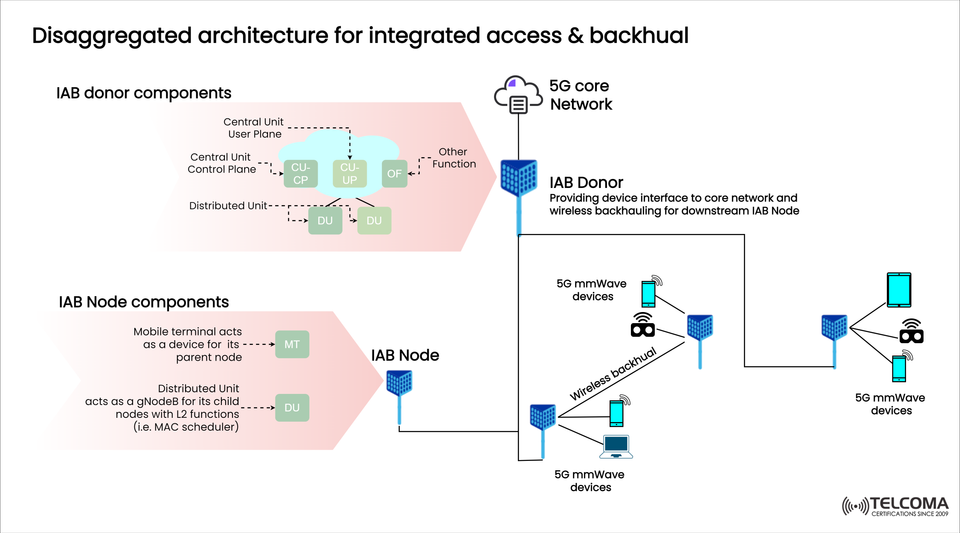

Disaggregated Architecture for Integrated Access and Backhaul (IAB) in 5G
As 5G rolls out worldwide, mobile operators are dealing with the tough task of densifying networks while keeping costs and complexity in check. The usual backhaul solutions—like fiber or microwave—often have a hard time scaling in crowded urban areas and rural locations.
This is where Integrated Access and Backhaul (IAB) steps in. It merges access and backhaul into the same wireless spectrum, letting operators extend 5G coverage without needing to lay expensive fiber.
What is Integrated Access and Backhaul (IAB)?
IAB is a cutting-edge 5G approach outlined in 3GPP Release 16. It’s set up to provide:
Access links (to connect 5G devices to the base station)
Backhaul links (to connect base stations to the core network)
using the same radio technology and spectrum.
Rather than installing fiber or microwave links for every small cell, IAB allows for wireless relaying, meaning nodes can act as both access points for user devices and backhaul nodes forwarding traffic upstream.
Key Benefits of IAB
Cost Efficiency: Cuts down on fiber deployment costs.
Faster Deployment: Great for urban hotspots and expanding into rural areas.
Flexibility: Allows for dynamic network growth.
Spectrum Efficiency: Reuses mmWave spectrum for both access and backhaul.
Disaggregated Architecture in 5G IAB
The diagram emphasizes how 5G IAB utilizes a disaggregated architecture, breaking down functions into separate units for improved scalability and effectiveness.
IAB Donor Components
The IAB Donor serves as the main node linked to the 5G Core Network. It has two key tasks:
It connects devices to the 5G core.
It provides wireless backhaul to downstream IAB nodes.
Functions of the IAB Donor (as shown in the image):
CU-CP (Central Unit – Control Plane): Manages signaling and control.
CU-UP (Central Unit – User Plane): Takes care of data forwarding.
DU (Distributed Unit): Positioned closer to the radio interface for scheduling and MAC layer functions.
OF (Other Functions): Includes support functions like mobility management or security.
IAB Node Components
An IAB Node serves as both a UE (User Equipment) for its parent node and as a base station for its child nodes.
Functions of IAB Node (from the image):
MT (Mobile Terminal): The node functions like a device (UE) when connecting to its donor.
DU (Distributed Unit): Acts as a gNodeB for downstream child nodes, handling L2 (MAC) scheduling and radio management.
This dual function allows the IAB node to relay traffic while also serving 5G devices like smartphones, VR headsets, and laptops.
Wireless Backhaul in Action
In the diagram:
The IAB donor connects to the 5G core.
It supplies wireless backhaul to IAB nodes through the mmWave spectrum.
Each IAB node serves 5G mmWave devices while also sending data upstream.
This setup can be linked together, creating multi-hop wireless backhaul without the need for fiber.
Why Disaggregation Matters in IAB
Traditional RAN architectures bundle all functions into one entity, making it tough to scale. With disaggregated RAN (following Open RAN principles), different functions are separated, enabling flexible deployments.
Advantages of Disaggregation in IAB:
Scalability: Operators can scale CU, DU, and MT resources independently.
Virtualization: CU functions can be hosted in the cloud, making orchestration easier.
Interoperability: Allows for open interfaces between components from different vendors.
Efficiency: By splitting control, user plane, and distributed functions, resource usage is optimized.
This means disaggregated IAB isn't just a cost-saving backhaul solution but also a way to future-proof network design.
Technical Workflow of IAB
Access Request: A 5G device (like a smartphone or VR headset) connects to a nearby IAB node using mmWave access.
Relay Role: The IAB node operates as a gNodeB for the device and as a UE for its donor.
Wireless Backhaul: The node sends data upstream via wireless backhaul to its donor.
Donor Processing: The IAB donor manages control and user plane functions and forwards traffic to the 5G Core Network.
End-to-End Path: This creates a smooth data path from the device to the IAB node, then to the donor, the 5G core, and finally to the internet or cloud.
Use Cases of 5G IAB
Urban Densification
Fiber deployment for every small cell in crowded cities can get pricey.
IAB nodes can be set up on lampposts or rooftops, providing wireless backhaul to donors.
Rural Coverage Expansion
Remote areas often lack fiber infrastructure.
IAB allows for multi-hop wireless backhaul to extend 5G coverage without needing to lay fiber.
Temporary Networks
Great for events, disaster recovery, or military operations where quick setup is crucial.
IAB offers connectivity without waiting for fixed backhaul to be installed.
Private 5G Networks
Companies can set up private 5G networks using IAB nodes within campuses or factories.
This ensures coverage in hard-to-reach areas without needing extensive infrastructure.
Challenges of IAB Deployment
Despite its potential, IAB does come with some challenges:
Spectrum Sharing: Access and backhaul share the same spectrum, which can cut efficiency.
Latency: Multi-hop backhaul may lead to increased end-to-end latency.
Throughput Reduction: Each hop uses up some of the capacity.
Reliability: Weather and interference can impact mmWave wireless backhaul links.
Solutions Under Development:
More intelligent scheduling algorithms to balance access and backhaul.
Multi-band IAB (using sub-6 GHz for backhaul and mmWave for access).
AI-driven optimization to help with dynamic traffic load balancing.
IAB vs. Traditional Backhaul: A Comparison
Feature IAB (Integrated Access & Backhaul)Traditional Backhaul (Fiber/Microwave)Deployment Cost Low – no trenching for fiber High – fiber installation is costly Deployment Speed Fast – wireless setup Slow – fiber buildout takes months Flexibility Highly flexible, scalable Limited by physical infrastructure Latency Higher with multi-hop Lower, fiber is near-ideal Capacity Limited by spectrum reuse Very high with fiber Use Case Urban densification, rural coverage Core urban backhaul, long-term capacity
Conclusion
The disaggregated architecture for Integrated Access and Backhaul (IAB) is a significant advancement in 5G deployment. By merging access and backhaul over the same spectrum, IAB paves the way for cost-effective, rapid, and flexible network expansion.
For operators, it offers an efficient means to broaden coverage and densify networks without being limited by fiber infrastructure. For enterprises and private networks, it opens doors to flexible deployments in urban settings, rural areas, and temporary situations.