
Disaggregated RAN Explained: 3GPP Logical Architecture for CU/DU Splits
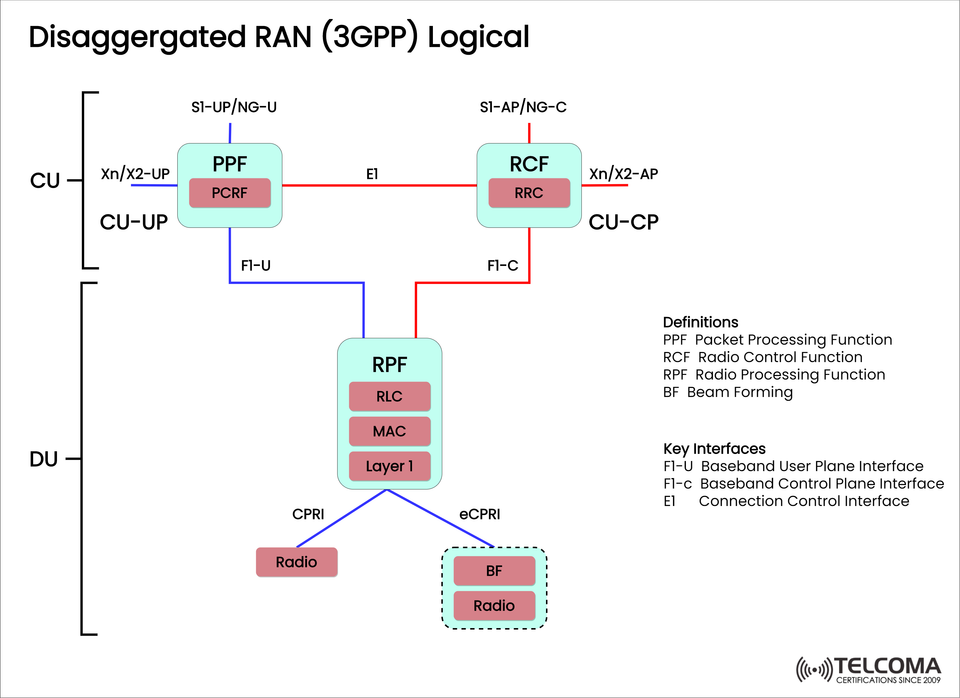

Disaggregated RAN (3GPP) Logical Architecture
The telecommunications system is moving toward virtualization and cloud-native, and the development of Disaggregated RAN (Radio Access Network) by 3GPP is fundamentally changing how RAN systems have traditionally been operated. Disaggregated RAN (3GPP) leverages the logical functions of a RAN system being separated, into distinct physical Central Units (CU) and Distributed Units (DU), that allows the disaggregated RAN to provide tremendous flexibility, scalability and cost savings in the implementation of the RAN architecture.
The legitimate failings of the Disaggregated RAN (3GPP) architecture, including the interfaces, interconnects and protocols possible for disaggregated RAN.
📌 Disaggregated RAN Key Components
The disaggregated RAN architecture shows the functional elements of the RAN as distinct logical blocks, where each block has input responsibilities or roles.
- Central Unit - User Plane (CU-UP)
Here the block is the PPF (Packet Processing Function)
Role: Transfers user data and forwards to/from the RAN.
Includes: PCRF (Policy and Charging Rules Function)
Interfaces:
F1-U – CU-UP connects DU - for user-plane data. to/from DU
E1 CU-CP will connect with CU-UP to synchronize control, elements under control of CU-UP can be outside of CU-CP and DU as long as CU-CP is aware of them
Xn/X2-UP – allows communication between CU-UP
S1-UP / NG-U – connect core network user plane to network.
- Central Unit - Control Plane (CU-CP)
Here, the block is the RCF (Radio Control Function)
Role: Signals control with the UE, includes: RRC (Radio Resource Control)
Interfaces:
F1-C – CU-CP to DU control-plane signaling, logical control aspects of DU for exercise control.
E1 – connects CU-CP to CU-UP, for control signaling.
🔌 Interface Summary
Interface Description
F1-U Baseband user plane interface (CU-UP ↔ DU)
F1-C Baseband control plane interface (CU-CP ↔ DU)
E1 Internal control interface (CU-CP ↔ CU-UP)
CPRI DU to Radio legacy interface
eCPRI Enhanced DU to Radio interface, with support for BF and Radio
S1 / NG Core legacy (4G) and 5G interfaces
💡 RAN Disaggregation Benefits
Network Flexibility: Can separate control and user plane scaling.
Cloud-nativeness: Supports virtualization/containerization of RAN functions.
Interoperability: Open interfaces enable multiple vendor deployments.
Efficiency: Centralized control and distributed processing improves resource efficiencies.
🧠 Technical Definitions Recap
PPF – Packet Processing Function (handles user data)
RCF – Radio Control Function (handles signaling and session control)
RPF – Radio Processing Function (handles physical layers)
BF – Beamforming (optimizes signals for performance)
🧭 Real-World Implications of Disaggregation RAN
Disaggregation RAN is more than a concept - it is already affecting commercial 5G launches around the world. The applicability of this architecture allows for many things:
MEC for ultra-low latency services.
Network slicing that adapts dynamically to give enterprises custom offerings.
Massive MIMO and Beamforming to increase spectral efficiency in dense urban conditions.
Open RAN (O-RAN) capacity for multi-vendor plug-and-play architecture.
🌐 Deployment Scenarios
✔️ Urban High-Capacity Use Cases
Need: Necessity for high throughput and scalable user plane.
Solution: Disaggregate CU-UP provisioned in cloud data center, DU function located at the cell site.
Benefit: Centralized control and provides seamless routing of user data.
✔️ Rural Low-Latency Applications
Need: Necessity for fast control signalling where backhaul is less limited.
Solution: CU-CP and DU remain co-located in configuration for less delay through the split E1/F1-C interface.
Benefit: The simplified architecture is clear while the logical separation remains and is functional.
✔️ Enterprise Private Networks
Need: Needs custom SLAs and local control.
Solution: Disaggregated CU-CP to ensure a clear ability to maintain mobility control, and a dedicated DU can control RAN coverage in enterprise campuses.
Benefit: High security and control of the network while use of resources is optimized.
🧱 Breakdown of the Architecture from the Diagram
Now we'll identify how the drawing breaks down to real layers:
➤ CU Layer (Centralized Unit)
CU-UP (User Plane):
Located here: It is the Packet Processing Function (PPF).
It interfaces with external networks (NG-U/S1-U) and DU internally via F1-U.
It interfaces with the CU-CP via E1.
CU-CP (Control Plane):
Located here: It is the Radio Control Function (RCF).
It manages RRC-signaling mobility via NG-C/S1-AP.
It interfaces with DU via F1-C and with CU-UP via E1.
➤ DU Layer (Distributed Unit)
Radio Processing Function (RPF):
Located here: contains RLC, MAC, and Layer 1 (PHY).
It terminates the F1-U and F1-C interfaces from CU.
It interfaces with the Radio via CPRI and eCPRI.
It is compatible with the Beamforming (BF) used in advanced configurations.
🧰 Advantages that Network Operators will Realize
- Feature Benefit for Operators
- Logical separation of roles Allows for scaling and managing control/user planes much easier
- Flexible placement Can place computing resources where needed and as needed
Cloud-native architecture Allows for virtualization, NFV, and containerization
- Vendor interoperability Allows for Open RAN deployments and competition across vendors
- Future proof Sets up networks for 6G and more importantly drives towards AI automation.
📈 How This Supports Open RAN Evolution
While this architecture maintains compatibility with 3GPP, it is also in support of Open RAN ideals:
Open Interfaces: E1, F1-C, F1-U, and eCPRI are all open interfaces.
🏁 Conclusion
The Disaggregated RAN Logical Architecture (3GPP) presents an important transition from one-dimensional RAN "hardware-like" systems to modular, scalable and future-proof architectures. It offers operators a flexible solution to manage the increasing complexity of 5G including managing edge-based services, scaling dense urban coverage, and enabling mission-critical applications.
For telecommunications professionals and technology buffs who want to understand and design, deploy and optimize future-generation mobile networks it is important to become familiar with this logical architecture and the relationships that exist between the CU-UP, CU-CP, DU and their respective interfaces.