
Disruptive Future Trends in 6G: Localization, Security, AI, and Beyond

Future Trends in 6G: What to Expect in Localization, Security, AI, and More
As 5G becomes the norm around the world, the telecom sector is shifting its attention towards 6G—the next mobile network expected to roll out by around 2030. While 5G brought incredible advancements in speed, latency, and connectivity, 6G is set to bring even bigger changes, impacting not just telecommunications, but also society, industries, and our digital lives.
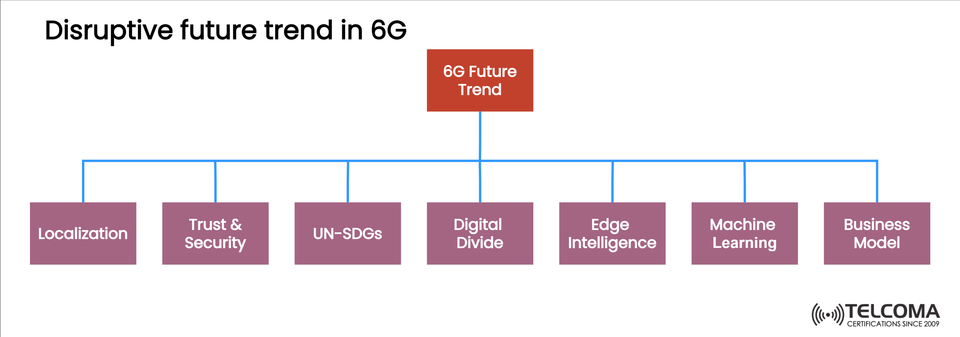
The diagram included highlights the key trends to watch in 6G:
Localization
Trust & Security
UN-SDGs (United Nations Sustainable Development Goals)
Bridging the Digital Divide
Edge Intelligence
Machine Learning
New Business Models
In this post, we’ll explore each of these trends—what they mean, why they’re important, and how they’ll influence the future of 6G for both telecom pros and tech fans.
- Localization in 6G
Localization means super accurate positioning services built right into 6G networks. Unlike GPS, which doesn’t perform well indoors or in crowded urban spaces, 6G aims to achieve centimeter-level accuracy—and to do so seamlessly in various environments.
Why Localization is Key in 6G
Autonomous Systems: Think self-driving cars and drones that need real-time positioning accurate to within centimeters.
Industry 5.0: Factories will rely on precise location data for efficient robotic teamwork.
Smart Cities: Accurate positioning will be vital for managing traffic, public safety, and logistics.
Healthcare: Wearables that know users' locations will improve emergency response times.
6G will merge terahertz spectrum, AI-enhanced sensing, and network-native localization, making this a core component instead of an add-on.
- Trust & Security in 6G
As networks dive into crucial areas like healthcare, finance, defense, and energy, trust and security will become fundamental to 6G.
Key Security Features in 6G
Quantum-Safe Encryption: This protects communications from the threats posed by future quantum computing.
AI-Driven Threat Detection: It will spot anomalies in real-time, shielding billions of IoT devices.
Zero-Trust Architecture (ZTA): Every access point, user, and device will be continuously verified.
Blockchain Integration: This will help build trust in transactions, supply chains, and identity management.
For those in telecom, this trend means security will be built in from the start, ensuring privacy and resilience throughout the network.
- UN-SDGs and 6G Sustainability
The United Nations Sustainable Development Goals (UN-SDGs) are becoming more central to technology strategies worldwide. 6G will be developed with a focus on not just performance but also on sustainability and inclusivity.
How 6G Will Align with UN-SDGs
Climate Action: Ultra-high energy efficiency (uHEE) will help reduce networks’ carbon footprints.
Inclusive Connectivity: Helping underserved groups access the internet supports the idea of “Internet for All.”
Smart Agriculture: 6G-driven IoT sensors will improve resource efficiency in farming.
Health & Education: Telemedicine and remote learning will reach more people with reliable, low-latency connections.
By aligning with the SDGs, 6G ensures technology acts as a catalyst for equity and sustainability, rather than just being about competition.
- Bridging the Digital Divide
The digital divide is still a significant issue—billions lack reliable internet access. 6G aims to bridge this gap through consistent coverage and affordable connections.
Strategies to Bridge the Divide
Satellite-Terrestrial Integration: Low Earth Orbit (LEO) satellites will work alongside terrestrial 6G networks for worldwide coverage.
Affordable Infrastructure: Utilizing open RAN and software-defined networking (SDN) to keep costs down.
Community Networks: Supporting local operators to provide cost-effective services.
Edge Computing Expansion: Bringing services nearer to remote areas to lessen reliance on centralized data centers.
For telecom companies, tackling the divide isn’t only moral; it’s a chance to tap into a new market with billions of potential users and devices.
- Edge Intelligence in 6G
6G will bring edge intelligence, blending edge computing with AI. Rather than depending entirely on centralized cloud systems, smart processing will happen closer to where data is generated.
Benefits of Edge Intelligence
Ultra-Low Latency: Fast processing at the edge means sub-millisecond response times.
Bandwidth Efficiency: Less distance for data traveling reduces congestion on the network.
Context-Aware Services: Users enjoy personalized experiences, thanks to local data handling.
Resilience: Edge nodes will maintain service even if central servers go down.
You’ll see applications in areas from self-driving cars to immersive experiences and industrial automation, making edge intelligence a game-changer for 6G.
- Machine Learning in 6G
While 5G mainly used AI for network improvements, 6G will be AI-first—with machine learning woven into its design, operation, and user services.
Applications of Machine Learning in 6G
Self-Organizing Networks (SON): Automatic setup and optimization of networks.
Predictive Maintenance: Spotting potential issues before they affect users.
Dynamic Resource Allocation: ML will adjust things like spectrum and latency on-the-fly.
Personalized Services: Networks will adapt to what users prefer based on behavior and needs.
With machine learning, 6G networks will be not just faster, but smarter, capable of changing to meet evolving demands.
- New Business Models in 6G
Innovative technologies call for new business models. 6G will not only connect people and devices but also forge new economic structures for telecom companies and industries.
Emerging Business Models in 6G
Network-as-a-Service (NaaS): On-demand access to segments of the network.
Data Monetization Models: Using AI insights for various industries like retail, healthcare, and logistics.
Collaborative Ecosystems: Partnerships between telecoms, cloud providers, startups, and governments.
Pay-Per-Experience Models: Charging based on the quality of service (like pricing for holographic calls).
Green Business Models: Incentives for eco-friendly infrastructure and carbon-neutral operations.
For operators, this presents a mix of opportunities and challenges—finding ways to profit while ensuring inclusivity and sustainability.
Quick Comparison: 5G vs 6G Disruptive Trends
Category5G Approach6G Disruptive Trend Localization GPS + extra solutions Native cm-level precision in-network Trust & Security Standard encryption Quantum-safe + AI-driven security Sustainability Limited green efforts UN-SDG-driven ultra efficient designs Digital Divide Selective availability Global access via satellites + local networks Edge Computing Cloud-based with some edge support AI-driven distributed edge intelligence Machine Learning Network improvement only AI-native, integrated throughout Business Models Subscription or usage-based NaaS, pay-per-experience, sustainability incentives
Conclusion
The upcoming trends in 6G—localization, security, sustainability, digital inclusion, edge intelligence, machine learning, and new business models—herald a significant shift in how telecom networks will operate.
For telecom professionals, 6G is not just about higher speeds or lower latency; it’s about creating a secure, sustainable, and intelligent ecosystem. And for tech enthusiasts, it marks a step toward a connected future where networks anticipate needs, support new industries, and help bridge global disparities.
In the end, 6G isn’t merely an upgrade from 5G—it’s a complete rethinking that will transform society, industries, and the digital economy for many years to come.