
Distributed Detection in Wireless Sensor Networks: Architecture, Function, and Applications

Introduction
When it comes to today’s telecommunication and IoT environments, having accurate and reliable data is absolutely essential. Organizations use extensive sensor networks to gather information and make smart decisions—be it for detecting intrusions, monitoring industrial processes, or tracking changes in the environment.
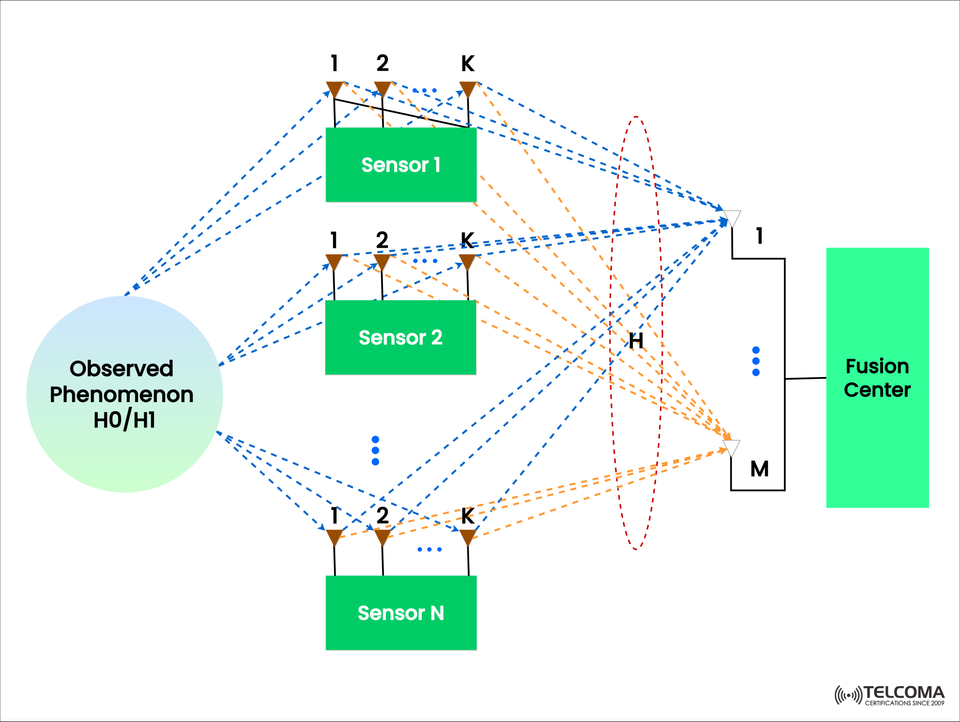
One of the most effective architectures that supports this kind of decision-making is the Distributed Detection System, which is outlined in the diagram above. This system connects lots of spatially distributed sensors that observe a phenomenon (referred to as H₀/H₁) and send their findings to a central hub, known as the Fusion Center (FC), which ultimately makes the final decision.
This teamwork ensures that detection is more reliable, robust, and energy-efficient than if each sensor were acting alone. In this article, we’ll take a closer look at how distributed detection functions, its architecture, the flow of data, its applications in telecom and IoT, and why it’s crucial for the future of smart networks.
What Is Distributed Detection?
Distributed detection refers to the method of combining observations or decisions made by multiple sensors that are spread out to determine the state of a specific phenomenon.
Each sensor gathers local data—like signal strength, temperature, or motion—and sends either the raw data or a local decision to a central processor (the Fusion Center). The FC then reaches a global decision (H₀ or H₁) based on all the inputs it receives.
This system shines especially in situations where:
Each sensor might have limited processing or communication capacity.
Individual observations could be noisy or unreliable.
The environment demands high fault tolerance and scalability.
System Architecture Explained
The diagram features a layered Distributed Detection System that consists of several key components:
Observed Phenomenon (H₀/H₁)
On the left side of the diagram is the observed phenomenon, represented by two hypotheses:
H₀ (Null Hypothesis): The event is not happening (for example, no signal is detected).
H₁ (Alternative Hypothesis): The event is happening (e.g., a signal is detected).
This could involve signal transmission, temperature thresholds, vibration, or any measurable condition in the environment.
Sensor Nodes (Sensor 1 to Sensor N)
Each sensor node—Sensor 1, Sensor 2, ..., Sensor N—monitors the phenomenon and processes the information locally.
Each sensor takes in K input signals or measurements (noted as inputs 1, 2, …, K). These inputs denote various observation channels, like frequency bands or signal sources.
Sensor Functions:
Data Acquisition: Gathering environmental or signal-based data.
Pre-Processing: Filtering noise, compressing data, or extracting features.
Decision Formation: Each sensor may decide on H₀ or H₁ using pre-defined local thresholds.
Transmission: Sending either raw data or the local decision to the fusion center.
The dotted blue lines illustrate the flow of information from the phenomenon to the sensors, while the dashed orange lines represent the communication links from the sensors to the fusion center.
- Communication Channels
Between the sensors and the fusion center, there are M communication channels depicted by multiple dotted and dashed lines in the diagram.
These channels can include:
Wireless links (common in IoT and mobile systems)
Wired connections (often found in industrial setups)
Each channel may face:
Noise and interference
Bandwidth limitations
Energy constraints
This makes communication efficiency and data reduction crucial for optimizing the system.
- Fusion Center
The Fusion Center (FC) acts as the central node that gathers data or local decisions from all sensors and merges them to arrive at a final global decision.
Depending on the system’s setup, it employs data fusion or decision fusion algorithms.
Fusion Techniques:
Type Description Example Data Fusion Combines raw data from all sensors collectively Centralized processing Decision Fusion Each sensor sends a binary decision (H₀/H₁)Majority voting Hybrid Fusion Merges both methods Weighted likelihood
Fusion Rules:
AND Rule: H₁ is the final decision only if all sensors report H₁ (high reliability, minimal false alarms).
OR Rule: H₁ is the final decision if any sensor reports H₁ (high sensitivity).
Majority Rule: The final decision is based on the majority of sensor votes.
Weighted Fusion: Sensors that show better reliability or lower noise carry more influence.
Workflow of Distributed Detection
Here’s a step-by-step breakdown of the information flow:
Phenomenon Observation: An event occurs—such as a signal being transmitted or an anomaly appearing.
Sensor Measurement: Each sensor collects multi-channel data (1 to K) from the environment.
Local Processing: Sensors perform local computations and may decide between H₀ and H₁.
Data Transmission: Sensors send their data or decisions through the communication channels to the fusion center.
Global Fusion: The Fusion Center compiles the inputs and uses fusion algorithms to reach the final decision.
Output Decision: The system determines whether the phenomenon is present (H₁) or absent (H₀).
Applications in Telecom and IoT
Distributed detection is foundational to numerous advanced technologies in telecommunications and Internet of Things (IoT) networks. Let’s look at some key applications:
- Cognitive Radio Networks (CRN)
Sensors identify if certain frequency bands are occupied (H₁) or free (H₀).
The fusion center manages dynamic spectrum access among users, enhancing spectral efficiency.
- Smart Cities
Distributed sensors track traffic density, air quality, and infrastructure status.
Data fusion guarantees accurate and dependable analytics across the city.
- Environmental and Industrial Monitoring
Sensors spot hazardous situations (like gas leaks or temperature spikes).
Fusion minimizes false alarms and boosts early detection.
- Wireless Surveillance Systems
Cameras, microphones, and motion sensors work together to detect unauthorized activities.
Fusion heightens event detection accuracy, especially in noisy circumstances.
- Healthcare and Wearable Networks
Biosensors track vital signs and anomalies in patient data.
The fusion center (like a mobile device or cloud server) gathers readings to notify healthcare providers.
Advantages of Distributed Detection Systems
✅ Increased Reliability: Lowers the risk of failure from a single sensor.
✅ Noise Reduction: Merges multiple signals for improved accuracy.
✅ Scalability: It's easy to add new sensors.
✅ Energy Efficiency: Local decision-making cuts down on transmission burden.
✅ Strong Decision-Making: Functions effectively in uncertain or noisy settings.
✅ Low Latency: With edge processing, it allows for real-time responses.
Challenges and Limitations
Even with its benefits, distributed detection has some challenges that telecom engineers need to tackle:
Channel Noise and Fading: Transmission errors can impact fusion accuracy.
Synchronization: Sensors need to be time-aligned for coherent data fusion.
Limited Bandwidth: Communication limitations can restrict data sharing.
Energy Constraints: Battery-operated sensors must have energy-efficient designs.
Security: Data transmitted between sensors and the fusion center needs protection.
Future Trends in Distributed Detection
New technologies are steering distributed detection toward even smarter architectures:
Machine Learning Integration: AI models dynamically optimize fusion rules.
Edge Computing: Brings fusion closer to sensors for quicker decision-making.
5G and 6G Networks: Facilitate ultra-reliable, low-latency communication.
Blockchain for Security: Offers tamper-proof communication in sensor networks.
Energy Harvesting Sensors: Prolong network life for remote applications.
Conclusion
The Distributed Detection System stands as a key element of today’s wireless sensor and telecom networks. By intelligently integrating data from multiple sensors, it achieves greater accuracy, reliability, and robustness in decision-making.
As telecommunications continue to advance with IoT, 5G, and AI-driven analytics, distributed detection systems will remain integral to the development of intelligent, energy-efficient, and autonomous networks.
The diagram perfectly captures this dynamic—from the observed phenomenon (H₀/H₁) to the fusion center’s final decision—showing how collaboration between sensors fosters smarter, data-driven insights that power our connected world.