
Distributed Edge Architecture for 5G Applications: Powering Ultra-Low Latency and High Performance
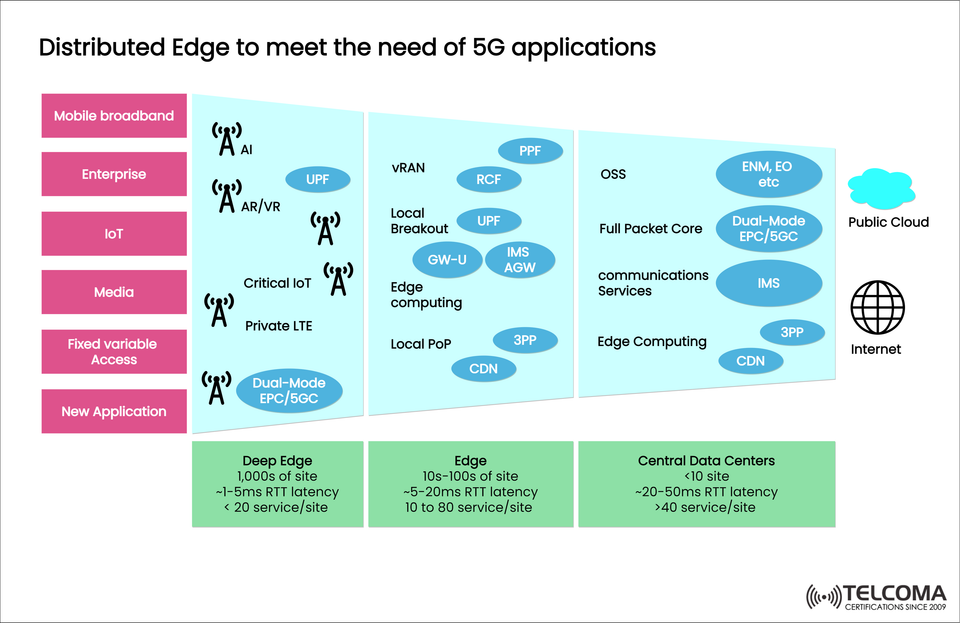

Distributed Edge: Fulfilling the Needs of 5G Applications
The 5G mobile network isn’t just about quicker data; it represents a smart, distributed setup built to support real-time, data-heavy, and low-latency applications.
To make this happen, 5G networks use a Distributed Edge Architecture, which moves computing and storage closer to users, devices, and applications.
What is Distributed Edge?
Distributed Edge Computing is a network design approach that spreads processing capabilities across different levels—from centralized data centers to localized edge sites right next to end-users.
Instead of sending all the data back to far-off cloud servers, it processes information closer to where it’s generated, greatly cutting down on latency and boosting performance for applications that need real-time responsiveness.
5G Application Domains Enhanced by Distributed Edge
The left side of the image highlights key application areas that gain from edge computing within 5G networks:
Mobile Broadband: Fast internet access for users and devices.
Enterprise: Smart factories, connected offices, and private networks.
IoT (Internet of Things): Countless sensors and devices sending data.
Media: Live streaming, gaming, and content distribution.
Fixed Variable Access: A mix of mobile and fixed connections.
New Applications: Innovations like drone networks, self-driving cars, and smart cities.
Each of these domains has unique latency, reliability, and data throughput needs that the distributed edge is built to address.
Core Layers of Distributed Edge Architecture
The architecture features three deployment layers, each tailored for different latency, scale, and service requirements.
Edge Layer|Latency (RTT)|Number of Sites|Typical Services per Site|Purpose
Deep Edge|~1–5 ms|Thousands|< 20|Ultra-low latency applications close to users/devices.
Edge|~5–20 ms|Hundreds|10–80|Regional processing and service aggregation.
Central Data Centers|~20–50 ms|< 10|> 40|Core network, large-scale processing, and cloud integration.
- Deep Edge: Nearest to the User
Deep Edge nodes sit at the edge of the network—often alongside base stations or local access points.
Key Characteristics:
Very low latency (~1–5 ms).
Thousands of distribution points.
Fewer than 20 services managed per site.
Functions:
Supports time-sensitive applications like:
Augmented Reality (AR) and Virtual Reality (VR).
Self-driving vehicles and drones.
Industrial automation.
Hosts AI engines, private LTE, and dual-mode EPC/5GC (Evolved Packet Core/5G Core) for flexible setups.
Allows for local data breakout to enable real-time analysis and quick decision-making.
By processing data locally, Deep Edge cuts down round-trip delay, which is crucial for mission-critical IoT and tactile internet scenarios.
- Edge: Regional Aggregation Layer
The Edge layer serves as an intermediate processing stage between Deep Edge and Central Data Centers.
Key Characteristics:
Moderate latency (~5–20 ms).
Tens to hundreds of locations.
Manages 10–80 services per site.
Core Components:
vRAN (Virtualized RAN): Boosts flexibility and lessens hardware reliance.
Local Breakout: Directs traffic locally for quicker service access.
UPF (User Plane Function): Facilitates distributed data management.
RCF and PPF: Control resource and policy management at the edge.
Edge Computing Platforms: Provide services and store data near users.
CDN (Content Delivery Network): Enhances media distribution.
3PP (Third-Party Providers): Integrate external services like analytics or OTT content.
This layer adds regional intelligence and scalability, handling applications that need a balance between real-time performance and wider service deployment—think smart manufacturing and connected healthcare.
- Central Data Centers: Core Network and Cloud Integration
At the top layer, Central Data Centers provide the backbone for the distributed architecture, managing network control and orchestration functions.
Key Characteristics:
Latency of ~20–50 ms.
Fewer than 10 sites per network.
Capable of hosting 40+ services per site.
Functions and Components:
Dual-Mode EPC/5GC: A unified packet core that supports both 4G and 5G traffic.
OSS (Operations Support Systems): Oversee and monitor network operations.
IMS (IP Multimedia Subsystem): Facilitates voice, video, and multimedia communication services.
3PP (Third-Party Platforms): Allow for external integrations.
CDN (Content Delivery Networks): Improve user experiences for streaming and gaming.
ENM, EO: Tools for managing and orchestrating end-to-end operations.
These data centers connect smoothly with public cloud platforms and the internet, supporting scalable service deployment and global connectivity.
Integration with the Public Cloud and Internet
The right side of the diagram emphasizes the hybrid cloud model in the 5G edge architecture.
Public Cloud Connection: Provides scalability for AI/ML workloads, analytics, and increased storage capacity.
Internet Access: Guarantees a global reach for both enterprise and consumer applications.
By tying private 5G cores to cloud infrastructure, operators can efficiently offer Network-as-a-Service (NaaS) and edge-powered enterprise solutions.
5G Edge Application Examples
Here are some real-world scenarios where the distributed edge makes a significant impact:
Augmented and Virtual Reality (AR/VR):
Requires super-low latency and high bandwidth.
Deep Edge nodes carry out rendering and processing close to users to create immersive experiences.
Autonomous Vehicles:
Deep Edge processes real-time data from sensors to ensure collision avoidance and optimize routes.
Smart Factories:
The Edge layer manages robotic automation and predictive maintenance with local computing power.
AI and Machine Learning at the Edge:
AI models run in central data centers but are executed at Deep Edge for instant results.
Media Streaming and Gaming:
CDN at the Edge boosts content delivery and cuts down on buffering.
IoT and Industrial Automation:
Essential IoT services require predictable low-latency performance at Deep Edge sites.
Private LTE/5G Networks:
Companies deploy on-site cores for enhanced data security and compliance.
Key Advantages of Distributed Edge in 5G
The distributed edge brings a range of technical and business benefits:
⚡ Ultra-Low Latency: Speeds up responsiveness for real-time applications.
🌐 Increased Reliability: Localized data processing reduces reliance on the network.
💼 Enterprise Empowerment: Supports private and hybrid network models.
🔒 Data Protection: Keeps sensitive data within localized setups.
🚀 Scalability: Modular deployment from Deep Edge to the central cloud.
🧠 AI-Enhanced Efficiency: Enables automatic network optimization through NWDAF and AI engines.
Challenges of Deploying Distributed Edge
Even with its benefits, setting up distributed edge comes with its challenges:
High Infrastructure Expenses: Significant CAPEX is needed for edge nodes and management systems.
Operational Complexity: Effective orchestration, synchronization, and lifecycle management are essential.
Interoperability Issues: The need to integrate multi-vendor edge and cloud systems.
Energy Concerns: Edge nodes must function sustainably with low power consumption.
Operators address these challenges through automation, containerized network functions (CNFs), and orchestration platforms like Kubernetes and ETSI MEC frameworks.
Conclusion
The Distributed Edge Architecture is crucial for realizing the full potential of 5G—offering ultra-low latency, extensive connectivity, and smart services.
By strategically distributing computing across Deep Edge, Edge, and Central Data Centers, telecom operators can facilitate real-time experiences for applications in AI, AR/VR, IoT, and critical industrial automation.
This architecture not only redefines network efficiency but also opens up new revenue avenues in sectors like enterprise, media, and smart cities.
As 5G continues to advance, the Distributed Edge will remain a key driver for next-gen digital transformation—fast, reliable, and adaptable to every application's needs.