
Distribution of RAN Measurement Tasks in 5G: Role of gNB-CU, gNB-DU, and UE Reports
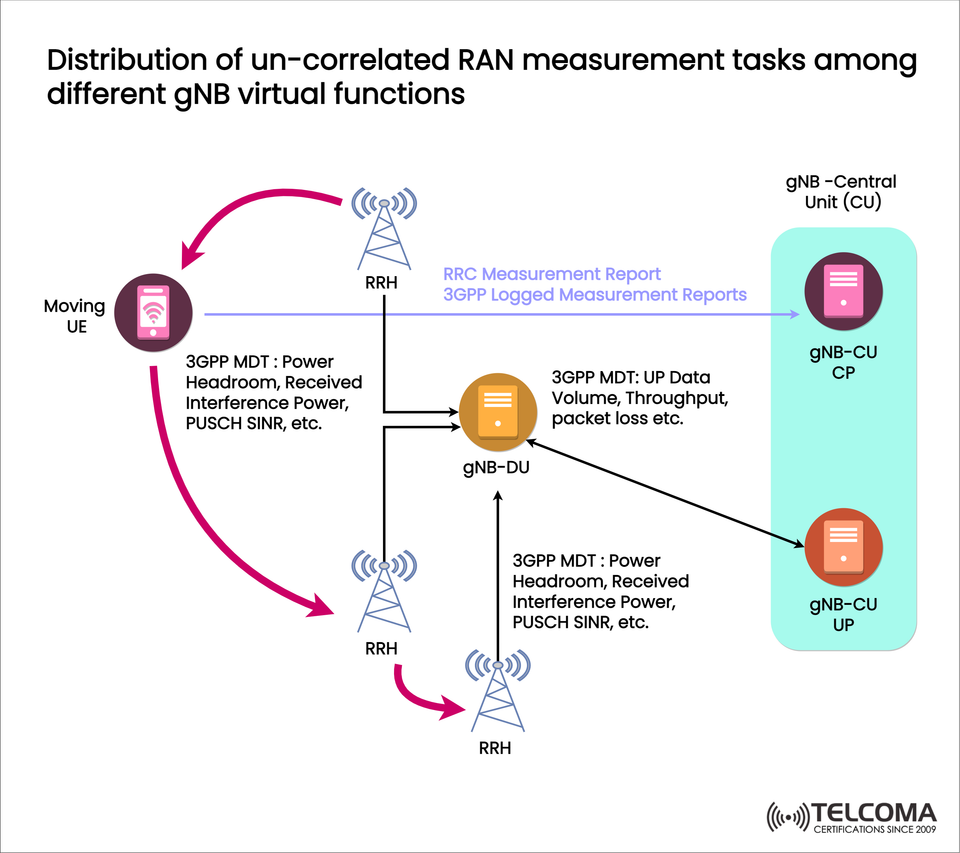

Distribution of Un-Correlated RAN Measurement Tasks in 5G
The 5G Radio Access Network (RAN) aims for high performance while catering to various use cases like enhanced mobile broadband (eMBB), massive machine-type communication (mMTC), and ultra-reliable low-latency communication (URLLC). To make this happen, the network relies on measurement tasks that monitor factors such as throughput, latency, interference, and power levels.
The diagram we uploaded illustrates how these measurement tasks are spread out across different gNB virtual functions:
gNB-DU (Distributed Unit)
gNB-CU-CP (Central Unit – Control Plane)
gNB-CU-UP (Central Unit – User Plane)
User Equipment (UE) with 3GPP MDT capabilities
RRHs (Remote Radio Heads)
This distribution enhances scalability, efficient monitoring, and effective optimization of the 5G RAN.
Why RAN Measurement Tasks Matter
In mobile networks, measurement reports are crucial for a few reasons:
Keeping an eye on radio conditions such as SINR, interference, and received power.
Assessing network performance, including throughput, packet loss, and latency.
Aiding in mobility management tasks like handovers and cell reselection.
Supporting optimization and troubleshooting efforts thanks to detailed insights.
In 5G, these tasks are divided among various entities instead of being concentrated in a single base station. This method boosts accuracy, efficiency, and scalability.
gNB Virtual Functions and Their Roles
The gNB is divided into centralized and distributed units to make network operations smoother. Each part has its own measurement responsibilities.
- gNB-DU (Distributed Unit)
Situated near the radio site, the DU handles time-sensitive functions. It conducts real-time RAN measurements such as:
Power Headroom Reports (PHR): Shows available transmission power for UEs.
Received Interference Power: Monitors interference levels at the cell edge.
PUSCH SINR (Signal-to-Interference-plus-Noise Ratio): Evaluates uplink channel quality.
These measurements are vital for ensuring uplink reliability and scheduling efficiency.
- gNB-CU-CP (Control Plane)
The CU-CP deals with higher-layer signaling and mobility management. It processes:
RRC Measurement Reports: Gathered from the UE, these cover metrics like neighbor cell quality, mobility events, and handover triggers.
3GPP Logged MDT Reports: Historical measurement logs collected by UEs for optimization purposes.
These reports aid in mobility decision-making and long-term network optimization.
- gNB-CU-UP (User Plane)
The CU-UP focuses on user data and transport functions. Its measurement tasks cover:
Uplink/Downlink Data Volume
Throughput Monitoring
Packet Loss Statistics
Such metrics offer insights into Quality of Experience (QoE) and help operators enforce QoS (Quality of Service) policies.
- User Equipment (UE)
The UE also actively participates in RAN measurement through 3GPP MDT (Minimization of Drive Tests). It collects:
Power headroom values
SINR reports
Interference levels
Coverage quality data
This cuts down on the need for expensive drive tests and provides real-world feedback on network performance.
- Remote Radio Heads (RRHs)
RRHs connect to the DU and manage RF transmission. They also collect local measurements like interference levels and SINR, which they then pass to the DU for further analysis.
Understanding Un-Correlated Measurement Tasks
The term “un-correlated” measurement tasks in the diagram emphasizes that different entities carry out separate, independent measurements. For instance:
A UE’s SINR measurement might not directly link to packet loss statistics from the CU-UP.
Likewise, throughput metrics from the CU-UP differ from interference power measured at the DU.
Even though these measurements are un-correlated, they can complement one another when analyzed together, providing a well-rounded view of network performance.
Key Measurement Types in 5G RAN
Measurement Task Collected By Description Use Case Power Headroom (PHR)UE, DU Remaining power margin for uplink Scheduling & uplink optimization PUSCH SINRUE, DU, RRH Uplink channel quality Link adaptation & modulation selection RRC Measurement Report UE → CU-CP Neighbor cell quality, mobility events Handover & mobility Throughput CU-UP Uplink/downlink data rate QoS enforcement Packet Loss CU-UP Missing data packets Service quality monitoring Logged MDTUE → CU-CP Historical coverage/interference data Offline optimization
Benefits of Distributed Measurement Tasks
- Accuracy and Reliability
Measurements taken at various layers give a multi-dimensional view of the network, enhancing optimization accuracy.
- Lower Latency in Decision-Making
DU-level measurements allow for real-time scheduling, while CU-CP focuses on long-term mobility decisions.
- Efficient Troubleshooting
Operators can compare data from CU-UP, DU, and UE to quickly identify performance issues.
- Scalability and Flexibility
Distributing tasks across different units avoids bottlenecks and allows for cloud-native scaling.
- Reduced OPEX via MDT
With UEs gathering MDT data, operators cut back on the need for costly drive testing campaigns.
Example Workflow of Measurement Flow
A moving UE measures SINR and interference power, reporting back to the DU.
The DU collects local measurements and shares them with the CU.
The CU-CP acts on RRC measurement reports, triggering handovers if necessary.
The CU-UP assesses throughput and packet loss to keep an eye on QoE.
MDT logs from the UE are uploaded to the CU periodically for optimization.
This layered workflow guarantees both real-time responsiveness and long-term planning.
Challenges in Managing RAN Measurement Tasks
Even with the advantages, distributing measurements brings its own set of challenges:
Data Correlation Issues: Independent measurements might not line up without advanced analytics.
Transport Requirements: Transmitting measurements from DU to CU demands low-latency, high-bandwidth fronthaul.
Interoperability: Multi-vendor settings can lead to inconsistencies in reporting.
Complexity: Operators need to manage large volumes of measurement data effectively.
Future Directions in RAN Measurement
The distribution of measurement tasks is changing with new trends:
AI/ML for Correlation: Machine learning techniques will help combine un-correlated data into actionable insights.
O-RAN Integration: Open RAN frameworks will standardize measurement interfaces across different vendors.
Edge Processing: DUs and edge clouds will process measurements locally to cut down on delays.
6G Readiness: Future networks will broaden measurement scopes to include sensing and environmental awareness.
Key Takeaways
5G RAN spreads measurement tasks across gNB-DU, gNB-CU-CP, gNB-CU-UP, UEs, and RRHs.
Un-correlated measurements like SINR, throughput, packet loss, and MDT logs offer varied perspectives.
This distribution enhances accuracy, scalability, and optimization but calls for careful data integration.
The mix of real-time DU measurements and long-term CU-CP reports guarantees strong performance management.
Conclusion
The way RAN measurement tasks are distributed in 5G illustrates the network’s cloud-native and modular design. By giving clear roles to the CU, DU, and UEs, operators can gather rich, multi-layered insights into network performance.
While these measurements are un-correlated at their source, they form a comprehensive picture when combined—supporting better optimization, quicker troubleshooting, and enhanced QoE.
As the industry moves toward O-RAN, AI-driven analytics, and edge processing, distributed RAN measurement will become even more vital for the future of mobile connectivity.