
DL Preemption in 5G NR Release 15 Explained: Managing eMBB and URLLC with Precision

DL Preemption in 5G NR Release 15: Finding the Right Balance Between eMBB and URLLC for Top Network Performance
With 5G, the telecom industry has really stepped into a new era of amazing performance and flexibility. But here’s the tricky part: delivering ultra-reliable low-latency communications (URLLC) alongside enhanced mobile broadband (eMBB) traffic is no small feat. These services have vastly different needs; URLLC focuses on needing extreme reliability and super low latency, whereas eMBB is all about high data throughput.
To tackle this issue, 3GPP Release 15 introduced something called Downlink (DL) Preemption in 5G New Radio (NR). This feature lets the network give priority to URLLC users by temporarily interrupting ongoing eMBB transmissions when it’s necessary, helping meet URLLC’s strict latency requirements.
Understanding the Challenge: eMBB vs URLLC
Parameters e MBB (Enhanced Mobile Broadband)URLLC (Ultra-Reliable Low-Latency Communication)Primary Goal High data rate, multimedia streaming Minimal latency, mission-critical reliability Latency Tolerance Tens of milliseconds As low as 1 ms Reliability RequirementModerate99.999%Typical Use Cases Video streaming, AR/VR, cloud gaming Industrial automation, remote surgery, autonomous vehicles
Even though both services share the same 5G spectrum, their scheduling demands often conflict. eMBB usually takes up large amounts of bandwidth for long periods, while URLLC needs instant resource availability. That’s where DL preemption comes in, ensuring both can work well together.
What is DL Preemption?
Downlink (DL) preemption is a resource management feature in 5G NR that enables the gNB (base station) to temporarily interrupt an ongoing eMBB transmission to deliver URLLC traffic when it urgently needs to.
Instead of waiting for a new Transmission Time Interval (TTI), the gNB can preempt part of the eMBB resources already assigned and allocate them to the URLLC User Equipment (UE). This way, URLLC packets can be sent out without missing their strict latency deadlines.
How DL Preemption Works: A Step-by-Step Look
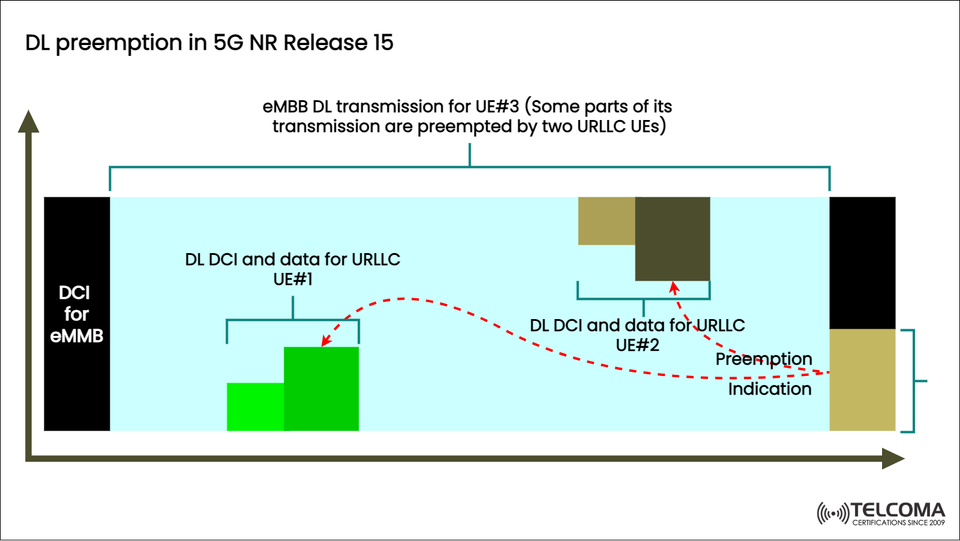
The diagram uploaded shows the process clearly. Let’s break it down:
Initial eMBB Transmission (UE #3): The gNB sets up a downlink (DL) transmission for an eMBB user (UE #3). The resources (time-frequency blocks) are fully allocated for its data.
Arrival of URLLC Data (UE #1 and UE #2): Suddenly, two URLLC users (UE #1 and UE #2) need packets sent out immediately. If they wait for the next scheduling chance, they'll miss URLLC’s latency requirements.
DL Preemption Execution: The gNB spots parts of the ongoing eMBB transmission that can be momentarily overwritten by URLLC data.
The green blocks in the image show the DL DCI (Downlink Control Information) and data for URLLC UE #1.
The brown blocks are for URLLC UE #2 transmissions.
Preemption Indication to eMBB UE: After preemption happens, the gNB sends a Preemption Indication (PI) message to the affected eMBB UE (#3). This lets the eMBB device know that some Resource Blocks (RBs) in its transmission were preempted and shouldn’t be counted as valid.
eMBB Retransmission (HARQ): The eMBB UE finds missing data blocks and can ask for retransmission using the Hybrid Automatic Repeat Request (HARQ) mechanism. This ensures no information gets permanently lost.
Simultaneous Coexistence: Both eMBB and URLLC continue sharing resources dynamically. URLLC gets its latency needs met, while eMBB keeps its throughput via HARQ recovery.
Key Components in DL Preemption
- Preemption Indication (PI):
This is sent by the gNB to let eMBB UEs know about preempted resource elements (REs).
It helps the UE correctly identify which parts of its data have been overwritten.
Delivered through the Physical Downlink Control Channel (PDCCH) or higher-layer signals.
- Resource Element Mapping:
URLLC transmissions only replace the eMBB data in the necessary resource elements.
The rest of the eMBB transmission keeps going unchanged.
This partial overwrite minimizes any loss in throughput.
- HARQ Mechanism for Recovery:
eMBB leverages HARQ to recover preempted data.
Since just a small part is impacted, the effect on latency and throughput remains minimal.
Benefits of DL Preemption in 5G NR
DL preemption is a cornerstone of 5G NR’s flexible structure. Here are some benefits:
✅ Ultra-low latency for URLLC: Guarantees that crucial packets are sent out right away.
✅ Efficient spectrum use: Avoids locking down resources exclusively for URLLC, leading to better efficiency.
✅ Dynamic resource sharing: Allows different service types (URLLC, eMBB, mMTC) to coexist.
✅ Backward compatibility: Keeps eMBB continuity through HARQ retransmissions.
✅ Network adaptability: Scales across various 5G deployment scenarios (like industrial automation and vehicular networks).
DL Preemption vs Semi-Static Resource Partitioning
Feature DL Preemption Semi-Static Partitioning Resource Allocation Dynamic, on-demand Fixed, pre-allocated Latency Performance Extremely low Moderate Spectrum Efficiency High Lower (resources can stay unused)Complexity Higher (dynamic scheduling needed)Lower Ideal Use Case Mixed eMBB–URLLC environments Predictable traffic loads
DL preemption is typically the better choice in networks with variable traffic and diverse QoS needs because it adapts to real-time demands.
Implementation Considerations
Even though DL preemption boosts performance, it does add some complexity to scheduler design and signaling:
Scheduler Complexity: The gNB scheduler has to quickly decide which eMBB transmissions can be interrupted without significantly hurting QoS.
Preemption Signaling Overhead: More control signaling (Preemption Indications) slightly increases PDCCH load.
HARQ Buffer Management: Efficient handling of HARQ buffers is crucial for smooth retransmissions.
QoE (Quality of Experience) Optimization: Operators need to find the right balance between latency for URLLC and throughput for eMBB, often supported by AI-driven scheduling algorithms.
Real-World Use Cases
DL preemption is crucial in situations where latency absolutely cannot be compromised:
Industrial IoT: Robotic systems and machine automation.
Autonomous Vehicles: Vehicle-to-everything (V2X) communications.
Healthcare: Remote surgery and real-time patient monitoring.
AR/VR Applications: Making sure immersive experiences go smoothly alongside critical control data.
In these scenarios, URLLC packets have to be delivered in microseconds—even if that means briefly disrupting a video stream or a data transfer.
5G NR Release 15: Laying the Groundwork for Future Releases
Release 15 set the stage for preemption, and subsequent releases (16 and beyond) will further improve scheduling flexibility and coexistence efficiency. Future networks are expected to integrate AI-driven schedulers and network slicing to make preemption even more adaptive and seamless.
Conclusion
DL preemption in 5G NR Release 15 is a pivotal innovation that allows coexistence between URLLC and eMBB without sacrificing either latency or throughput. By dynamically reallocating resources and keeping eMBB users informed through preemption indications, 5G networks can handle urgent URLLC traffic right away, all while keeping efficiency on point.
As we move from 5G to 6G, methods like DL preemption will continue to ensure that networks are flexible, responsive, and ready to meet the diverse demands of our interconnected future.