
DL-SCH Physical Layer Processing Explained: From eNodeB to Mobile Terminal

Introduction: The Importance of DL-SCH
In both LTE and 5G NR, the Downlink Shared Channel (DL-SCH) serves as the primary transport channel for sending user data and control information from the eNodeB (base station) to mobile devices (UE).
Some key features of DL-SCH are:
It supports dynamic scheduling.
It manages Hybrid ARQ (HARQ) retransmissions.
It allows for variable transport block sizes per TTI (Transmission Time Interval).
It can multiplex various services.
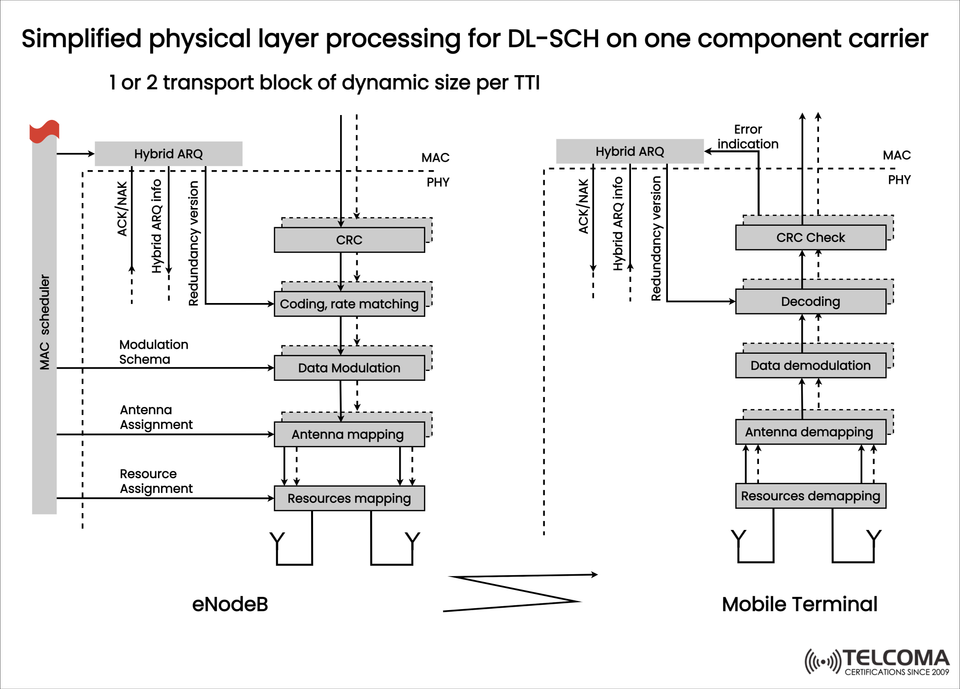
The diagram uploaded illustrates a simplified view of DL-SCH physical layer processing on a single component carrier, showing how data travels through different processing stages at both the eNodeB and the mobile terminal.
DL-SCH Physical Layer Processing at eNodeB
On the transmitter side (eNodeB), several steps are involved in processing the data before it gets sent out. Each step ensures that the data is efficiently error-protected, modulated, and mapped to physical resources.
- Hybrid ARQ (HARQ) Integration
HARQ offers error correction through retransmissions.
If the UE sends a negative acknowledgment (NACK), the eNodeB will resend the data using a redundancy version for improved decoding.
This helps maintain reliability, even when signal conditions aren’t great.
- CRC Insertion
Each transport block gets a Cyclic Redundancy Check (CRC) added.
This allows the UE to verify data integrity upon arrival.
If the CRC check fails, HARQ kicks in for a retransmission.
- Channel Coding & Rate Matching
The data is encoded with either Turbo Coding (LTE) or LDPC Coding (5G NR).
Rate matching adjusts the encoded data to fit the available radio resources.
This step is crucial for maximizing spectral efficiency.
- Data Modulation
The encoded bits are converted into modulation symbols.
Supported schemes include QPSK, 16QAM, 64QAM, and 256QAM.
Higher-order modulation can enable greater throughput but needs better signal-to-noise ratio (SNR).
- Antenna Mapping
Symbols are spread over multiple antennas for MIMO transmission.
This boosts both throughput and reliability through spatial multiplexing or diversity schemes.
- Resource Mapping
Modulated symbols are allocated to specific time-frequency resources.
This allocation is managed by the MAC scheduler, promoting efficient spectrum use.
At this stage, the data is all set to be transmitted over the air interface to the UE.
DL-SCH Processing at the Mobile Terminal
On the receiver side (UE/mobile terminal), the signal undergoes the opposite process to retrieve the original data.
- Resource Demapping
The UE pulls the designated resource blocks from the incoming signal.
This isolates the intended DL-SCH data from other signals.
- Antenna Demapping
With multiple antennas, signals are separated using MIMO detection techniques.
This reconstructs the original streams sent.
- Data Demodulation
The symbols are transformed back into bit sequences using the correct modulation scheme.
The UE adjusts based on the modulation format specified by the eNodeB.
- Decoding & Rate Recovery
The received bits get decoded with Turbo or LDPC decoding.
Rate recovery makes sure that the redundancy versions from retransmissions are combined accurately.
This boosts the odds of successful decoding.
- CRC Check
The decoded data is subjected to a CRC check.
If the CRC check is successful → data is passed on to the higher layers.
If it fails → the UE will send a NACK via HARQ feedback, asking for a retransmission.
The Role of Hybrid ARQ in DL-SCH
HARQ (Hybrid Automatic Repeat Request) is essential for the reliability of DL-SCH.
ACK/NACK Feedback: The UE lets the eNodeB know if decoding was successful.
Incremental Redundancy: Instead of just repeating, retransmissions include extra parity bits.
Low Latency: It operates at the MAC-PHY layer, allowing for quick retransmission decisions.
This setup ensures low error rates and high spectral efficiency, even in challenging channel conditions.
Visualizing DL-SCH Processing
Here’s a simplified flow comparing the transmitter and receiver:
eNodeB Processing Mobile Terminal Processing
CRC insertion CRC check
Coding & rate matching Decoding & rate recovery
Data modulation Data demodulation
Antenna mapping Antenna demapping
Resource mapping Resource demapping
HARQ retransmission if needed HARQ ACK/NACK feedback
This side-by-side view highlights the mirrored nature of transmission and reception.
Why DL-SCH Matters in LTE/5G
The DL-SCH is the main channel for LTE and NR downlink communications. It enables:
User Data Transmission – delivering IP packets for browsing, streaming, and gaming.
System Information Blocks (SIBs) – broadcasting essential network information.
Paging Messages – alerting idle UEs about incoming calls or messages.
Random Access Response – helping UEs establish initial connections.
Without DL-SCH, user connectivity and mobility management wouldn’t be feasible.
Technical Advantages of DL-SCH
Flexibility: Supports dynamic scheduling and various services.
Scalability: Operates across single and multiple carriers.
Efficiency: Adaptive coding, modulation, and HARQ optimize spectrum use.
Reliability: Strong error correction through HARQ and CRC.
Compatibility: A core component of both LTE and 5G NR.
Challenges in DL-SCH Implementation
Though powerful, DL-SCH comes with its own set of challenges:
HARQ retransmission latency – particularly in high mobility settings.
Resource allocation complexity – managing multiple UEs in a dynamic schedule.
Interference management – especially in densely populated areas.
Processing overhead – advanced coding and MIMO require significant computational resources.
These challenges are where 5G improvements (like LDPC coding, flexible HARQ strategies, and massive MIMO) can help.
DL-SCH in LTE vs. 5G NR
Feature LTE DL-SCH 5G NR DL-SCH
Coding Turbo Codes LDPC Codes
HARQ 8 processes Up to 16 processes
Modulation QPSK, 16QAM, 64QAM Adds 256QAM
Scheduling 1 ms TTI Flexible slot-based scheduling
MIMO 4x4 typical Up to 64x64 Massive MIMO
This evolution makes DL-SCH more robust in NR, meeting the needs of URLLC, eMBB, and mMTC.
Conclusion
The DL-SCH physical layer processing is crucial for LTE and 5G NR downlink communication. From CRC insertion, coding, modulation, antenna mapping, to HARQ-based retransmissions, every step ensures reliable data delivery.
On the eNodeB side, data is prepared with redundancy, mapped, and sent.
On the mobile terminal side, data is demapped, decoded, and verified.
HARQ ensures that any errors are promptly corrected through retransmissions.
For telecom professionals, grasping DL-SCH processing is vital, as it forms the backbone of nearly all user-plane and control-plane data delivery in modern cellular networks.