
Downlink Architecture of PDCP in 5G | Sequence Numbering, Integrity, Ciphering

Getting to Know PDCP in 5G
The Packet Data Convergence Protocol (PDCP) is a key player in the 5G protocol stack, sitting between the Radio Link Control (RLC) and the Radio Resource Control (RRC)/Service Data Adaptation Protocol (SDAP). It’s all about making sure that user and control plane data is secure, reliable, compressed, and transferred efficiently.
In downlink PDCP architecture, we see how data flows from the gNB (the 5G base station) to the user equipment (UE). By integrating security and optimization features, PDCP helps 5G deliver high data rates, low latency, and secure communication.
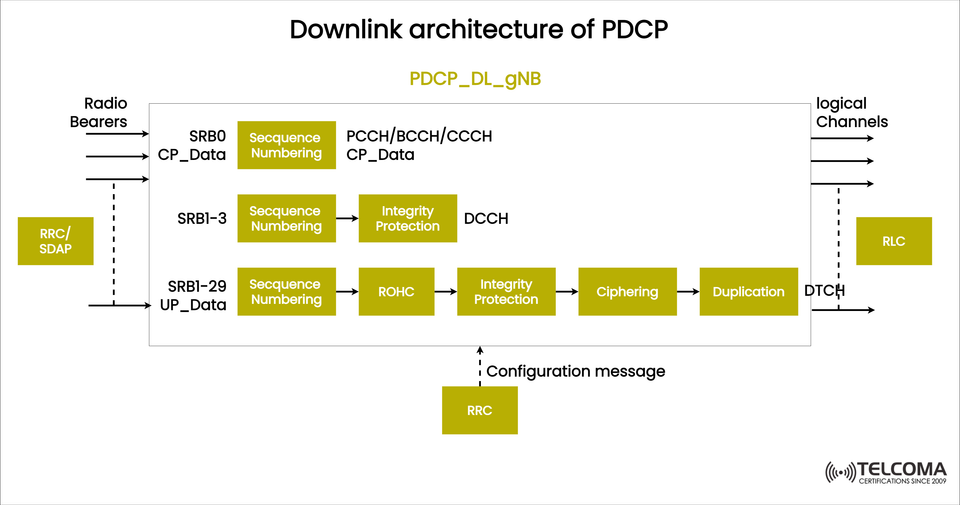
The diagram above shows the Downlink Architecture of PDCP (PDCPDLgNB), underscoring its key functions across Signaling Radio Bearers (SRBs) and Data Radio Bearers (DRBs).
Quick Overview of PDCP Downlink Functions
PDCP is responsible for both Control Plane (CP) and User Plane (UP) data, each taking a slightly different route in the downlink architecture:
SRB0 (CP Data): Basic sequence numbering for signaling messages (like BCCH and CCCH).
SRB1-3 (CP Data): Adds integrity protection for secure control signaling (DCCH).
DRBs/SRB1-29 (UP Data): Features advanced capabilities such as ROHC, integrity protection, ciphering, and duplication—all to ensure efficient and secure data transfer (DTCH).
Deep Dive into PDCP Downlink Functions
- Sequence Numbering
Gives each PDCP Protocol Data Unit (PDU) a unique sequence number.
Guarantees in-sequence delivery and enables duplicate detection at the UE.
Crucial for both control plane and user plane transmissions.
Without this numbering, keeping packets in order in high-throughput and low-latency situations—like those in 5G—would be impossible.
- Integrity Protection
Makes sure that control plane data (SRB1-3) isn’t tampered with.
Utilizes Message Authentication Codes (MAC-I) for authenticating signaling messages.
Safeguards critical RRC and NAS signaling, ensuring commands (like handover and bearer setup) are valid and secure.
This mechanism helps block any malicious attempts to interfere with signaling traffic.
- Robust Header Compression (ROHC)
Primarily used for user plane traffic (SRB1-29, DRBs).
Compresses IP/UDP/RTP headers to save on bandwidth.
Particularly valuable for VoIP, video streaming, and gaming, where sometimes headers can be larger than the actual data payload.
By trimming this overhead, ROHC boosts spectral efficiency and cuts down on latency.
- Ciphering
Ensures data confidentiality by encrypting PDCP PDUs before they’re sent.
Employs standardized encryption algorithms like 128-NEA1/2/3.
Applies to both control and user plane data, shielding user privacy and thwarting eavesdropping.
Ciphering is a fundamental security feature for 5G, keeping user data private.
- Duplication
A new addition in 5G, supporting URLLC (Ultra-Reliable Low Latency Communication).
Lets the same PDCP PDU be sent over multiple radio links to increase reliability.
Guarantees that data still gets to the UE even if one of the paths fails due to poor radio conditions.
Duplication enhances robustness and is essential for mission-critical applications such as autonomous driving or remote surgeries.
PDCP Across Different Bearers
Radio Bearer Type Functionality in PDCPSRB0 (CP Data)Sequence numbering just for initial signaling (PCCH, BCCH, CCCH).
SRB1-3 (CP Data)Sequence numbering + Integrity protection for DCCH signaling.
SRB1-29 (UP Data)Sequence numbering + ROHC + Integrity protection + Ciphering + Duplication for DTCH.
This separation makes sure that control messages stay secure and reliable, while user data is optimized for efficiency and safeguarded against loss or tampering.
Working Together with RRC, SDAP, and RLC
RRC (Radio Resource Control): Sets up PDCP functions, like turning ciphering or duplication on through configuration messages.
SDAP (Service Data Adaptation Protocol): Maps QoS flows to DRBs, sending data into PDCP.
RLC (Radio Link Control): Accepts PDCP PDUs for segmentation and reassembly before they’re physically transmitted.
PDCP is central to the radio protocol stack, working with both higher and lower layers to make sure that data is transmitted efficiently and securely.
The Importance of PDCP in 5G
PDCP isn’t just a pass-through—it brings in advanced capabilities that boost 5G’s security, efficiency, and reliability compared to LTE. Some major benefits include:
Data security through ciphering and integrity protection.
Efficiency thanks to ROHC compression that saves bandwidth.
Reliability via duplication for critical communications.
Flexibility with varied approaches for control and user plane data.
Wrapping Up
The downlink architecture of PDCP in 5G shows its vital role in balancing security, efficiency, and reliability. From basic sequence numbering in signaling bearers to complex functions like ROHC, ciphering, and duplication in user bearers, PDCP guarantees that data transmission over 5G networks meets the high demand of enhanced Mobile Broadband (eMBB), Ultra-Reliable Low Latency Communication (URLLC), and massive IoT (mMTC).
For those in telecom, getting a handle on PDCP’s downlink architecture is crucial for designing, optimizing, and troubleshooting next-gen networks.
Real-World Uses of PDCP Downlink Features
- Sequence Numbering in Action
Think about a video streaming session on a 5G network. For a smooth experience, data packets need to reach the user equipment (UE) in the right order; otherwise, you might see frame skips or experience playback problems. That’s where sequence numbering comes into play—it keeps track of each packet. So if packet #5 shows up before #4, the UE can put it all back together correctly.
Without this, even a tiny mix-up in packet order could mess up real-time services like VoIP, gaming, or live broadcasts.
Integrity Protection for Important Signaling
Integrity protection is super important when it comes to network signaling. For instance:
When there's a handover from one gNB to another, the UE needs reliable RRC messages.
If a hacker tried to fake or change those control messages, it could lead to the UE losing its connection.
Integrity protection makes sure that the signaling data comes from a legitimate source, so it helps keep the network reliable and retains user trust.
- ROHC for Streamlined Data Transmission
In 5G VoIP calls, headers like IP/UDP/RTP can be quite hefty—sometimes up to 60 bytes—while the actual data might only be around 20 bytes. If we don't use ROHC, that space is wasted.
With ROHC, those headers can be squished down to just 1–4 bytes, making things way more efficient.
This is especially key in crowded urban networks where bandwidth is at a premium.
So, ROHC plays a direct role in enhancing spectral efficiency and improving user experience.