
Downlink Architecture of RLC in 5G | Transparent Mode, UM, and AM Explained

Introduction to RLC in 5G
The Radio Link Control (RLC) layer is crucial in the 5G protocol stack, sitting between the Packet Data Convergence Protocol (PDCP) and the Medium Access Control (MAC) layer.
RLC's job is to make sure that data coming from PDCP is properly divided, arranged, and retransmitted if needed. This is key for achieving reliable and efficient communication within 5G networks.
The downlink setup of RLC outlines how data travels from the gNB (base station) to the User Equipment (UE). It also offers various modes of operation—Transparent Mode (TM), Unacknowledged Mode (UM), and Acknowledged Mode (AM)—depending on the traffic type.
RLC Functions in 5G
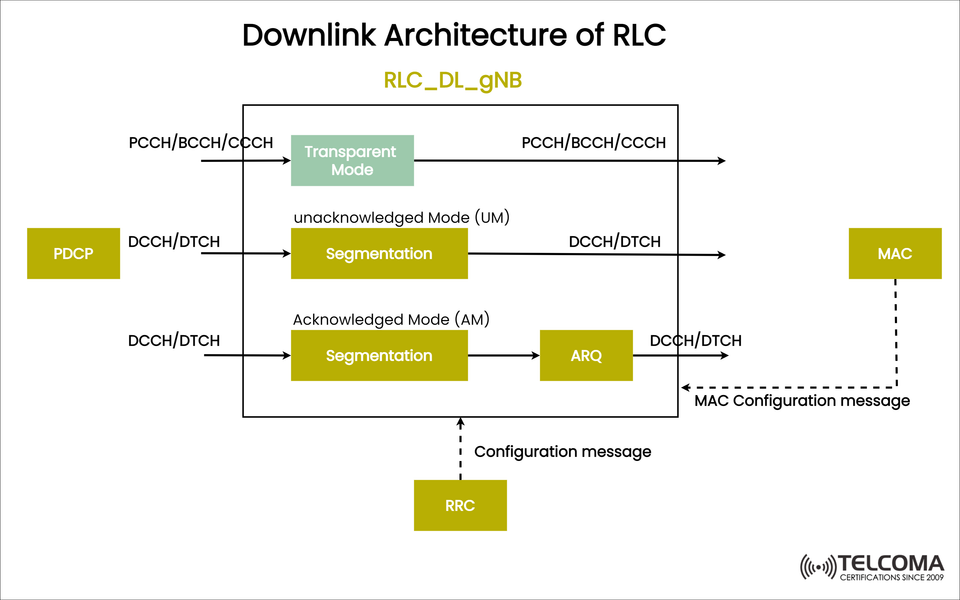
The diagram above shows the RLC Downlink Architecture (RLC_DL_gNB) and illustrates how it interacts with the PDCP, RRC, and MAC layers. Here are some of its primary functions:
Segmentation and Concatenation – Breaking down large PDCP PDUs into smaller RLC PDUs or merging smaller ones.
Error Control – Using ARQ (Automatic Repeat reQuest) in AM mode to manage retransmissions.
In-sequence Delivery – Making sure packets arrive in the correct order.
Adaptability – Offering three modes (TM, UM, AM) to fit different service needs.
Three Modes of RLC Downlink
- Transparent Mode (TM)
Used for broadcast and control channels like PCCH, BCCH, and CCCH.
No header information is added; PDCP PDUs go straight to MAC.
Guarantees low latency and minimal processing load.
Use Case: Great for broadcast messages such as system information that don’t need retransmission or ordering.
- Unacknowledged Mode (UM)
Offers segmentation and reassembly without retransmitting packets.
Includes sequence numbers for orderly delivery but doesn’t request retransmission for lost packets.
Best for applications where speed is prioritized over reliability, like VoIP, video streaming, or gaming.
Advantages of UM:
Lower latency compared to AM.
Offers reasonable reliability via sequence numbering.
- Acknowledged Mode (AM)
Provides the highest level of reliability among all modes.
Employs segmentation plus ARQ (Automatic Repeat reQuest) for error detection and retransmission.
Makes sure data is delivered accurately and in order.
Ideal for crucial traffic like control signaling and services that need guaranteed quality.
Advantages of AM:
High reliability thanks to retransmissions.
Ensures ordered delivery.
Trade-off: It has higher latency than UM due to the retransmission process.
RLC Downlink Flow Explained
Here’s the journey data takes through RLC in the downlink path:
PDCP → RLC Input: Data PDUs come from PDCP (Control Plane or User Plane).
RLC Mode Selection: Based on settings (from RRC), data goes into one of the three modes:
TM (no processing)
UM (segmentation only)
AM (segmentation + ARQ)
Segmentation and Concatenation:
Large PDCP PDUs get split into smaller RLC PDUs to fit MAC transport blocks.
Smaller PDCP PDUs can be combined into one RLC PDU to maximize transmission.
ARQ (for AM only):
If data loss occurs, retransmission is triggered.
This ensures high reliability.
Delivery to MAC:
RLC PDUs are sent to the MAC layer.
MAC takes care of multiplexing, scheduling, and actual radio transmission.
Configuration by RRC:
RRC sets the RLC modes for different radio bearers based on service requirements.
RLC Modes and Use Cases
Here’s a quick side-by-side of the three modes with their features and applications:
RLC Mode Key Functionality Use Cases Transparent Mode (TM)No header, direct pass-through Broadcast channels (BCCH, PCCH, CCCH)Unacknowledged Mode (UM)Segmentation + Sequence numbers, no retrans mission VoIP, video streaming, gaming Acknowledged Mode (AM)Segmentation + ARQ retransmission + ordering DCCH (control), high-reliability services
Integration with PDCP, RRC, and MAC
PDCP → RLC: RLC takes in PDUs from PDCP for segmentation and reliability checks.
RRC → RLC: RRC provides the setup details, deciding if a bearer will use TM, UM, or AM.
RLC → MAC: RLC sends PDUs to the MAC, which multiplexes them onto physical channels.
Feedback from MAC: This helps RLC refine retransmissions and manage buffers.
This collaboration guarantees a smooth data flow across the layers, striking a balance between throughput, reliability, and latency.
Advantages of RLC Downlink in 5G
RLC’s design offers several benefits:
Flexibility: Different modes can cater to a variety of 5G traffic needs.
Reliability: AM ensures dependable delivery for essential services.
Efficiency: UM cuts down on overhead for time-critical traffic.
Scalability: Handles both broadcast (TM) and unicast (AM/UM) traffic effectively.
Challenges in RLC Implementation
While RLC boosts 5G reliability, it does pose some challenges:
Increased Latency in AM: Retransmissions may slow down applications that require quick responses.
Buffer Management: Large data bursts call for effective management of RLC buffers.
Complexity in Dual Connectivity: Coordinating RLC between multiple gNBs can be tricky.
These issues need careful optimization by network engineers.
RLC in LTE vs 5G
Feature LTE RLC5G RLC Modes (TM/UM/AM)Supported Supported Dual Connectivity Limited Enhanced Latency Optimization Basic segmentation Improved segmentation & low-latency handling URLLC Support Not optimized Designed with URLLC in mind
5G RLC is a step up from LTE, offering better support for dual connectivity and ultra-reliable low-latency communication (URLLC).
Future of RLC in 5G-Advanced and Beyond
RLC will keep evolving to meet future demands:
AI-driven retransmission strategies to reduce latency.
Energy-smart segmentation for IoT devices.
Dynamic mode switching between UM and AM based on traffic behavior.
Enhanced URLLC capabilities for crucial applications.
Conclusion
The Downlink Architecture of RLC in 5G is essential for transmitting data while balancing latency, reliability, and efficiency. With its three distinct modes—Transparent Mode, Unacknowledged Mode, and Acknowledged Mode—RLC is versatile enough to support various services, from broadcast messages to real-time applications and critical signaling.
For anyone in telecommunications, grasping RLC is key for network design, optimization, and troubleshooting. As 5G transitions into 5G-Advanced and eventually 6G, RLC will remain a vital component to ensure smooth and reliable communication.