
Downlink Channel Mapping in LTE/5G: Logical, Transport, and Physical Channels Explained

The Importance of Downlink Channel Mapping
In mobile communication systems like LTE and 5G NR, it’s crucial to transmit information efficiently from the network (base station) to the User Equipment (UE). This involves a well-organized hierarchy of channels that guarantee the effective delivery of user data and control information.
The downlink channel mapping ties together three types of channels:
Logical Channels – Specify what kind of data is being sent (like control or user data).
Transport Channels – Describe how that data gets transported through the air.
Physical Channels – Define where and how the data is actually sent using radio resources.
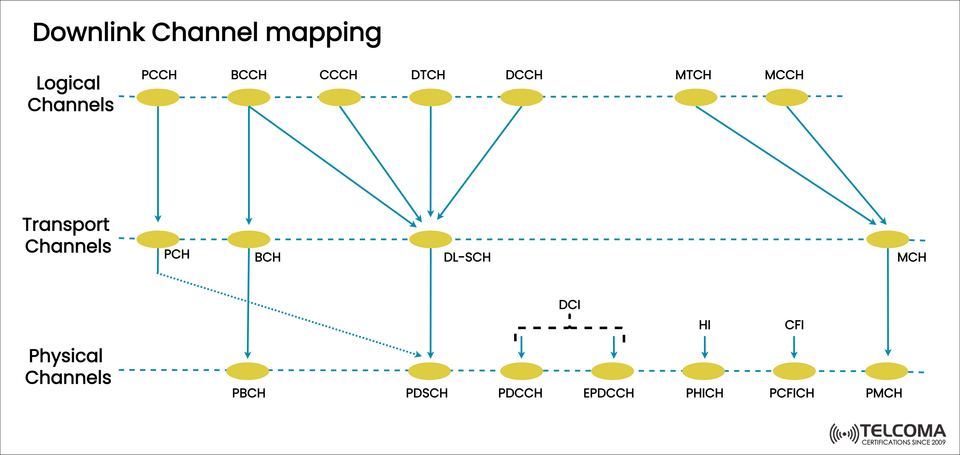
The diagram illustrates this mapping clearly, showing the connection between logical channels, transport channels, and ultimately, physical channels.
Types of Channels in Downlink Transmission
Before we dive into mapping, let’s get a grip on the three categories:
Logical Channels (What gets transmitted?)
Logical channels indicate the type of information sent to the UE and are generally divided into:
Control Channels – Carry signaling information.
Traffic Channels – Handle user payload data.
Transport Channels (How is it sent?)
Transport channels detail how data is delivered over the air interface, including mechanisms for error protection and multiplexing.
Physical Channels (Where is it sent?)
Physical channels represent the actual radio resources (like OFDM symbols and subcarriers) used for sending transport channels over the air interface.
Downlink Logical Channels
According to the diagram, here are the logical channels:
PCCH (Paging Control Channel): Used for sending paging messages to alert UE about incoming services.
BCCH (Broadcast Control Channel): Transmits system information (like cell configuration).
CCCH (Common Control Channel): Supports random access signaling for UEs that don’t have an RRC connection.
DTCH (Dedicated Traffic Channel): Carries user-specific data for a particular UE.
DCCH (Dedicated Control Channel): Sends UE-specific signaling (like RRC messages).
MTCH (Multicast Traffic Channel): Used for multicast or broadcast user data.
MCCH (Multicast Control Channel): Provides control information for multicast or broadcast services.
Downlink Transport Channels
Logical channels are mapped to the following transport channels:
PCH (Paging Channel): Sends paging messages from PCCH.
BCH (Broadcast Channel): Transfers system information from BCCH.
DL-SCH (Downlink Shared Channel): The primary transport channel for user and control data. It carries data from CCCH, DTCH, DCCH, and sometimes BCCH.
MCH (Multicast Channel): Delivers multicast or broadcast traffic along with related control information.
Downlink Physical Channels
Transport channels are carried over physical channels:
PBCH (Physical Broadcast Channel): Transmits BCH, which includes essential system info.
PDSCH (Physical Downlink Shared Channel): Carries DL-SCH, transmitting user data and control information.
PDCCH (Physical Downlink Control Channel): Transmits downlink control information (DCI) related to scheduling.
EPDCCH (Enhanced Physical Downlink Control Channel): Offers additional scheduling control, introduced in LTE-A for better flexibility.
PHICH (Physical Hybrid-ARQ Indicator Channel): Sends HARQ ACK/NACK responses.
PCFICH (Physical Control Format Indicator Channel): Tells the UE the size of the control region.
PMCH (Physical Multicast Channel): Carries MCH for multicast or broadcast services.
How Downlink Channel Mapping Works
The flow is demonstrated in the diagram:
Logical Channels → Transport Channels:
PCCH maps to PCH.
BCCH maps to BCH or DL-SCH (depending on the type of system information).
CCCH, DTCH, and DCCH map to DL-SCH.
MTCH and MCCH map to MCH.
Transport Channels → Physical Channels:
PCH is sent on PDSCH.
BCH is sent on PBCH.
DL-SCH is sent on PDSCH.
MCH is sent on PMCH.
Control Information Support:
PDCCH/EPDCCH carries scheduling and resource assignment (DCI).
PHICH provides HARQ feedback.
PCFICH indicates the number of OFDM symbols reserved for control channels.
This layered mapping ensures efficient multiplexing of signaling and user data, enabling reliable downlink communication.
Example: Paging in LTE/5G
To illustrate:
Paging info starts at PCCH (logical channel).
It’s carried over PCH (transport channel).
Finally, it gets transmitted via PDSCH (physical channel).
This process helps idle-mode UEs receive paging messages without wasting energy.
Advantages of Structured Downlink Mapping
Efficiency: Maximizes the use of the radio spectrum by organizing channels hierarchically.
Flexibility: Supports unicast, multicast, and broadcast transmissions.
Reliability: Offers error correction, retransmission, and control mechanisms.
Scalability: Accommodates a variety of services—from IoT signaling to high-throughput video.
Downlink Channel Mapping in 5G NR vs LTE
While the diagram shows LTE principles, 5G NR builds on them:
DL-SCH and PDSCH continue to serve as the main carriers of user data.
Control channels (PDCCH, EPDCCH) are more versatile, supporting massive MIMO and beamforming.
Broadcast channels (BCH/PBCH) have been optimized for quick synchronization and system info delivery.
Multicast/Broadcast (PMCH) has been enhanced to support 5G Broadcast and Public Warning Systems.
Challenges in Downlink Channel Mapping
Complex Scheduling: Balancing control and data resources in crowded networks.
Interference Management: Control channels like PDCCH are very sensitive to interference.
Energy Efficiency: UEs need to decode control channels often, which can drain battery life.
Spectrum Evolution: Transitioning from LTE mapping to 5G NR adds layers of complexity.
Summary Table of Downlink Channel Mapping
Logical Channel | Transport Channel | Physical Channel | Purpose
PCCH | PCH | PDSCH | Paging
BCCH | BCH/DL-SCH | PBCH/PDSCH | System info
CCCH | DL-SCH | PDSCH | Random access signaling
DTCH | DL-SCH | PDSCH | User data
DCCH | DL-SCH | PDSCH | Dedicated signaling
MTCH | MCH | PMCH | Multicast traffic
MCCH | MCH | PMCH | Multicast control info
Conclusion
Downlink channel mapping in LTE/5G establishes a structured framework that connects logical, transport, and physical channels for reliable delivery of both user and control data.
As shown in the diagram, paging, broadcast messages, dedicated signaling, and multicast traffic are all organized through a clear hierarchy. This design guarantees efficiency, flexibility, and scalability in today’s cellular networks.
For telecom professionals, understanding downlink channel mapping is key to optimizing network performance, reducing interference, and gearing up for 5G NR advancements, where downlink control and data channels will be even more important for massive connectivity and ultra-reliable low-latency communication (URLLC).