
Downlink Channel Model for Single User MIMO Explained | 5G & Beyond

Today's wireless communication is all about needing faster data rates, enhanced reliability, and efficient spectrum usage. To hit these targets, MIMO (Multiple Input Multiple Output) has emerged as a crucial technology in 4G LTE, 5G NR, and the future 6G networks.
MIMO utilizes multiple antennas at both the transmitter (base station) and the receiver (user device) to send several data streams at once, which considerably boosts throughput and spectrum efficiency.
This article dives into the Downlink Channel Model for Single User MIMO (SU-MIMO), using an included diagram for clarity.
What Exactly is Single User MIMO (SU-MIMO)?
In SU-MIMO, the base station focuses its antenna resources on just one user. This is different from MU-MIMO (Multi-User MIMO), where antenna resources are shared among multiple users at the same time.
Purpose of SU-MIMO: Maximize the data speed for a single user.
Key Advantage: Higher data rates come from being able to transmit multiple data streams (or layers) in parallel.
Example Use Cases: Power users like VR/AR gamers, UHD video streamers, or businesses that need a lot of bandwidth.
Breaking Down the Downlink Channel Model
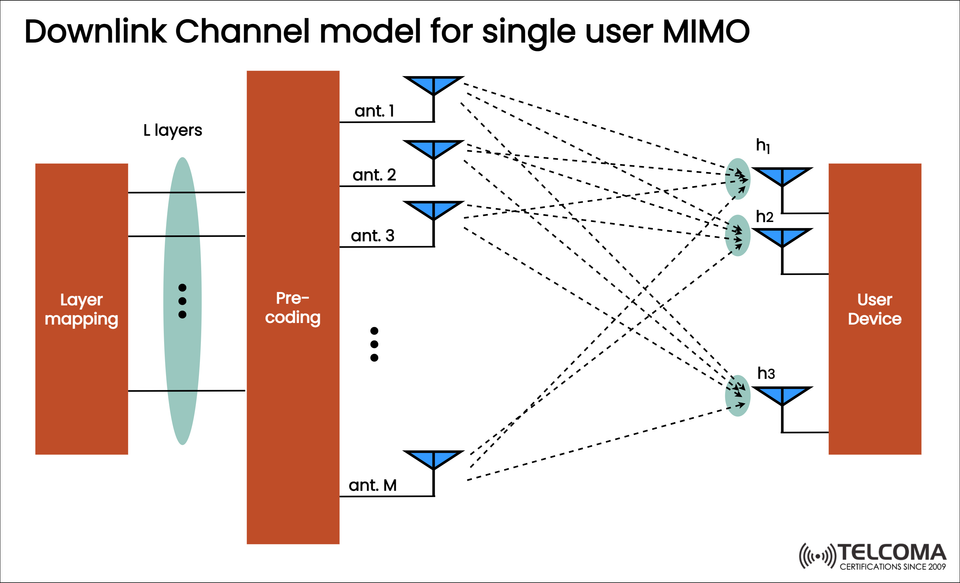
The diagram shows how data streams (or layers) are sent from the base station to the user device in SU-MIMO. Let's go through it step by step.
Layer Mapping
The incoming user data gets split into L layers.
Each layer is its own separate data stream.
The maximum number of layers is ≤ min(transmit antennas, receive antennas).
Purpose: Make it possible to transmit different data streams simultaneously.
Example: If a base station has 4 antennas and the user device has 2, it can handle up to 2 layers.
Precoding
After mapping the layers, precoding happens.
Precoding involves mathematical transformations (based on channel state information – CSI) that help to shape signals before they are sent out.
Purpose: To ensure that the signals reach the user’s antennas with as little interference as possible.
Precoding adjusts to the channel matrix (H), which captures how signals move between transmit and receive antennas.
Benefit: It enhances reliability and cuts down on inter-layer interference.
Transmission through Antennas (ant.1 to ant.M)
The precoded signals are sent out through M antennas at the base station.
Each antenna transmits a weighted mix of the layers.
With several antennas, you can take advantage of spatial diversity to fight fading and boost reliability.
Propagation & Channel Effects (h1, h2, h3, …)
Signals move through different wireless channels (h1, h2, h3 …).
Each channel introduces effects like path loss, fading, and multipath reflections.
The channel matrix H reflects these effects and is vital for detecting and decoding on the receiver side.
Reception at the User Device
The user device, which has multiple antennas, picks up the combined signals.
The device then uses MIMO detection algorithms (like Zero-Forcing, MMSE) to unpack the transmitted layers.
Lastly, it reconstructs the original user data.
Advantages of Single User MIMO
Higher Data Rates: Sending parallel streams boosts the user’s throughput.
Spectral Efficiency: Better utilization of the available bandwidth.
Robustness: Multiple antennas help tackle fading and interference.
Scalability: Supports advanced features like beamforming for more targeted coverage.
Challenges with SU-MIMO
Even though SU-MIMO has some great benefits, it does come with its own set of technical hurdles:
Channel State Information (CSI) Feedback: Getting accurate and timely CSI is vital for effective precoding.
Complexity: Having more antennas leads to greater processing demands.
Mobility Issues: Users on the move can cause quick changes in channel states, making CSI outdated fast.
Hardware Constraints: User devices might not have enough antennas due to size, cost, or power limits.
SU-MIMO vs. MU-MIMO
Feature SU-MIMOMU-MIMOR e source Allocation Dedicated to one user Shared among multiple users Throughput per User High Moderate System Capacity Lower overall Higher overall Complexity Moderate Higher Use Case High-demand single user Multiple users with moderate needs
Real-World Uses for SU-MIMO
5G eMBB (Enhanced Mobile Broadband): Superfast internet access for high-end users.
Fixed Wireless Access (FWA): SU-MIMO delivers stable, high-speed connections to residences.
Enterprise Networks: Industries that need private 5G with consistent performance.
Gaming & Streaming: Essential for VR/AR applications that require ultra-high data rates.
Looking Ahead: SU-MIMO in 6G
As we move towards 6G, SU-MIMO is set to progress with:
Massive MIMO (64+ antennas): Enhancing throughput and beamforming capabilities.
AI-driven Precoding: Using machine learning to streamline channel estimation and precoding.
THz Bands: Utilizing ultra-wide bandwidths where SU-MIMO can ensure reliable connections.
Wrapping Up
The Downlink Channel Model for Single User MIMO shows how modern wireless systems can achieve parallel data transmission to maximize throughput for individual users.
With techniques like layer mapping, precoding, multiple antennas, and advanced detection, SU-MIMO provides higher data rates, better reliability, and improved spectrum efficiency—making it a key player for 5G and future technologies.
For those in telecom, getting a handle on SU-MIMO is essential to understanding how upcoming networks will provide smooth, high-speed connectivity to keep up with rising demands.
In-Depth Look at the SU-MIMO Downlink Model
To make it easier for telecom pros and enthusiasts to grasp the diagram, here’s a step-by-step look at the Downlink Channel Model for Single User MIMO.
Block / Element Function Role in MIMO Downlink Layer Mapping Splits the user’s data into multiple independent streams (layers).
Lets multiple data streams be sent at the same time to boost throughput. Precoding Applies mathematical weights (based on Channel State Information - CSI).
Shapes signals to reduce interference and improve delivery to the user’s antennas. Transmit Antennas (ant.1 … ant. Physical antennas at the base station sending recoded signals. Uses spatial diversity to send signals over different paths. Channel Matrix (h1, h2, h3 …)Represents the wireless channel effects like fading, path loss, and multipath propagation.
Gives a mathematical model for how signals travel from each transmit antenna to each receive antenna. Receive Antennas (User Device)Antennas on the UE (User Equipment).Capture the transmitted signals and send them to detection algorithms. User Device Processing Applies MIMO detection (like Zero Forcing, MMSE, ML Detection).Reconstructs original data streams while keeping errors to a minimum.