
Downlink Mapping of Logical to Transport Channels in LTE/5G Explained

In today’s mobile communication landscape, especially with technologies like LTE (Long-Term Evolution) and 5G NR (New Radio), data travels through several layers before it reaches the end-user device. A key step in this journey is the mapping of logical channels to transport channels.
Logical channels indicate what type of information is being sent, whereas transport channels specify how this data is transmitted over the air interface. Grasping this mapping is crucial for telecom engineers to ensure that signaling, control, and user data are delivered effectively while meeting the required Quality of Service (QoS) standards.
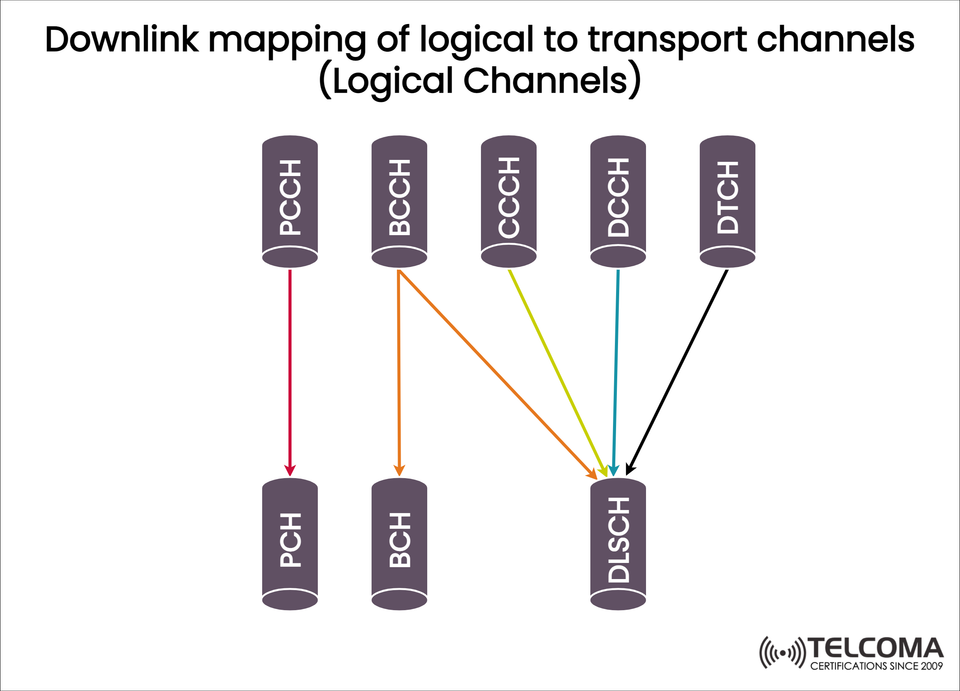
The diagram attached provides a clear overview of the downlink mapping of logical channels (PCCH, BCCH, CCCH, DCCH, DTCH) to transport channels (PCH, BCH, DL-SCH). Let’s dive deeper into this mapping.
Logical vs. Transport Channels: The Basics
Before we get into the mapping, it’s important to understand the distinction:
Logical Channels (What data is sent?)
They define what type of information is being transmitted (whether it's control plane or user plane).
Examples include: Broadcast Control Channel (BCCH), Paging Control Channel (PCCH).
Transport Channels (How data is sent?)
They specify how and with what characteristics the data is delivered over the physical medium.
Examples include: Broadcast Channel (BCH), Downlink Shared Channel (DL-SCH).
In short:
Logical = Type of information
Transport = Method of delivery
Downlink Logical Channels in LTE/5G
The following logical channels function in the downlink:
PCCH (Paging Control Channel)
This channel carries paging messages that alert UEs about incoming calls, SMS, or any changes in system information.
It sends messages to UEs in both idle and connected modes.
BCCH (Broadcast Control Channel)
This channel broadcasts system information to all UEs.
It provides essential parameters that UEs need for cell access.
CCCH (Common Control Channel)
It helps set up initial connections between the UE and gNB/eNB.
This channel is used before establishing a dedicated signaling link.
DCCH (Dedicated Control Channel)
It carries dedicated signaling messages exchanged between the UE and the network.
For instance, it includes RRC signaling for mobility, bearer setup, and handovers.
DTCH (Dedicated Traffic Channel)
This channel transmits user data for a specific UE.
Examples include internet browsing and video streaming.
Downlink Transport Channels in LTE/5G
The related transport channels are:
PCH (Paging Channel)
This channel carries paging information.
It uses discontinuous reception (DRX) cycles to help save UE battery life.
BCH (Broadcast Channel)
This channel delivers system information blocks (SIB1, Master Information Block).
It assists in cell search and initial access.
DL-SCH (Downlink Shared Channel)
This is the most versatile downlink transport channel.
It carries dedicated user data, signaling, and broadcast information (except MIB).
Supports HARQ, link adaptation, and dynamic scheduling.
Downlink Mapping: Logical to Transport Channels
The diagram shared clearly illustrates how logical channels correspond to transport channels in the downlink direction:
Logical Channel Mapped Transport Channel Purpose
PCCH PCH Paging messages for UEs
BCCH BCH / DL-SCH System information broadcast
CCCH DL-SCH Common control signaling during access
DCCH DL-SCH Dedicated signaling (RRC, NAS)
DTCH DL-SCH User-plane data (internet, video, voice)
Explanation of the Mapping
PCCH → PCH
Paging messages from the PCCH logical channel are sent to the PCH transport channel.
This ensures that UEs in idle mode can be alerted when necessary.
BCCH → BCH and DL-SCH
The MIB is transmitted on the BCH for cell access.
Other SIBs are delivered via DL-SCH to allow flexible scheduling.
CCCH → DL-SCH
During initial access (like the RACH procedure), CCCH maps to DL-SCH.
This enables common signaling before a dedicated channel is established.
DCCH → DL-SCH
Dedicated signaling such as handover commands, bearer setup, and measurement reports are sent through DCCH.
It’s mapped to DL-SCH for dependable delivery.
DTCH → DL-SCH
All user-plane data flows via the DTCH.
It’s mapped to DL-SCH, which supports advanced mechanisms like HARQ for error correction.
Why DL-SCH is Central to Downlink Data
You might notice that most logical channels are linked to DL-SCH. That’s because DL-SCH provides:
Dynamic Scheduling: Resources are allocated based on channel conditions and QoS needs.
Error Correction with HARQ: This guarantees data reliability.
Support for Both Control and User Data: It can handle both DCCH and DTCH seamlessly.
High Efficiency: DL-SCH multiplexes various logical channels for optimal spectrum efficiency.
So, DL-SCH really serves as the powerhouse of the downlink transport layer.
Use Cases of Downlink Channel Mapping
Broadcasting System Information (BCCH → BCH/DL-SCH):
When a new UE joins a cell, it decodes the MIB from BCH and other SIBs from DL-SCH.
Paging (PCCH → PCH):
When there’s an incoming call, the UE is notified by paging via PCCH mapped to PCH.
Connection Setup (CCCH → DL-SCH):
Initial signaling for random access takes place on CCCH mapped to DL-SCH.
Dedicated Signaling (DCCH → DL-SCH):
During handovers, the UE receives RRC messages via DCCH through DL-SCH.
User Data (DTCH → DL-SCH):
All kinds of internet traffic, OTT apps, and streaming data are carried via DTCH mapped to DL-SCH.
Troubleshooting Insights
Telecom experts often look into channel mapping when troubleshooting:
Paging Failures: Problems with PCCH → PCH mapping may stop the UE from waking up.
System Access Failures: Issues in BCCH delivery (either via BCH or DL-SCH) can result in attach failures.
Handover Drops: Errors in DCCH mapping on DL-SCH might cause calls to drop.
Data Throughput Issues: Problems with DTCH mapping on DL-SCH can lead to a poor user experience.
LTE vs. 5G NR Channel Mapping
Even though the idea of mapping logical to transport channels is quite similar, 5G NR brings some improvements:
Aspect LTE 5G NR
Paging PCCH → PCH Similar
Broadcast BCCH → BCH/DL-SCH Similar, with enhanced scheduling flexibility
User Data DTCH → DL-SCH Same, but optimized for higher throughput
Reliability HARQ-based HARQ + flexible retransmission options
QoS Handling Based on QCI Based on 5QI (more service-aware)
Conclusion
The downlink mapping of logical to transport channels in LTE and 5G ensures that different information types—ranging from paging and system broadcasts to user data and signaling—get delivered efficiently to UEs.
PCCH maps to PCH for paging messages.
BCCH maps to BCH/DL-SCH for system info dissemination.
CCCH, DCCH, DTCH map to DL-SCH for signaling and user data communications.
Grasping this mapping is vital for telecom engineers engaged in network planning, optimization, and troubleshooting. As we transition to 5G, this mapping continues with greater flexibility, catering to a variety of services from enhanced broadband to ultra-reliable low-latency communication (URLLC).