
Downlink User Plane Architecture of Layer 2 in LTE/5G Explained
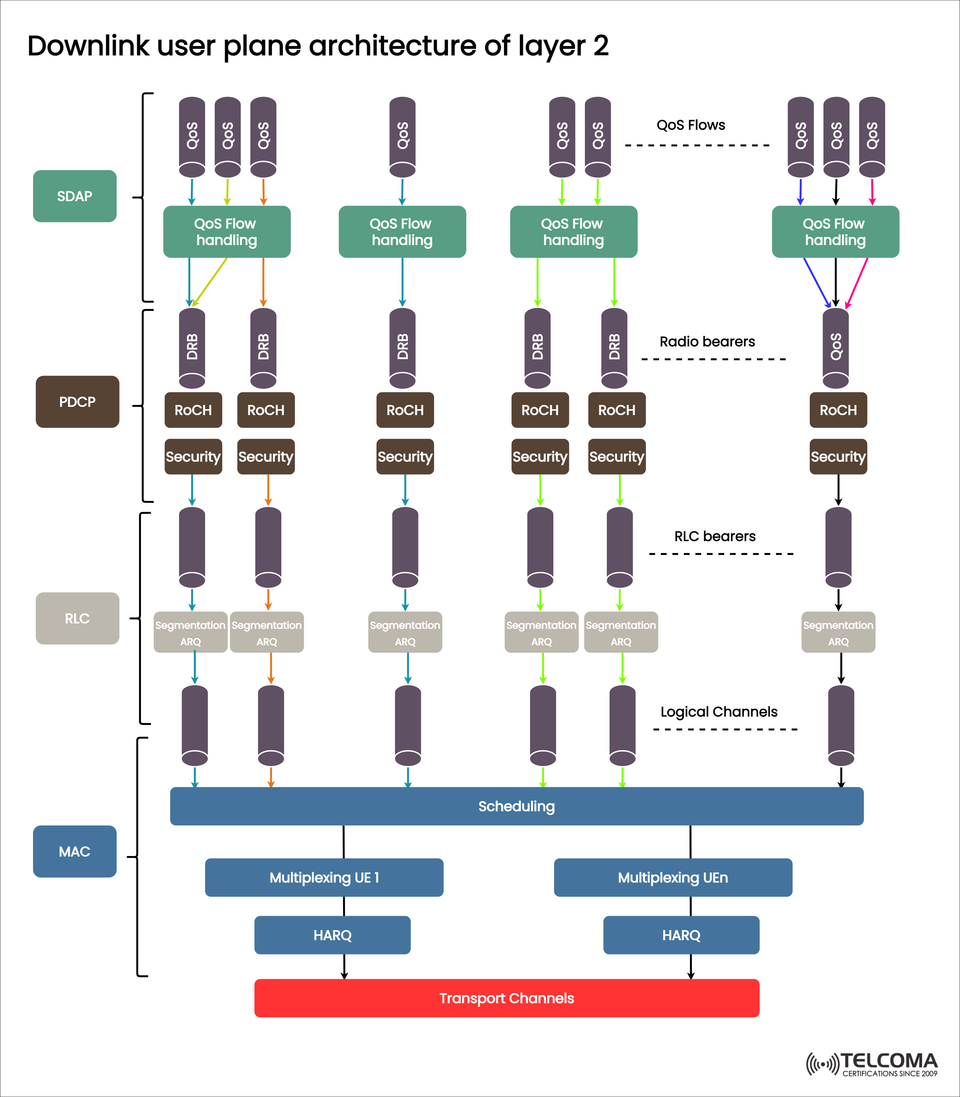

In LTE and 5G NR networks, data makes its way through various protocol layers before reaching the end user. The downlink user plane of Layer 2 is crucial because it manages user data—like voice, video, browsing, and gaming—while adhering to strict QoS (Quality of Service) standards.
The diagram provided offers a clear look at the Layer 2 downlink user plane architecture, illustrating how packets flow through different sublayers: SDAP, PDCP, RLC, and MAC. Each sublayer contributes its own functions, from QoS management and security to segmentation, multiplexing, and HARQ retransmissions.
This blog will break down the architecture step by step, shedding light on the function of each component, how they work together, and why they're essential for a seamless user experience in today’s telecom networks.
Layer 2 Downlink User Plane: The Big Picture
In LTE/5G, the Layer 2 user plane consists of four main sublayers:
SDAP (Service Data Adaptation Protocol) – Handles QoS mapping.
PDCP (Packet Data Convergence Protocol) – Adds security and performs header compression.
RLC (Radio Link Control) – Manages segmentation and error correction.
MAC (Medium Access Control) – Takes care of scheduling, multiplexing, and HARQ.
These sublayers function sequentially to prepare data for transmission over transport channels, which eventually connect to physical channels that deliver the data over the air.
Step 1: SDAP – Service Data Adaptation Protocol
Main Function: Manages QoS Flows in 5G NR and ensures they are linked to the correct bearers.
Role in LTE vs. 5G:
In LTE, SDAP isn’t used explicitly (the QoS is handled within EPS bearers).
5G brings in SDAP to manage multiple QoS flows for each PDU session.
Key Features of SDAP:
QoS Flow Handling:
Every service (like video streaming, VoIP, gaming) gets a dedicated QoS flow.
These flows are prioritized and directed to the right Data Radio Bearer (DRB).
Mapping:
SDAP connects QoS flows to DRBs.
This ensures urgent data (like emergency calls) gets prioritized over less critical traffic.
📌 Example: Imagine someone watching YouTube (which needs high throughput) while also making a VoIP call (which requires low latency). SDAP ensures the VoIP call has lower latency while the video gets the bandwidth it needs.
Step 2: PDCP – Packet Data Convergence Protocol
Main Function: Adds security and header compression to packets.
Position in Layer 2: Sits directly below SDAP and above RLC.
PDCP Responsibilities:
Security (Ciphering and Integrity Protection):
Shields user data from eavesdroppers.
Guarantees signaling integrity for secure communication.
Header Compression:
Minimizes the overhead of IP headers using ROHC (Robust Header Compression).
Essential for applications like voice and video, where small packets are the norm.
Duplicate Elimination:
Gets rid of duplicate PDUs received during handovers or retransmissions.
5G URLLC situations, PDCP ensures that sensitive applications (such as remote surgery or industrial automation) remain both secure and efficient.
Step 3: RLC – Radio Link Control
Main Function: Takes care of segmentation, reassembly, and ARQ error correction.
Position in Layer 2: Located below PDCP and above MAC.
Modes of Operation:
TM (Transparent Mode): Minimal processing (typically used for broadcasts).
UM (Unacknowledged Mode): No retransmission, ideal for low-latency applications.
AM (Acknowledged Mode): Involves retransmission, ensuring reliability.
RLC Key Features:
Segmentation & Reassembly: Breaks down large PDCP SDUs into smaller RLC PDUs for transmission.
ARQ (Automatic Repeat Request): Resends lost packets at the RLC layer (in AM mode).
Buffering: Holds data during handovers to ensure smooth continuity.
Example: A Netflix video segment that's too large for one transport block gets split by RLC into multiple packets, which are then reassembled at the receiving end.
Step 4: MAC – Medium Access Control
Main Function: Handles scheduling, multiplexing, and HARQ retransmissions.
Position in Layer 2: Directly above the physical layer.
Key MAC Functions:
Logical-to-Transport Channel Mapping:
Receives data from various logical channels (RLC bearers).
Maps them to shared transport channels.
Scheduling:
Allocates radio resources on the fly, considering QoS and channel conditions.
Managed by the gNB scheduler in 5G.
Multiplexing:
Combines data from multiple users (like UE1, UEn) into shared resources.
This increases spectrum efficiency.
HARQ (Hybrid Automatic Repeat Request):
Provides quick retransmission at the physical layer.
Reduces latency while ensuring reliability.
Example: If a packet gets corrupted during transmission, HARQ allows for nearly instant retransmission without going back through RLC.
Integration of All Sublayers
The overall flow of data in the downlink user plane Layer 2 is:
SDAP: Maps QoS flows to DRBs.
PDCP: Secures data, compresses headers, and removes duplicates.
RLC: Segments data and applies ARQ for error correction.
MAC: Schedules resources, multiplexes UEs, and implements HARQ.
Transport Channels: Deliver data to the physical layer for transmission.
QoS Flows, Radio Bearers, and RLC Bearers
The diagram also emphasizes three key bearer concepts:
QoS Flows (SDAP level): Reflect application-level QoS needs.
Radio Bearers (PDCP level): Carry specific data streams with set characteristics.
RLC Bearers (RLC level): Ensure segmentation, ARQ, and delivery of PDCP data.
This layered bearer structure guarantees that end-to-end QoS requirements (like latency, throughput, and reliability) are consistently achieved.
Table: Functions of Layer 2 Sublayers in Downlink
Sublayer Main Functions Examples
SDAP **QoS flow handling, QoS → DRB mapping Video QoS vs. Voice QoS
PDCP **Security, ROHC compression, duplicate removal Secure VoIP call
RLC **Segmentation, ARQ retransmission, reassembly Netflix video buffering
MAC **Scheduling, multiplexing, HARQ LTE/5G resource allocation
Why Layer 2 Downlink Architecture Matters
QoS Assurance: Guarantees low latency for gaming/VoIP and high throughput for streaming.
Reliability: Thanks to ARQ and HARQ, data gets delivered even in poor radio conditions.
Security: Protects user privacy and guards against tampering.
Efficiency: Multiplexing and header compression help save bandwidth and resources.
Scalability: Accommodates a range of 5G use cases, from eMBB (enhanced mobile broadband) to URLLC (ultra-reliable low-latency communication) and mMTC (massive IoT).
Conclusion
The downlink user plane architecture of Layer 2 in LTE/5G is essential for efficient data delivery. Each sublayer—SDAP, PDCP, RLC, and MAC—has its own specific role:
SDAP deals with QoS mapping.
PDCP secures and compresses data.
RLC manages segmentation and error correction.
MAC schedules and multiplexes resources, utilizing HARQ.
All together, these layers transform raw IP traffic into reliable radio transmissions that fulfill the QoS demands of modern applications like streaming, cloud gaming, AR/VR, and critical IoT services.
As telecom networks continue to evolve towards 5G and beyond, getting a handle on Layer 2 architecture is crucial for professionals looking to boost performance, troubleshoot issues, and roll out next-gen services with speed, reliability, and security.