
Dual Connectivity in 5G Explained: NR-DC, EN-DC, NGEN-DC, NE-DC Options

The shift from LTE (4G) to 5G isn’t just a quick jump; it’s more like a well-planned journey. A crucial part of this journey is Dual Connectivity (DC), a feature set by 3GPP that lets a user device (UE) connect to two base stations at the same time—one serving as the master and the other as the secondary.
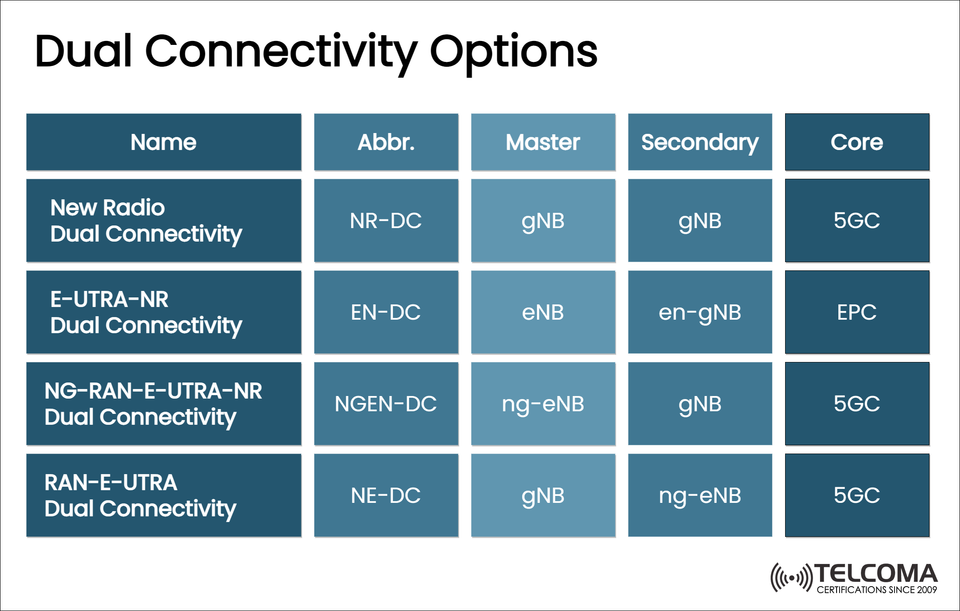
This setup provides better throughput, increased reliability, and smooth mobility between LTE and 5G networks. The accompanying image shows the different dual connectivity options—NR-DC, EN-DC, NGEN-DC, and NE-DC—each tailored for specific deployment scenarios.
In this blog, we’ll unpack these options, delve into their architecture, and discuss how they contribute to the evolution of mobile networks.
What is Dual Connectivity (DC)?
Dual Connectivity (DC) is where a device stays connected to two different network nodes simultaneously, usually from different Radio Access Technologies (RATs) or generations.
Master Node (MN): Takes care of control plane functions.
Secondary Node (SN): Adds to user plane capacity.
Core Network: This could be EPC (Evolved Packet Core for LTE) or 5GC (5G Core).
By using both master and secondary nodes, dual connectivity offers better spectral efficiency, more reliable handovers, and enhanced user experiences.
Types of Dual Connectivity Options
The image you uploaded points out four major types of DC. Let’s break them down:
- NR-DC (New Radio – Dual Connectivity)
Abbreviation: NR-DC
Master Node: gNB (Next-generation NodeB, i.e., 5G base station)
Secondary Node: gNB (another 5G base station)
Core: 5GC (5G Core)
Explanation:
With NR-DC, a device can connect to two 5G gNBs at the same time. Both the master and secondary nodes belong to the 5G RAN and are connected to the 5G Core.
Use Case:
High-performance 5G networks.
Great for dense urban spots where several gNBs overlap in coverage.
- EN-DC (E-UTRA–NR Dual Connectivity)
Abbreviation: EN-DC
Master Node: eNB (Evolved NodeB, i.e., LTE base station)
Secondary Node: en-gNB (5G-enabled gNB linked to EPC)
Core: EPC (Evolved Packet Core, from LTE networks)
Explanation:
Known as Option 3x, EN-DC is commonly used in early 5G setups. Here, the LTE eNB controls the signaling while the 5G gNB adds extra capacity via the EPC.
Use Case:
Non-Standalone (NSA) 5G deployments.
It helps operators launch 5G while utilizing existing LTE EPC.
- NGEN-DC (NG-RAN–E-UTRA–NR Dual Connectivity)
Abbreviation: NGEN-DC
Master Node: ng-eNB (Next-generation eNodeB linked to 5GC)
Secondary Node: gNB
Core: 5GC (5G Core)
Explanation:
In this arrangement, an ng-eNB (an LTE node upgraded to interface with 5GC) serves as the master while the gNB is the secondary node. It lets LTE handle control signaling while 5G manages capacity.
Use Case:
Transitional setups where LTE nodes are updated to connect directly to 5GC.
Ideal for areas with a mix of LTE and 5G coverage.
- NE-DC (RAN–E-UTRA Dual Connectivity)
Abbreviation: NE-DC
Master Node: gNB
Secondary Node: ng-eNB
Core: 5GC
Explanation:
In this case, the 5G gNB acts as the master, managing the control signaling, while the LTE ng-eNB adds capacity. This structure is a reversal of NGEN-DC.
Use Case:
Areas where 5G coverage is strong, but LTE is available as a backup.
Ensures stability during early 5G rollouts.
Summary Table of Dual Connectivity Options
Name Ab br Master Node Secondary Node Core New Radio Dual ConnectivityNR-DCgNBgNB5GCE-UTRA-NR Dual Connectivity (Option 3x)EN-DC eNBe n-gNBEP CNG-RAN-E-UTRA-NR Dual ConnectivityNGEN-DCng-eNBgNB5GCRAN-E-UTRA Dual ConnectivityNE-DCgNBng-eNB5GC
Key Benefits of Dual Connectivity
Smooth Migration to 5G
EN-DC and NE-DC let operators roll out 5G while keeping LTE investments.
Higher Throughput
Combining spectrum from both nodes enhances user data rates.
Seamless Mobility
Guarantees continuous connectivity when switching between LTE and 5G areas.
Better Coverage
Secondary connections help improve performance at the edges of cells.
Network Flexibility
Operators can deploy based on existing infrastructures and future aspirations.
Dual Connectivity in Real Deployments
EN-DC (Option 3x) is the most widely used NSA solution since it makes the most of LTE EPC.
NR-DC is set to take over in Standalone 5G (SA) setups when operators fully shift to 5GC.
NGEN-DC and NE-DC serve as transitional solutions, ensuring smooth adoption of 5GC without dropping LTE support.
For instance:
In urban environments, NR-DC boosts capacity by linking to two gNBs.
In suburban areas, EN-DC facilitates extended 5G services while still relying on LTE coverage.
Challenges of Dual Connectivity
Increased Complexity: Coordinating signaling across multiple nodes can be a hassle.
Device Support: Not all smartphones and IoT devices are compatible with every DC option.
Spectrum Fragmentation: It needs smart spectrum allocation between LTE and 5G bands.
Core Upgrades: Moving from EPC to 5GC requires meticulous planning.
Future of Dual Connectivity in 5G and Beyond
As networks progress toward 5G Standalone (SA) and eventually 6G, dual connectivity will continue to be pivotal for ensuring backward compatibility and optimizing performance.
Short-term: EN-DC will maintain its lead in NSA deployments.
Medium-term: NR-DC and NE-DC will be essential as operators transition fully to 5GC.
Long-term: Beyond 5G, similar concepts to DC will branch out into multi-connectivity with Wi-Fi, satellite, and non-terrestrial networks.
Conclusion
Dual Connectivity isn’t merely a transitional feature; it’s the link that allows LTE and 5G to work together smoothly. From EN-DC facilitating Non-Standalone 5G to NR-DC driving full 5G Standalone deployments, every option is crucial for operators’ strategies.
For those in telecom, grasping DC is vital for designing, launching, and fine-tuning 5G networks. As 5G evolves and we look ahead to 6G, dual and multi-connectivity solutions will be key for delivering high-performance, resilient, and future-ready networks.