
Dual Connectivity Topology in 5G: Architecture, Functions & Benefits

Introduction: Why Dual Connectivity Matters for 5G
5G is more than just faster data—it's about delivering reliability, efficiency, and smooth connectivity across varied networks. To make this happen, 5G brings in Dual Connectivity (DC), which allows a user device (UE) to connect to two base stations (gNBs) at the same time.
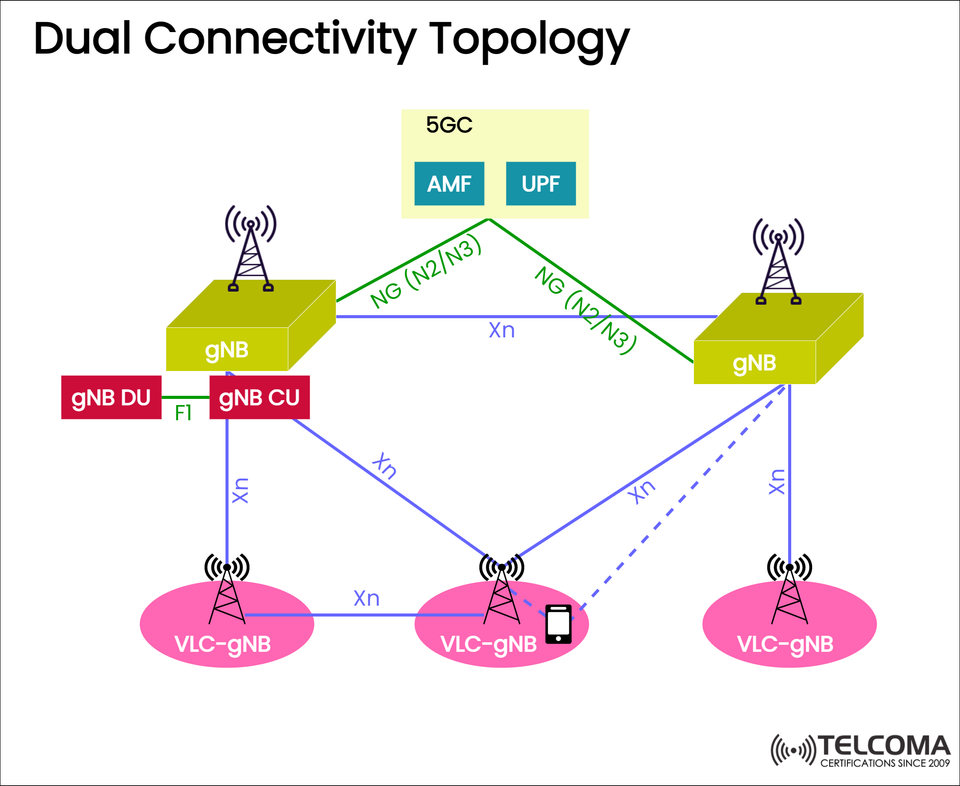
This setup boosts throughput, enhances mobility, and increases overall network efficiency. The diagram we've included gives a clear view of the 5G dual connectivity layout, showing how gNBs, the gNB-CU/DU split, VLC-gNBs, and 5GC integrate.
Understanding the Dual Connectivity Layout
The diagram demonstrates how a User Equipment (UE) keeps simultaneous connections with different gNBs through various interfaces. Let's break it down step by step.
- 5GC (5G Core Network)
Made up of AMF (Access and Mobility Management Function) and UPF (User Plane Function).
Links to gNBs via the NG interface:
N2: Control plane signaling (between gNB and AMF).
N3: User plane data (between gNB and UPF).
Handles centralized session management, mobility, and data routing.
- gNB (Next Generation NodeB)
Serves as the 5G base station.
Provides radio access and connects directly to the 5G Core.
In the diagram, you can see two gNBs linked through the Xn interface, which lets them share information about UE context and mobility.
Key Functions of gNB:
Managing radio resources.
Terminating data/control planes.
Working with other gNBs for smooth handoffs.
- gNB CU/DU Split
5G introduces a split between the Centralized Unit (CU) and Distributed Unit (DU):
gNB-CU (Central Unit):
Deals with non-real-time functions like PDCP (Packet Data Convergence Protocol).
Handles control-plane signaling.
Connects to the DU through the F1 interface.
gNB-DU (Distributed Unit):
Takes care of real-time tasks like RLC, MAC, and PHY layers.
Placed nearer to the radio site to cut down latency.
Interacts with CU for higher-layer processing.
This CU/DU split adds flexibility, allowing for centralized management with quick, localized processing.
- VLC-gNB (Virtualized Low-Cost gNBs)
VLC-gNBs are lightweight, virtualized base stations mainly intended for dense urban or indoor environments.
They connect to gNBs through both the Xn and Uu interfaces.
Offer localized coverage and a boost in capacity.
In the layout, several VLC-gNBs extend the reach of the central gNBs, ensuring coverage in areas with high demand.
- UE (User Equipment)
This can be a smartphone or IoT device that can connect to multiple gNBs simultaneously.
The UE utilizes dual connectivity to:
Combine bandwidth from different cells.
Stay reliable if one link drops.
Ensure smooth mobility between cells.
- Interfaces in Dual Connectivity
The diagram illustrates several interfaces that facilitate seamless communication:
NG (N2/N3): Connects gNBs to the 5G Core (AMF/UPF).
Xn: Connects gNB-to-gNB and gNB-to-VLC-gNB for coordination.
F1: Links gNB-CU and gNB-DU.
Uu: Air interface between UE and gNB/VLC-gNB.
How Dual Connectivity Works in 5G
Dual Connectivity operates on a principle of Master Node (MN) and Secondary Node (SN):
UE first connects to a Master gNB (MN).
This MN manages the main connection and control signaling.
A Secondary gNB (SN) is added.
The UE establishes a secondary connection to the SN, typically to enhance throughput or reliability.
Traffic is split.
The MN and SN coordinate via the Xn interface.
User data can be distributed across both nodes for greater efficiency.
Mobility is handled smoothly.
As the UE moves, handovers between SNs or MNs are managed without dropping the session.
This setup ensures multi-point connectivity, resulting in strong performance in real-world situations.
Benefits of Dual Connectivity in 5G
Dual Connectivity offers several key benefits essential for hitting 5G performance targets:
Higher Throughput: Combines bandwidth from various gNBs.
Smooth Mobility: Easy transitions between cells reduce call drops and interruptions.
Improved Reliability: If one connection weakens, the secondary one maintains the link.
Spectrum Efficiency: Lets operators mix different spectrum bands for better usage.
Load Balancing: Spreads user traffic across gNBs, helping to avoid congestion.
Cost-Effective Coverage Expansion: With VLC-gNBs, operators can enhance coverage without needing to deploy full-scale gNBs everywhere.
Dual Connectivity vs. Carrier Aggregation
Even though they're often mixed up, Dual Connectivity (DC) and Carrier Aggregation (CA) are not the same:
Feature Dual Connectivity (DC)Carrier Aggregation (CA)Definition UE connects to two gNBs at the same time. UE connects to one gNB using multiple carriers. Deployment Needs multiple gNBs with an Xn interface. Requires a single gNB to manage aggregated carriers. Flexibility Can support different RATs (e.g., LTE + NR).Limited to one RAT. Use Case Mobility, redundancy, inter-RAT scenarios. Peak throughput in the same coverage area.
Both methods work together in 5G to enhance user experience.
Real-World Applications of Dual Connectivity
Smartphones in Urban Areas: Use multiple cells for steady high-speed data.
Industrial IoT: Guarantees essential machine-to-machine communication with backup links.
Autonomous Vehicles: Ensures ultra-reliable connectivity while moving through cells.
AR/VR Applications: Delivers consistent high throughput for immersive experiences.
Mission-Critical Services: Public safety networks gain from redundancy and reliability.
Challenges with Dual Connectivity Implementation
Although dual connectivity has lots of benefits, it also brings some challenges:
Signaling Overload: More connections need effective signaling protocols.
Resource Management Complexity: Coordinating between MN and SN requires advanced Radio Resource Management.
Latency in Coordination: The Xn interface has to be fine-tuned to avoid delays.
Deployment Costs: Adding VLC-gNBs raises infrastructure expenses.
Solutions like smart orchestration, AI-powered RRM, and virtualized network functions (VNFs) are in development to help tackle these issues.
Conclusion
The Dual Connectivity Topology in 5G is key to the network’s speed, reliability, and flexibility. By allowing a UE to connect to two gNBs at once, this architecture enhances throughput, guarantees smooth mobility, and ensures strong reliability.
With gNB-CU/DU functional splits, VLC-gNBs for localized coverage, and smart coordination through the Xn interface, this setup is foundational for delivering high-performance 5G services.
For those in telecom and tech, grasping dual connectivity is crucial to understanding how 5G supports applications like autonomous vehicles, industrial IoT, immersive AR/VR, and critical communication.
As networks develop, Dual Connectivity combined with Carrier Aggregation and network slicing will shape the next-generation mobile experience, establishing 5G as the backbone of the digital age.