
Dynamic Selection of PUCCH Carrier in 5G NR Explained: TDD 3:1 and 4:1 Operation

Dynamic Selection of PUCCH Carrier in 5G NR: Boosting Uplink Flexibility and Efficiency
In 5G NR (New Radio), the focus is squarely on efficiency and flexibility. A standout feature that helps achieve this is the dynamic selection of the PUCCH carrier, which is especially useful in Time Division Duplex (TDD) systems.
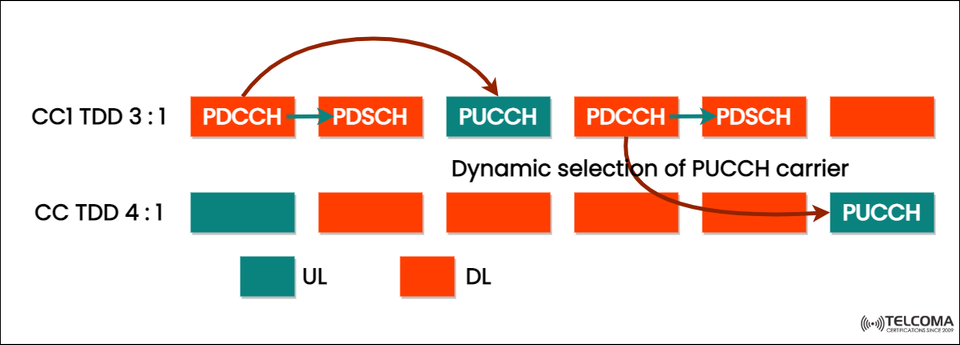
The image shared clearly shows how dynamic PUCCH (Physical Uplink Control Channel) selection works between two component carriers (CCs) set up for TDD — one with a 3:1 downlink (DL) to uplink (UL) slot ratio and another with a 4:1 ratio. This feature makes sure that important uplink control information (UCI) like ACK/NACK, scheduling requests (SR), and channel state information (CSI) can be sent efficiently, even in fast-changing multi-carrier networks.
Understanding the PUCCH in 5G NR
Before we dive into dynamic carrier selection, let’s quickly go over what PUCCH does.
The Physical Uplink Control Channel (PUCCH) is responsible for carrying important control signals from the UE (User Equipment) to the gNB (base station), including things like:
ACK/NACK feedback: To indicate whether downlink (PDSCH) receptions were successful or not.
Scheduling Requests (SR): To ask for uplink resources for data transmission.
Channel State Information (CSI): To let the gNB know about the quality of the channel for better link adaptation.
In simple terms, PUCCH is basically the voice of the UE — it helps coordinate the uplink and downlink transmissions.
The Challenge in TDD Systems
5G NR operates on Time Division Duplex (TDD), where uplink (UL) and downlink (DL) share the same frequency but occur at different times.
A TDD configuration outlines how many slots are designated for DL and UL in a frame.
Different carriers can have different DL:UL ratios, which often depend on traffic patterns.
For instance:
TDD 3:1: This setup has three DL slots for every one UL slot, favoring downlink-heavy traffic (eMBB).
TDD 4:1: This one is even more DL-centric, ideal for high-throughput downlink applications.
The issue comes up when PUCCH timing for sending feedback does not sync up with UL slots across carriers, which can lead to delays or missed feedback opportunities.
To tackle this, 5G NR brought in dynamic PUCCH carrier selection.
What Is Dynamic PUCCH Carrier Selection?
Dynamic PUCCH carrier selection gives the UE the ability to pick which carrier to use for sending its uplink control information in real-time, based on the UL slot configuration available at that moment.
Meaning, the UE can choose among multiple component carriers (CCs) — picking the one that has a UL slot available that best fits its feedback timing.
This process ensures:
Quick transmission of ACK/NACK and CSI.
Effective use of available UL resources.
Smooth coordination in carrier aggregation (CA) scenarios.
Step-by-Step Explanation of the Image
The diagram shows two TDD carriers and the workings of dynamic selection:
Carrier 1 (CC1) – TDD 3:1 Configuration:
Mainly DL (three DL slots for one UL slot).
Uplink opportunities are limited and might not align with PDSCH reception.
Carrier 2 (CC2) – TDD 4:1 Configuration:
Even more DL-heavy but with a different slot setup.
The UL slot may show up at a different timing compared to CC1.
PDCCH → PDSCH → PUCCH Flow:
The PDCCH (Physical Downlink Control Channel) allocates resources and scheduling info for the PDSCH (Physical Downlink Shared Channel) transmission.
After the UE receives PDSCH data, it needs to send ACK/NACK feedback via PUCCH.
Dynamic PUCCH Selection:
When it’s time to send ACK/NACK, the UE checks which carrier (CC1 or CC2) has an available UL slot that opens up first.
Based on slot availability, it dynamically picks the PUCCH carrier.
This means feedback gets sent on time, keeping latency low and maintaining sync.
In the image:
The arrows illustrate the dynamic switching of PUCCH between CC1 and CC2.
This dynamic selection eliminates the need to wait for the next available UL opportunity on a specific carrier.
Technical Benefits of Dynamic PUCCH Carrier Selection
Better Uplink Timing Flexibility:
This allows the UE to respond quicker with ACK/NACK or CSI feedback, regardless of UL timing differences between carriers.
Maximized Use of UL Resources:
Helps avoid idle UL resources and ensures efficient resource use across carriers.
Lower Feedback Latency:
Shortens the time between PDSCH reception and the corresponding PUCCH feedback.
Higher Throughput for eMBB:
By separating DL-heavy carriers from UL feedback timing, the network can keep high DL throughput.
Greater Reliability for URLLC:
URLLC applications gain from quicker feedback loops and more precise timing.
Configuration and Control
The gNB keeps the UE updated on:
Which PUCCH resources are available for use.
The set of allowed carriers for feedback transmission.
The conditions or triggers for switching PUCCH carriers.
This control process is managed through Radio Resource Control (RRC) signaling, enabling flexible adjustments to network load and channel conditions.
Dynamic PUCCH Selection in Carrier Aggregation (CA)
In multi-carrier 5G setups:
One carrier (often the primary cell or PCell) takes care of control signaling.
Secondary carriers (SCells) boost data throughput.
Dynamic PUCCH selection allows the UE to send control feedback (PUCCH) for downlink data received on any carrier using the best available uplink slot across all aggregated carriers.
For example:
A UE might receive downlink data on CC1 but send the ACK/NACK feedback on CC2, where UL is available sooner.
This cross-carrier feedback helps cut down delays and makes the network more responsive.
Comparison: Static vs Dynamic PUCCH Selection
Feature Static PUCCH Carrier Dynamic PUCCH Carrier Carrier Selection Predefined (fixed)Determined dynamically Flexibility Limited High Feedback Latency Higher (depends on UL availability)Lower (uses earliest UL slot)Resource Efficiency Moderate Optimal Typical Use Case Simple configurations Carrier Aggregation, TDD-heavy deployments
Dynamic selection really shines in dense TDD environments and CA setups, where timing mismatches and asymmetrical traffic patterns are common.
Use Cases in Real Networks
Dynamic PUCCH selection is crucial in scenarios like:
5G NSA (Non-Standalone) networks using dual connectivity with LTE and NR.
5G SA (Standalone) setups featuring multiple NR carriers with varying TDD ratios.
Industrial IoT and URLLC, where timely and predictable uplink control feedback is key.
Massive MIMO systems, which often require frequent CSI feedback to fine-tune beamforming.
By smartly selecting where to send PUCCH, 5G networks can keep up their reliability and speed, even as the number of carriers and services on the network grows.
Implementation Considerations
Operators looking to implement dynamic PUCCH selection need to think about:
Synchronization accuracy across TDD carriers.
Inter-carrier interference control for uplink control signals.
UE capability support, since not every device may be able to handle dynamic PUCCH switching.
Scheduler complexity, as the gNB must efficiently manage dynamic control mapping.
Conclusion
Dynamic PUCCH carrier selection in 5G NR is a significant advancement that boosts uplink efficiency, cuts down on feedback latency, and supports flexible scheduling in TDD-based and carrier aggregation environments.
By allowing UEs to dynamically choose where to send control info (PUCCH) based on the availability of UL slots, networks can make the most of their resources and respond quickly — which is especially crucial in crowded deployments and varying traffic scenarios.
As we move from 5G to 6G, features like dynamic PUCCH selection are set to play an essential part in developing smarter, more adaptable, and lower-latency wireless systems.