
Early Stage 5G SA Devices and Multiple VoLTE Options Explained
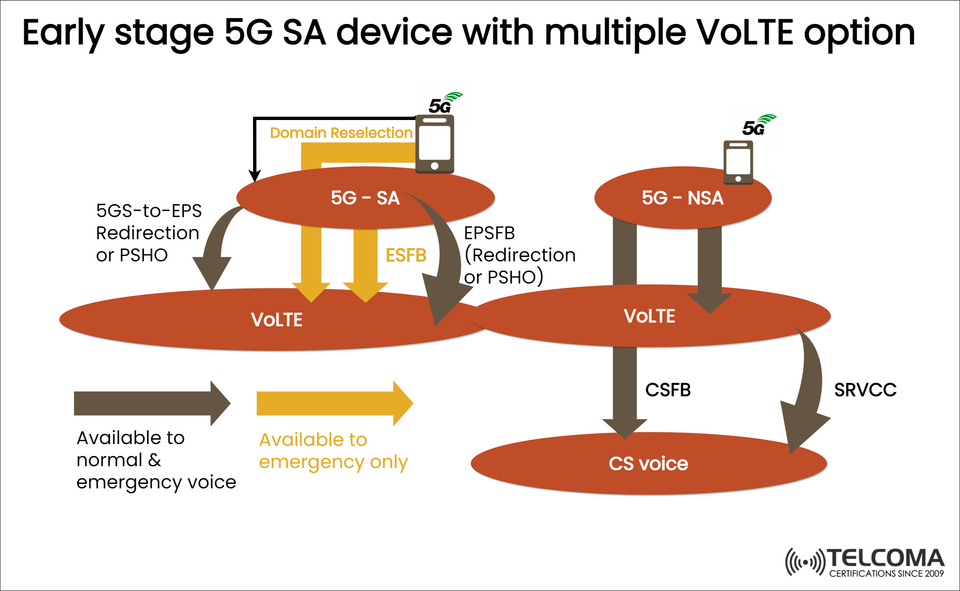

Early Stage 5G SA Devices with Multiple VoLTE Options
The shift from 4G LTE to 5G New Radio (NR) has brought about super-fast data speeds and reduced latency. But there's still one major hurdle: voice services in 5G networks. In contrast to LTE, where VoLTE (Voice over LTE) became the go-to for making calls over data, the 5G Standalone (SA) setup doesn’t natively offer voice call support right off the bat.
This is where fallback methods and multiple VoLTE options become crucial, allowing users to continue making all kinds of voice calls, even emergency calls, without a hitch.
The diagram above shows how early 5G SA devices manage voice communication. Let’s break it down a bit.
Understanding 5G Voice Challenges
Even though 5G SA introduces a 5G Core (5GC) that doesn't depend on LTE, it was initially built with a focus on data-first services. To make voice calls work, networks rely on Evolved Packet System (EPS) fallback and connect with 4G LTE or even older circuit-switched (CS) networks.
Some key challenges include:
Ensuring voice call availability, both normal and emergency.
Keeping service continuity while transitioning between 5G, 4G, and 3G.
Supporting both Standalone (SA) and Non-Standalone (NSA) 5G devices.
VoLTE as the Default Voice Service
At the core of supporting voice in 5G is VoLTE (Voice over LTE), which remains the main packet-switched voice solution. Since 5G SA can't handle voice calls natively in its early days, devices switch back to LTE networks to utilize VoLTE.
VoLTE advantages:
High-quality voice (HD voice).
Allows simultaneous voice and data services.
More efficient spectrum use compared to circuit-switched voice.
So, for early SA deployments, VoLTE is essential for voice—with various fallback methods to keep things running smoothly.
5G SA with EPS Fallback (EPSFB)
For Standalone 5G devices, the main fallback option is EPS Fallback (EPSFB).
How it works:
When a voice call starts, the device switches from the 5G SA network to the LTE network.
This transition occurs via redirection or PSHO (Packet-Switched Handover).
Once connected to LTE, the call is handled through VoLTE.
Types of fallback in SA:
Normal EPSFB – handles standard voice calls.
Emergency EPSFB (ESFB) – for emergency-only calls.
This setup makes sure that even with early 5G SA networks lacking native voice support, both regular and emergency voice calls can still go through.
5G NSA and Voice Handling
With 5G Non-Standalone (NSA), things are a bit different since it's heavily reliant on LTE for control signaling and voice services.
Process:
Calls are made directly on LTE using VoLTE.
The 5G NR connection helps with providing more data bandwidth.
In NSA mode, keeping voice calls going is simpler because VoLTE is the primary source for calls.
Circuit-Switched Fallback (CSFB)
If VoLTE isn’t available, devices might have to use Circuit-Switched Fallback (CSFB).
How it works:
The device falls back from LTE or 5G to 3G or 2G CS voice networks.
Calls use traditional CS channels.
Limitations:
Longer call setup time.
Lower quality compared to VoLTE.
Still necessary for coverage in older networks.
CSFB serves as a backup option and is used mainly where LTE VoLTE coverage is sparse.
SRVCC – Seamless Handover to CS Networks
For ongoing calls, another key mechanism is Single Radio Voice Call Continuity (SRVCC).
How it works:
If you’re on a VoLTE call and LTE coverage drops, the call gets smoothly handed over to a 3G/2G CS voice network.
This guarantees you won’t lose the call.
Key advantage:
SRVCC acts as a link between VoLTE and older voice networks, which is especially useful where LTE or 5G coverage isn’t reliable.
Visual Breakdown from the Image
The image illustrates how early-stage 5G SA devices deal with multiple VoLTE options:
5G SA (Standalone)
Uses EPSFB (Redirection or PSHO) to shift calls to LTE VoLTE.
ESFB specifically manages emergency-only calls.
Domain reselection can happen when switching networks.
5G NSA (Non-Standalone)
Works directly with LTE for VoLTE.
If VoLTE is unavailable, CSFB redirects to legacy CS networks.
SRVCC secures a smooth handover during ongoing calls.
Voice Availability:
Normal and emergency calls are supported through EPSFB.
Emergency-only fallback is covered by ESFB.
Key Options for Voice in Early 5G SA
Mechanism Network Used Purpose Notes Vo LTE LTE Default PS voice High-quality, standard solution EPSFB LTE (from 5G SA)Normal & emergency calls Redirection or PSHOESFB LTE Emergency-only calls Ensures regulatory complianceCSFB2G/3GFallback for voice Legacy, slower setupSRVCC2G/3G (from LTE)Seamless voice continuity Mid-call handover
Why Multiple Vo LTE Options Matter
Having various Vo LTE pathways is crucial for:
Service continuity – Prevents dropped calls when switching between 5G, LTE, and older networks.
Emergency readiness – Prioritizes emergency calls even if VoLTE isn’t available.
Network flexibility – Lets operators roll out 5G SA while still using LTE voice setups.
User experience – Smooth transitions mean fewer call failures and better quality.
Looking Ahead – IMS-Based 5G Voice (VoNR)
While these fallback mechanisms are key now, the ultimate goal is to achieve native 5G voice service, known as VoNR (Voice over New Radio).
VoNR benefits:
Fully operates on the 5G Core (5GC).
Offers even lower latency than VoLTE.
Better for integrating advanced 5G services like AR/VR and network slicing.
Still, until 5G SA deployments are fully developed, various VoLTE fallback options will keep being essential.
Conclusion
At the early stages of 5G SA deployment, devices can’t count on native 5G voice (VoNR). Instead, they have to lean on multiple VoLTE options for continuity:
EPS Fallback (EPSFB/ESFB) covers both normal and emergency calls.
VoLTE on LTE is the go-to for voice support.
CSFB acts as a fallback, using 2G or 3G.
SRVCC helps with seamless mid-call handovers to older networks.
This multi-layered approach guarantees that users can always make voice calls, whether they’re in 5G SA, 5G NSA, LTE, or older network areas.
As networks progress, VoNR will eventually take the place of fallback methods, but for now, multiple VoLTE options are crucial in linking LTE-based voice and fully native 5G voice services.