
Edge Computing Drivers: Overcoming Centralized Cloud Challenges in the 5G Era
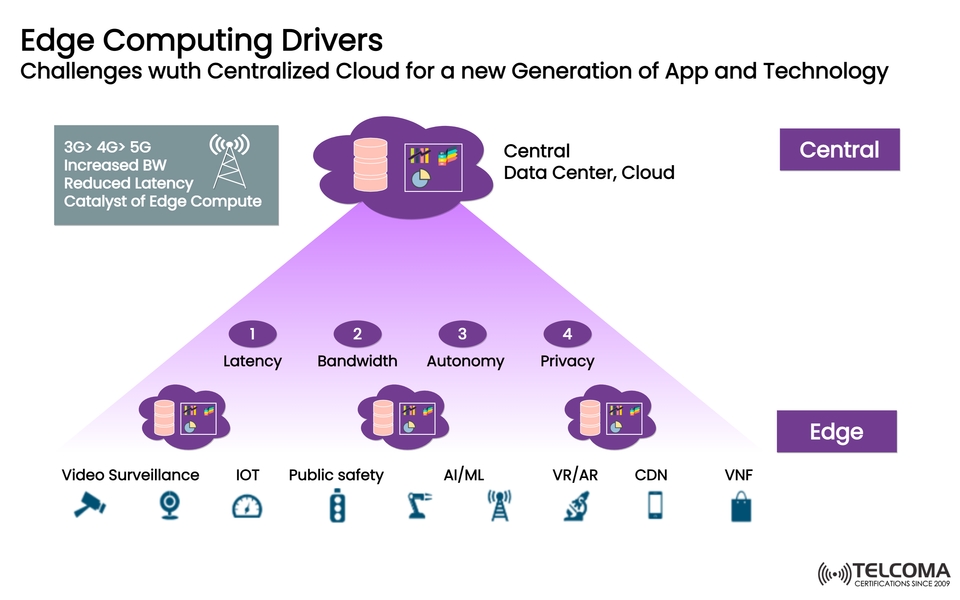

Why Edge Computing Matters: The Issues with Centralized Cloud for Next-Gen Apps
As we move from 3G and 4G to 5G, the surge of data-heavy applications—from IoT and AI/ML to VR/AR and video analytics—is changing what we need from networks and computing.
Although traditional centralized cloud setups have fueled the digital world for some time, they’re struggling to meet the demands of applications that need ultra-low latency, high bandwidth, and real-time decision-making.
That's where Edge Computing steps in. It decentralizes data processing, bringing computation closer to users or devices.
The image provided sums up the main challenges with centralized cloud models and highlights the four key drivers pushing us toward edge computing: latency, bandwidth, autonomy, and privacy.
What Is Edge Computing?
Edge computing is a distributed IT framework that shifts computation and data storage closer to where the data originates—think IoT devices, sensors, or local gateways—rather than just relying on distant cloud servers.
In simpler terms, instead of sending all data back to a far-off data center for processing, edge computing lets data be processed locally, right where it’s created.
This change helps cut down on network congestion, reduces latency, and lessens our reliance on centralized systems—making for nearly real-time responsiveness that’s crucial for 5G applications.
Challenges with Traditional Cloud Models
Before we get into the drivers for edge computing, it’s essential to recognize the limitations of the conventional cloud models shown in the image.
Latency
Data has to travel long distances to reach centralized data centers, and even a tiny delay can mess up time-sensitive operations like:
Self-driving cars needing to make split-second decisions
Industrial robots coordinating on the factory floor
Remote surgeries and real-time health monitoring
Latency is a major reason folks are turning to edge computing.
Bandwidth
The massive data generated by billions of connected IoT devices can choke network capacity. Sending raw sensor data or high-def video to the cloud nonstop can lead to:
Skyrocketing backhaul costs
Network congestion
Inefficient use of spectrum resources
With edge computing, we process data on-site, sending only relevant insights to the cloud, which saves bandwidth.
- Autonomy
Centralized clouds rely heavily on stable, fast internet connections. In critical situations (like public safety or remote mining), you can’t afford any downtime.
Edge computing enables local decision-making and autonomous operation, even if the connection to the main network is temporarily lost.
- Privacy and Security
Sending sensitive information—like health records or surveillance footage—to the central cloud puts it at risk for breaches or compliance issues.
Edge computing steps up data privacy by:
Keeping sensitive information local
Using encryption and anonymization at the source
Reducing exposure to risks associated with centralized systems
Breaking Down the Four Drivers of Edge Computing
The image highlights four main Edge Computing Drivers that are reshaping modern network designs.
- Reducing Latency
Edge computing cuts down latency by processing data close to where it’s created—whether that’s at a cell tower, base station, or even on a user’s smartphone.
A few examples include:
Video surveillance systems analyzing footage in real time for any anomalies.
Autonomous vehicles making prompt navigation choices based on sensor data.
Gaming and AR/VR applications offering lag-free, immersive experiences.
By avoiding the round trips to a central cloud, latency can drop from hundreds of milliseconds to under 10 ms in optimized 5G environments.
- Optimizing Bandwidth
Instead of sending huge volumes of raw data to centralized servers, edge computing processes and filters the data on-site.
Only the crucial or aggregated info is sent to the cloud.
This is particularly important for:
IoT networks, which have thousands of sensors constantly generating telemetry data.
CDNs (Content Delivery Networks) that store and deliver content close to users.
The outcome is that:
Bandwidth usage drops significantly.
Core network congestion is lessened.
Service costs go down while performance rises.
- Autonomy and Local Decision-Making
In environments where real-time control and resilience are crucial, autonomy becomes vital.
In edge computing setups:
Systems can still operate even when the connection to the cloud is interrupted.
Local nodes can make real-time decisions using cached data or AI models.
A few examples include:
Public safety systems that can process alerts even if the network is down.
Manufacturing robots that keep working during network interruptions.
AI/ML analyses carried out locally on edge servers without depending on the cloud.
This ability is essential for mission-critical and remote applications, ensuring reliability and continuous operation.
Privacy and Security
Edge computing lowers risk by keeping sensitive data local and minimizing cloud exposure.
Data like video feeds, health metrics, and user identifiers can be:
Processed and anonymized at the edge
Stored securely with local encryption
Shared selectively with central servers
Examples of this include:
Healthcare systems that keep patient information confidential
Video analytics for urban surveillance
Enterprise IoT that protects proprietary data from leaks
Centralized vs. Edge Computing: A Quick Comparison
Aspect Centralized Cloud Edge Computing Data Processing Location Far-off data centers Near the data source Latency High (50–200 ms)Very low (<10 ms)Bandwidth Usage Heavy Optimized Autonomy Dependent on connectivity Operates independently Privacy Data travels through the network Data remains local Best Use Cases Storage, analytics, backup Real-time IoT, AI, VR, and 5G applications
This comparison shows why many industries are increasingly leaning towards distributed computing architectures that blend cloud and edge capabilities.
Edge and Cloud: A Collaborative Future
It's also worth mentioning that Edge Computing doesn’t replace the cloud—it complements it.
In today's cloud-edge continuum, both systems work hand in hand:
The Edge takes care of real-time processing, quick decisions, and privacy-sensitive tasks.
The Cloud manages heavy computation, storage, and AI model training.
This hybrid approach guarantees scalability, reliability, and smart performance across networks.
Wrapping Up
The rise of 5G and advanced digital applications has laid bare the limitations of traditional centralized cloud models.
As shown in the image, issues regarding latency, bandwidth, autonomy, and privacy have become significant drivers for edge computing.
By shifting computing closer to users and devices, Edge Computing provides the speed, reliability, and data security necessary for this new wave of AI-powered, real-time, and mission-critical services.