
End-to-End Network Slicing in 5G: Architecture, Use Cases & Infrastructure

📶 What is End-to-End Network Slicing in 5G?
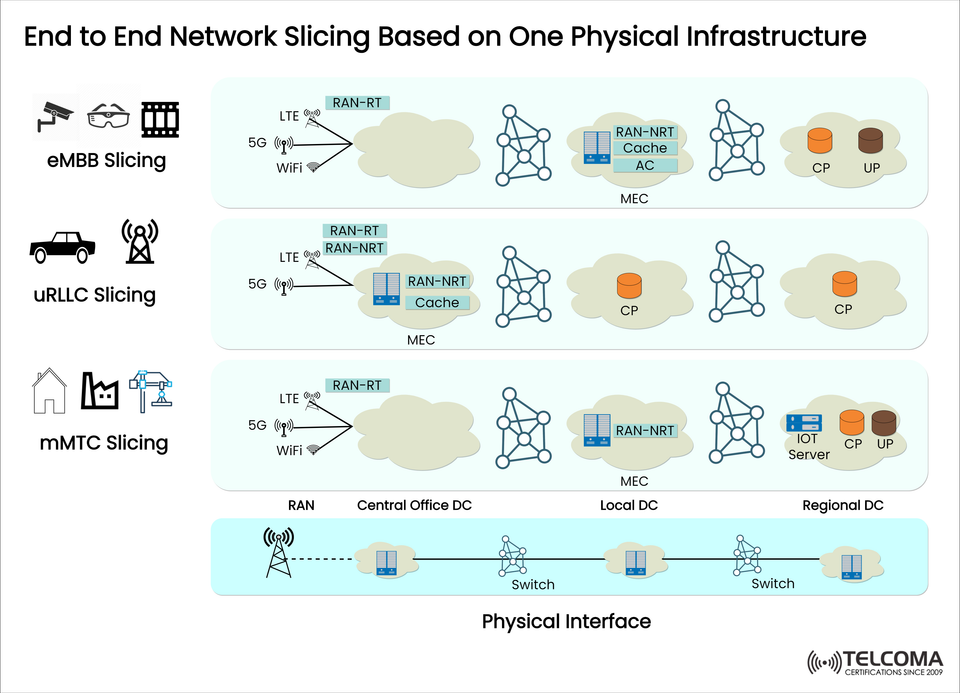
The Big Idea with end-to-end (E2E) network slicing is that numerous logical networks, i.e., network slices, can run on top of the same physical infrastructure. Each slice is customized to support various service requirements, such as high bandwidth, ultra-low latency, or massive IoT connectivity.
The provided diagram illustrates how eMBB, uRLLC, and mMTC slicing can utilize a shared physical interface that runs from RAN to core, using several datacenters.
🧩 Breakdown of Network Slices
The figure identifies three important 5G slice types, each of which correspond to a different area of use case domain:
📺 Enhanced Mobile Broadband (eMBB Slicing)
Use Cases: Streaming video at high speeds, AR/VR, large downloads.
Access: LTE, 5G, Wi-Fi.
Architecture:
RAN: RAN-RT (real time).
MEC: RAN-NRT (non-real time), caching, access controller.
Core: Control Plane (CP), User Plane (UP).
Key Feature: throughput with caching and MEC capabilities.
🚗 Ultra-Reliable Low Latency Communications (uRLLC Slicing)
Use Cases: Autonomous vehicles, industrial automation, remote surgery.
Access: LTE and 5G only (due to low latency requirements).
Architecture:
RAN: RAN-RT + RAN-NRT.
MEC: RAN-NRT with caching.
Core: CP layers that are distributed for ultra-reliable handoffs.
Key Feature: Ultra-low latency.
📌 Advantages of End-to-End Network Slicing
🔄 Multi-Services: eMBB, uRLLC, and mMTC can all happen among one network.
📉 Lower OPEX: Reduces reliance on parallel infrastructures.
📊 Custom QoS: Each slice has its own guaranteed performance.
⚙️ MEC: Bringing compute resources closer to end users reduces latency and increases available bandwidth.
🛡️ Security Isolation: The logical separation of slices has some added security benefits.
🛠️ Use Cases for Telecom Teams
Stakeholder How Network Slicing Provides Value
Operators Differentiate and modify services with service-level-agreements.
Enterprises Deploy and access private 5G slices for factories or campuses.
OEMs Ensure devices and services are slice aware.
System Integrators Design custom end-to-end architectures.
🧠 Conclusion: One Infrastructure, Infinite Possibilities
End-to-end network slicing is a fundamental part of the 5G architecture that enables all of those solutions to be more agile, efficient, and scalable. By allowing for multiple parallel virtual networks with dedicated logic and resources, operators provide custom services in an efficient manner without creating different infrastructures.
Whether it is a commitment to high-definition video streaming, autonomous driving, or a plethora of IoT devices, network slicing is the key to a future NextGen intelligent and service-aware 5G ecosystem.
🚀 Implementing Network Slicing
Successful delivery of end-to-end network slicing is much more than isolating traffic: it is an orchestration, automation, and intelligent resource management capability.
- Slice Lifecycle Management
Telecom operators will need a well-defined orchestration platform to:
Instantiate new slices as needed
Dynamically scale slices as the demand requires
Decommission slices that are unused or have expired.
Tools used:
✔️ ETSI NFV MANO
✔️ ONAP (Open Network Automation Platform)
✔️ Kubernetes and slice aware CNFs (Cloud-Native Functions)
SLA-Driven Resources
The slices need to comply with various QoS, latency, and bandwidth requirements. For example:
uRLLC slices require edge compute resources.
mMTC slices require high device density and minimal overhead.
- AI/ML to Enable Predictive Optimization
With AI and machine learning, slices can change dynamically in real-time for:
Predicting traffic spikes
Cutting latency by re-routing traffic
Auto-healing failed nodes or links along the slice path.
🔮 Future of End-to-End Network Slicing
Network slicing is evolving to support more dynamic, intelligent networks. Some future developments include:
✅ Slice-as-a-Service (SlaaS)
Operators will be able to offer slice definition and customization that ease enterprise adoption through developer and user API's or self-service portals directly to enterprises (e.g., factories, hospitals).
🌐 Cross Domain Slicing
Slicing will evolve beyond 5G for:
Satellite and non-terrestrial networks (NTN)
Fixed-wireless access (FWA)
🧰 Best Practices for Telecom Professionals
To deploy and manage network slicing effectively, telecom professionals should:
🛠️ Design
Identify use cases (such as a smart city or autonomous driving)
Define KPIs for each slice
Select relevant RAN/Core/Edge infrastructure
⚙️ Deploy
Leverage standardized APIs (i.e. 3GPP, ETSI)
Provide end-to-end observability and telemetry
Implement slice assurance tools
📈 Optimize
Conduct continuous slice performance audits
Utilize real-time analytics for proactive scaling
Modify policies using CI/CD workflows
🧭 Conclusion
End-to-end network slicing provides a new paradigm for 5G architecture. It turns a monolithic network into a flexible service delivery fabric, providing extensive new opportunities across industries.