
End-to-End Network Slicing in 5G: Enabling eMBB, uRLLC, and mMTC on a Shared Infrastructure

End-to-End Network Slicing in 5G: Allowing for Multiple Services on One Infrastructure
5G isn’t just a substantial technological jump in speed; it’s a paradigm shift in how we build and operate networks. One of the largest innovations in 5G networks is end-to-end network slicing or being able to give multiple virtual networks on a shared physical infrastructure.
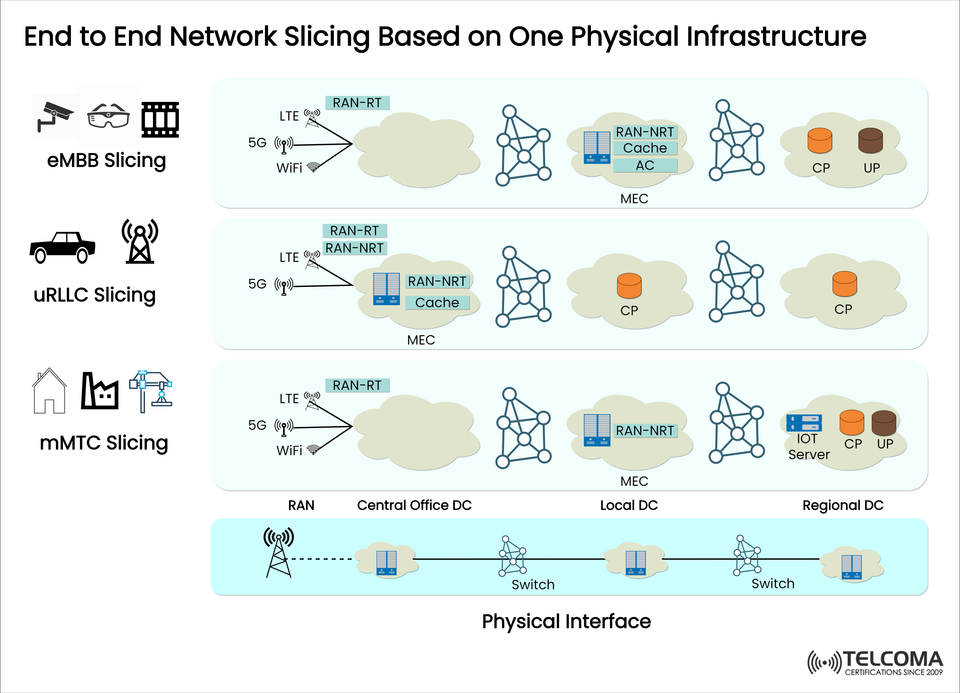
In this blog, we describe the concept of network slicing using the visual architecture below, and show how 5G can provide enhanced Mobile Broadband (eMBB), Ultra-Reliable Low Latency Communication (uRLLC) and massive Machine Type Communication (mMTC) in a flexible and scalable manner.
What is End-to-End Network Slicing?
Network slicing is the ability to create and run multiple isolated logical networks (or slices) on top of a common physical infrastructure. Each slice can be configured to support specific service requirements pertaining to speed, latency, or the number of connected devices.
The slices will span the following:
Radio Access Network (RAN)
Transport Network
Core Network
Edge and Cloud Infrastructure
The photo illustrates how a number of 5G slices can be architected across layers of data centers (DCs), from central office DCs (or facility) to regional DC to cover different use cases.
Explanation of the Key Service Slices
📶 eMBB Slicing – High Speed Data Access
Used by: Mobile video streaming apps, virtual reality (VR), augmented reality (AR), consumer broadband
Architectural Takeaway:
Utilizes LTE/5G/Wi-Fi in the RAN
RAN Real-Time (RAN-RT), is connected to Mobile Edge Computing (MEC)
MEC consists of running RAN Non Real-Time (RAN-NRT), cache and admission control (AC)
Transmit traffic through a distributed Control Plane (CP) and User Plane (UP) in most local/regional data centers.
🔑 Key Features
High data throughput
Local content caching for users
Bandwidth optimization
🚗 uRLLC Slicing – Ultra-Reliable Low Latency
Used by: Autonomous vehicles, remote surgery, smart electric grids
Architectural Takeaway:
RAN-RT and RAN-NRT integrated at the edge
Utilizes MEC with cached service response time
Data connects to the most local and distributed CP units
🔑 Key Features
Ultra-low latency
High reliability and precision
Real-time caching at-source proximity
🏠 mMTC Slicing – IoT and Massive Connectivity
Used by: Smart homes, smart factories, connected environmental sensors
Architectural Takeaway:
Focused on wide area coverage for mobility using LTE/5G/Wi-Fi
RAN-RT is a light version that connects to MEC and RAN-NRT and IoT servers.
COntrol Plane and User Plane operated designs with low bandwidth but high device density.
🔑 Key Features:
Massive IoT support
Efficient for small data packets
Low compute and storage footprint
Physical Infrastructure: Shared but Not Shared
As we already explained earlier, though the slices are logically separate, they share a common infrastructure. Here’s how:
Layer Description
RAN Shared LTE/5G/Wi-Fi Access points for all slices
Central Office DC Where MEC and edge computing services reside
Local DC Core functions such as CP and UP
Regional DC Broad scale processing and redundancy
Switching Layer Traffic isolation and handoff
Each layer of infrastructure can support multiple service types concurrently, without interference; this is made possible by virtualization and intelligent network orchestration.
Why Use Network Slicing in 5G
Network slicing offers unique advantages to service providers as well as enterprise customers:
✅ Service Differentiation: service level agreements (SLAs) for different users and applications
✅ Optimized Resourcing: optimized use of infrastructure is relevant across all verticals
✅ Agile Operations: service provider can create dynamic network slices with granularity leading to quicker provisioning and scaling
✅ Cost Optimization: shared physical network infrastructure leads to reduced capital and operational expenditures
✅ Business Enablement: opens up new revenue models for service providers with different slices in IoT, automotive, healthcare, etc.
Conclusion:
One Infrastructure, Many Opportunities
The visualized architecture above is an excellent example of how end-to-end network slicing enables operators to deliver eMBB, uRLLC, and mMTC over a single physical network. Also, with MEC distributed control and user.
Service Delivery Plans
A successful deployment of network slicing over a unified infrastructure necessitates a thorough approach that will reconcile flexibility, performance, and security.
🧠 Intelligent Slice Orchestration
Uses AI/ML algorithms that automatically track traffic loads, and then dynamically allocates slice resources.
Facilitates instantiation of a slice to enterprise customers on demand (e.g., temporary slices for events or emergencies).
🛡️ Security Use Case Per Slice
Each slice enforces isolation in the control and user planes despite sharing physical hardware.
Allows slice specific security policies for the slice, including encryption, access control, and quality of service (QoS) enforcement.
📊 Continuous Monitoring and SLA Enforcement
SLAs are different per slice (e.g., latency for uRLLC and throughput for eMBB).
Monitoring tools will ensure SLA compliance and automate remediation in case of performance degradation.
Deployment Challenges and Considerations
The vision of having a unified infrastructure, with multiple logical slices of the same physical network, is compelling, however, there are challenges of deployment that operators need to address:
Challenge Consideration
Orchestration Complexity Orchestration will require full automation and elements of a closed-loop system to maximize efficiency
Contention of Resource Scheduling will ultimately play a role in keeping resources conflict-free for slices
Latency bounds for uRLLC Will require a compute capability, preferably located at mediators, to achieve sub-millisecond latency
Security, Compliance and Fraud Prevention Ensuring local compliance and constraints.
Use Case Scenarios in a Shared Infrastructure Model
Here's how various industries support business with 5G slices on one infrastructure:
Industry Slice Type Application Example Key Benefit
Healthcare uRLLC Remote surgeries and patient monitoring Ultra-reliable, low-latency comms
Media eMBB 8K live streaming and AR/VR broadcasting High throughput with caching
Smart Cities mMTC Smart lighting, waste sensors, traffic management Massive IoT support with low power
automotive uRLLC + eMBB Autonomous driving and infotainment systems Real-time decisions + rich content
Manufacturing mMTC + uRLLC Robotics, asset tracking, predictive maintenance Device density + low-latency control
Looking Ahead: Beyond 5G with E2E Slicing
As 5G networks evolve into 6G mobile networks with AI-native networks, the advances in network slicing will also develop:
🔄 Intent-Based Networking (IBN): Automatically builds and tears down slices based on high-level business objectives.
🧬 Network Slicing-as-a-Service (NSaaS): Enterprises can rent their custom slices on a requested basis with zero-touch provisioning.
🧭 Federated Slicing Across Operators: Provide seamless continuity of slices across geographic and carrier domains.
🧱 Augmented by Edge AI and Quantum Networks for additional predictive orchestration and ultra-secure data transfer.
Takeaways: The Foundation of 5G Scalability
End-to-end network slicing is the foundation for fulfilling the 5G promise.