
EPDCCH Configuration in LTE Subframe Explained | Telecom Guide

Introduction
These days, in LTE and LTE-Advanced networks, making the most of spectrum is really important. It's all about meeting the rising demand for fast data and solid connectivity. Control channels are key to managing signaling, scheduling, and data delivery within subframes. We used to rely on the Physical Downlink Control Channel (PDCCH) for Downlink Control Information (DCI), but as LTE has developed, the Enhanced Physical Downlink Control Channel (EPDCCH) came into play to tackle issues of scalability and capacity.
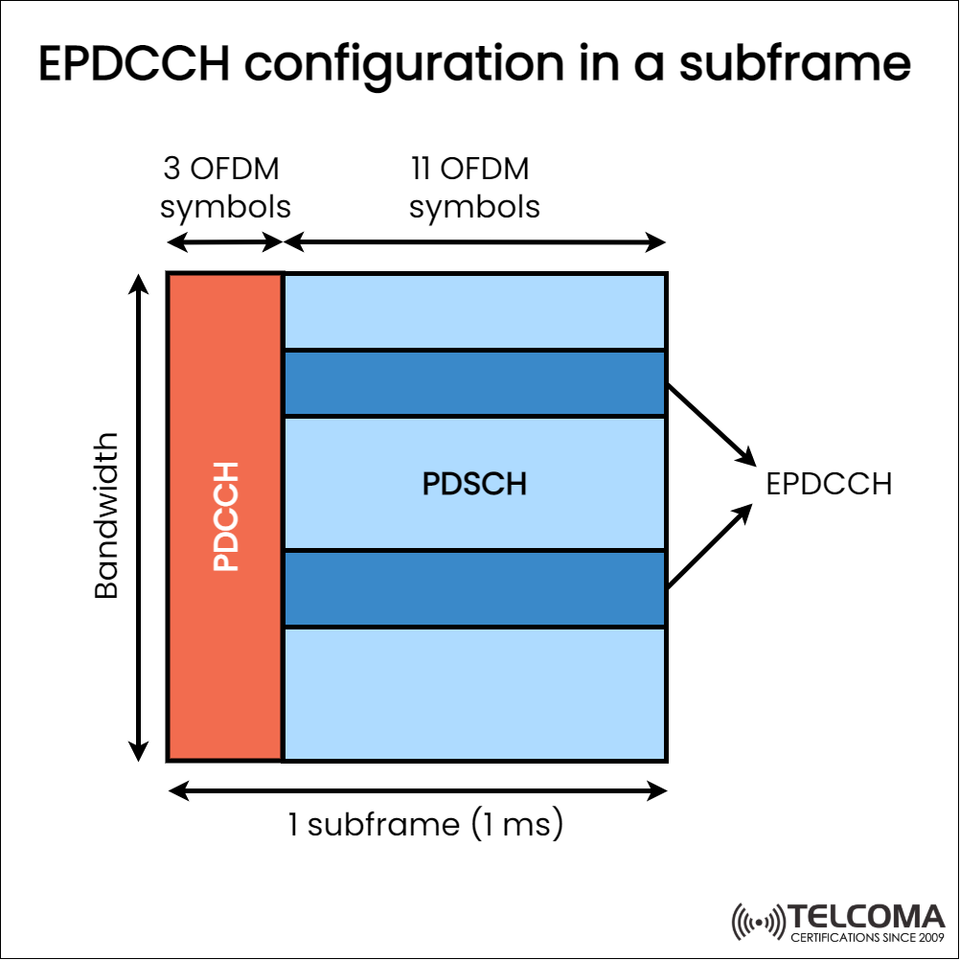
The image shared shows how EPDCCH is set up within a subframe and its link with PDCCH and PDSCH. In this blog post, we’ll unpack the configuration, delve into the technical details, and discuss why EPDCCH is significant for LTE networks.
LTE Subframe Basics
An LTE subframe lasts for 1 ms and includes 14 OFDM symbols with a normal cyclic prefix. These symbols are split between control channels and data channels.
PDCCH Region: Usually takes up the first 1–3 OFDM symbols within a subframe.
PDSCH Region: Fills the rest of the OFDM symbols and carries user data.
Bandwidth Dimension: This defines the frequency resources available for both control and data transmission.
This time-frequency grid is where PDCCH and EPDCCH make their marks.
PDCCH vs. EPDCCH
PDCCH (Physical Downlink Control Channel)
Found in the early part of a subframe (first 1–3 OFDM symbols).
Uses the full bandwidth but is limited to the control region.
Sends out essential control information like scheduling grants and HARQ feedback.
Limitation: With the growth of LTE, PDCCH became a bottleneck because of scarce resources and lack of frequency-domain granularity.
EPDCCH (Enhanced Physical Downlink Control Channel)
Rolled out in LTE Release 11.
Mapped in the PDSCH region instead of being stuck in the fixed control area.
Can use localized or distributed transmission across the frequency domain.
Offers better frequency-selective scheduling and enhanced interference management.
Frees up PDCCH resources, making it possible for networks to expand for carrier aggregation and denser setups.
EPDCCH Configuration in a Subframe
The image illustrates where EPDCCH fits within a subframe, along with PDCCH and PDSCH:
First 3 OFDM symbols: Set aside for the traditional PDCCH region.
Remaining 11 OFDM symbols: Primarily designated for PDSCH (Physical Downlink Shared Channel), which also includes EPDCCH.
Bandwidth usage: * PDCCH takes up the full bandwidth in the control area. * EPDCCH uses flexible resource blocks in the PDSCH region.
This layout allows for dynamic allocation of EPDCCH based on network load, interference, and user needs.
Key Features of EPDCCH
- Enhanced Capacity
By relocating control signaling to the PDSCH area, EPDCCH increases the available control resources, helping alleviate congestion in the traditional PDCCH.
- Frequency-Domain Flexibility
EPDCCH can be assigned to specific resource blocks, making it frequency-selective and improving effectiveness in situations with heavy interference.
- Support for Carrier Aggregation
In systems with multiple carriers, EPDCCH takes care of control signaling for secondary component carriers, which PDCCH wasn’t designed to handle.
- Improved Coverage and Reliability
With capabilities like beamforming and advanced transmission methods, EPDCCH boosts coverage in areas on the edge of the cell.
- Scalability for LTE-Advanced Pro and 5G Evolution
EPDCCH serves as a stepping stone for scalable control channels needed in the next generation of networks.
EPDCCH vs PDCCH: Technical Comparison
Feature PDCCHEPDCCH Location in Subframe First 1–3 OFDM symbols Within PDSCH region (flexible)Bandwidth Usage Entire system bandwidth Localized or distributed RBs Scheduling Granularity Coarse Fine (frequency-selective)Scalability Limited High (supports CA & Het Nets )Interference Handling Less efficient More robust with beamforming Coverage Standard Enhanced (especially at cell edges)
Why EPDCCH Matters for Telecom Operators
Higher Spectrum Efficiency: EPDCCH makes better use of unused frequency-domain resources for control signaling.
Better User Experience: With improved scheduling and interference management, users can expect more reliable and faster connections.
Support for Advanced Features: Carrier Aggregation, Coordinated Multipoint (CoMP), and heterogeneous setups benefit from what EPDCCH offers.
Future-Proofing: As networks transition towards 5G, EPDCCH helps ensure LTE remains effective and scalable.
Example Use Cases
Carrier Aggregation (CA): EPDCCH handles control signaling for secondary carriers, enabling quicker data rates.
Heterogeneous Networks (HetNets): Small cells and macro cells can coordinate more effectively using EPDCCH’s localized control channels.
Interference Management: The frequency-selective mapping of EPDCCH enhances performance in busy urban settings.
LinkedIn Post Version
🚀 EPDCCH in LTE: Smarter Control for Smarter Networks
As LTE networks have grown, the old Physical Downlink Control Channel (PDCCH) has started to hold things back. It has limited resources and lacks frequency-domain flexibility, making it tough to support advanced features like carrier aggregation and C o MP.
That’s where the Enhanced Physical Downlink Control Channel (EPDCCH) steps in. Instead of sticking to just the first 1–3 OFDM symbols, EPDCCH shifts control signaling into the PDSCH region, which brings some serious benefits:
🔹 Higher capacity by easing the load on congested PDCCH resources
🔹 Frequency-selective scheduling for smarter handling of interference
🔹 Support for carrier aggregation and HetNets
🔹 Better coverage at cell edges thanks to beamforming
In straightforward terms, EPDCCH lets LTE scale up efficiently while paving the way for LTE-Advanced Pro and 5G.
📡 For those in telecom, grasping how EPDCCH is configured in a subframe is crucial for optimizing spectrum efficiency, enhancing user experience, and prepping networks for the future.
👉 The transition from PDCCH to EPDCCH highlights how much of a difference control channels can make for network performance, even if they often get overlooked.
Conclusion
The launch of EPDCCH marked a significant advancement in LTE development, resolving the shortcomings of PDCCH while paving the way for more scalable advanced applications. By shifting control signaling to the PDSCH region, EPDCCH boosts capacity, enables frequency-selective scheduling, and supports features like carrier aggregation and CoMP.
For those in telecom, grasping how EPDCCH is set up in a subframe is crucial for fine-tuning and planning networks. As we move closer to 5G, EPDCCH shows how small innovations in LTE are still vital for providing smooth and high-performance connectivity across the globe.