
EPS Fallback in 5G: Call Flow and How It Enables Voice Continuity
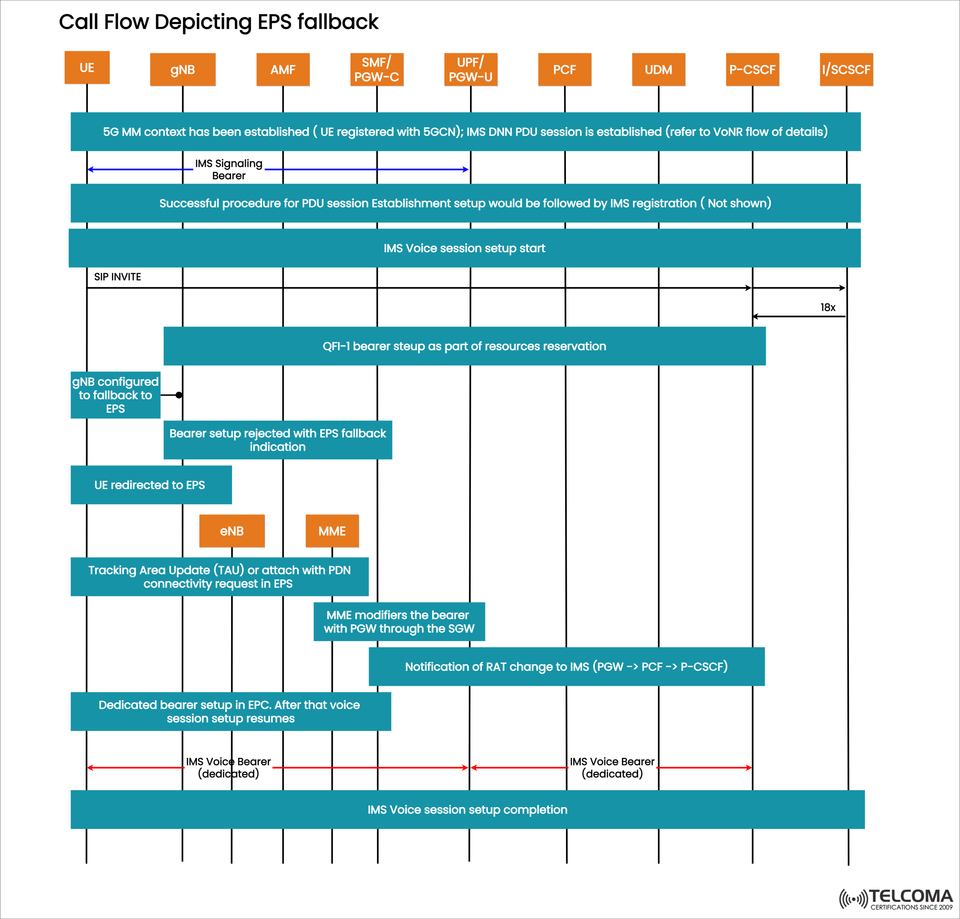

Understanding EPS Fallback in 5G: A Call Flow Breakdown
As telecom networks transition from LTE (4G) to 5G New Radio (NR), keeping voice services running smoothly poses a significant challenge. While the goal is to achieve Voice over New Radio (VoNR) in standalone 5G, early deployments often face hurdles due to limited NR coverage and varying device support.
Here’s where EPS Fallback plays a crucial role. The diagram attached outlines the call flow for EPS fallback, illustrating how a 5G device (UE) can smoothly switch back to the Evolved Packet System (EPS)—basically LTE networks—to carry out voice calls.
In this post, we’ll explore:
What EPS fallback is and its importance.
The step-by-step call flow for EPS fallback.
The roles of key network components (like gNB, eNB, AMF, MME, etc.).
The various advantages and challenges of EPS fallback.
Its significance in moving from VoLTE to VoNR.
What is EPS Fallback in 5G?
EPS fallback is a mechanism that allows a 5G-capable UE to revert to LTE/EPC for voice services (IMS-based VoLTE) when VoNR isn’t available or supported.
Why do we need EPS fallback?
Limited NR coverage: The rollout of 5G is still ongoing, and voice over NR isn't always an option.
Device capability gaps: Not all 5G smartphones are equipped to handle VoNR.
Core network readiness: Operators often deploy 5GC gradually, while voice continues to be managed by EPC.
Service continuity: It makes sure users can always make or receive calls.
In essence, EPS fallback fills the void between VoLTE and VoNR until 5G networks are fully developed.
Step-by-Step EPS Fallback Call Flow
The image shows how signaling and bearer setup works during an EPS fallback scenario. Here’s a detailed walkthrough of the flow:
- Setting Up 5G Context
The UE connects with the 5G Core (5GC), establishing a NAS signaling connection.
An IMS DNN PDU session is set up for signaling (SIP messages).
- Initiating IMS Session
After the PDU session is ready, the UE starts the IMS voice session setup (SIP INVITE).
This step needs a dedicated QFI-1 bearer for IMS voice.
- Bearer Rejection with EPS Indication
When the gNB realizes VoNR isn’t feasible, it rejects the bearer setup, indicating an EPS fallback.
This kicks off a redirection process.
- Redirecting to LTE (EPS)
The UE is sent from the 5G gNB to an LTE eNB.
At this point, the MME takes over mobility and session management.
- Tracking Area Update (TAU)
The UE carries out a TAU or PDN connectivity request in EPS.
This ensures the UE registers correctly in LTE/EPC.
- Bearer Modification via MME
The MME adjusts the bearer path through the Serving Gateway (SGW) to the Packet Gateway (PGW).
This sets up the bearer in the EPC.
- Notifying of RAT Change
The IMS system is alerted about the RAT change (5GC → EPC).
Notifications flow from PGW → PCF → P-CSCF.
- Setting Up Dedicated Voice Bearer in LTE
A dedicated IMS Voice Bearer (VoLTE) is established in LTE.
The SIP session continues, and the voice call is successfully set up.
Simplified EPS Fallback Flow (Table)
Step Action Key Network Elements1UE registers in 5GC, IMS PDU session created UE, gNB, AMF2SIP INVITE sent for voice UE, P-CSCF, I/S-CSCF3Bearer request rejected, fallback triggeredgNB4UE redirected to LTE (EPS)UE, eNB5Tracking Area Update (TAU) in LTEUE, MME6Bearer modified via EPCMME, SGW, PGW7RAT change notification to IMSPGW, PCF, P-CSCF8IMS Voice Bearer established in LTE eNB, IMS Core
Key Network Elements in EPS Fallback
UE (User Equipment): Initiates the voice call and transitions from NR to LTE.
gNB (Next Gen NodeB): Manages 5G NR, detects VoNR unavailability, and triggers fallback.
eNB (Evolved NodeB): The LTE base station that manages fallback connectivity.
AMF (Access and Mobility Management Function): Oversees registration in 5GC.
MME (Mobility Management Entity): Takes care of mobility in LTE/EPC.
SMF/PGW-C & UPF/PGW-U: Ensure session continuity and bearer setup.
PCF (Policy Control Function): Manages policy and quality of service (QoS).
P-CSCF/I-SCSCF: Handles SIP signaling for IMS voice calls.
Advantages of EPS Fallback
Maintains service continuity: Voice services stay available even when VoNR isn’t accessible.
Utilizes LTE coverage: Takes advantage of the extensive LTE network.
Facilitates smooth transitions: Assists operators in gradually moving from VoLTE to VoNR.
Compatible with various devices: Works for devices that don’t support VoNR.
Cost-effective: Postpones the pressing need for immediate VoNR deployment.
Challenges of EPS Fallback
Increased call setup delay: Redirecting to LTE can introduce additional latency (around 300–400 ms).
Complex signaling: Requires coordination between EPC and 5GC.
Potential QoS degradation: LTE might not match the quality of 5G NR.
Handover difficulties: Smooth transitions between LTE and NR need careful tuning.
Reliance on LTE longevity: EPS fallback remains effective only as long as LTE networks are operational.
Comparing EPS Fallback and VoNR
Feature EPS Fallback Vo NR Voice Path Falls back to LTE (Vo LTE)Native in 5G NR Latency Slightly higher due to fallback delay Lower latency, direct Coverage Dependent on LTE footprint Requires wide 5G NR coverage Call Quality Stable (LTE proven)Potentially higher with QoS assurance Complexity EPC + 5GC interworking needed Pure 5G-based
Transition from VoLTE to VoNR
EPS fallback is a transition technology. Operators use it while developing:
NSA networks with VoLTE: Early 5G deployments depend on LTE for voice services.
SA with EPS fallback: The 5G core is rolled out, but LTE still manages voice services.
SA with VoNR: Full native 5G voice service, eliminating the need for fallback.
This phased migration ensures:
Customer satisfaction (no dropped calls).
Operational flexibility for operators.
Future readiness as more VoNR-capable devices and coverage becomes available.
In Summary
The EPS fallback call flow illustrates how 5G networks maintain voice service continuity during the transition to full standalone VoNR. By rerouting calls to LTE/EPC, operators can leverage reliable VoLTE infrastructure while still deploying 5G NR and 5GC.
Short-term advantage: Reliable voice coverage during early SA rollouts.
Medium-term role: Enables mixed deployments with partial VoNR coverage.
Long-term transition: Once VoNR is fully developed, EPS fallback will be phased out.
For those in the telecom industry or enthusiasts, EPS fallback serves as a practical bridging technology, ensuring a smooth shift to a fully 5G future without sacrificing user experience.