
EPS Fallback in 5G SA Using N26 Interface Explained
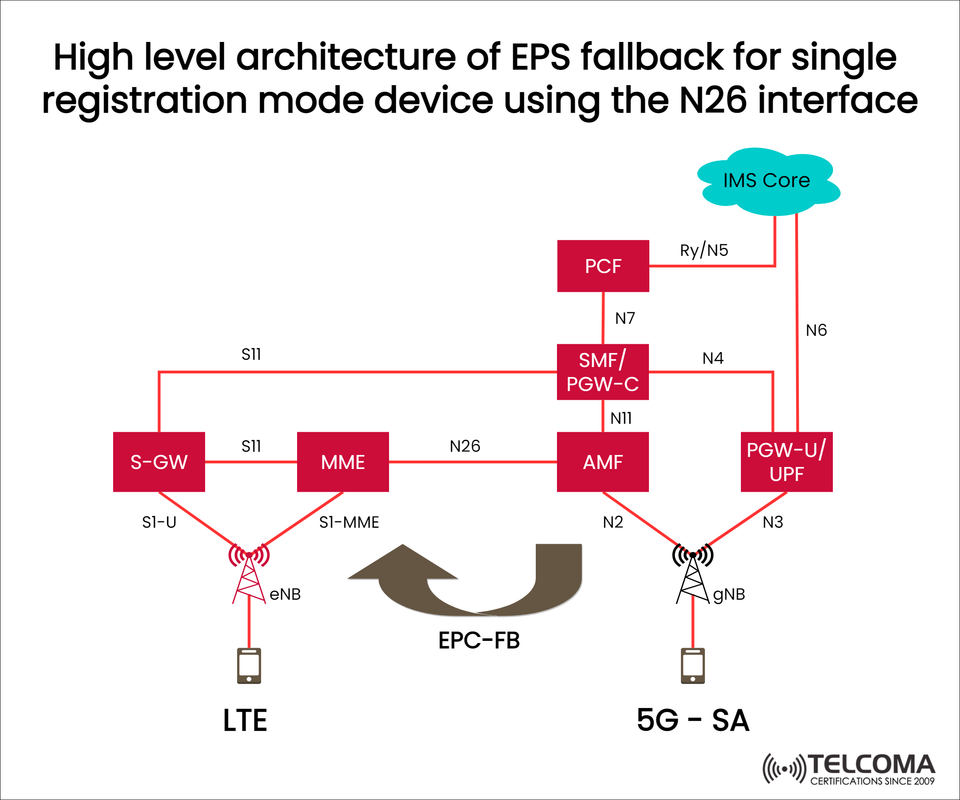

High-Level Architecture of EPS Fallback for Single Registration Mode Devices Using the N26 Interface
With the launch of 5G Standalone (SA) networks, providers are faced with the challenge of delivering reliable voice services. While 5G is great at offering super-fast data and low latency, 5G-native voice—known as VoNR (Voice over New Radio)—isn’t always an option right away. To fill this gap, we use EPS fallback (Evolved Packet System Fallback).
The illustration above shows the high-level architecture of EPS fallback for single registration mode devices using the N26 interface, which is essential for ensuring smooth voice service continuity between 5G SA and LTE VoLTE.
Why EPS Fallback is Necessary in 5G SA
5G SA brings in a brand-new 5G Core (5GC) architecture. Now, while data services can easily operate on 5GC, voice services still rely on the IMS (IP Multimedia Subsystem) Core, which was originally designed for LTE VoLTE.
Without fallback: Devices on 5G SA without VoNR coverage can’t make voice calls.
With EPS fallback: The device switches back to LTE VoLTE for both regular and emergency calls.
This setup allows operators to roll out 5G SA while still depending on the well-established VoLTE infrastructure from LTE.
Single Registration Mode and N26 Interface
Devices can register in two modes:
Dual Registration Mode (DRM):
UE registers with both EPC (LTE Core) and 5GC separately.
This method involves more complex signaling and uses up more power.
Single Registration Mode (SRM):
UE registers only with 5GC, and the transition to LTE is handled via the N26 interface.
This approach simplifies signaling and cuts down on device complexity.
The N26 interface helps integrate the AMF (Access and Mobility Management Function) in 5GC with the MME (Mobility Management Entity) in EPC. This makes it possible to switch smoothly from 5G SA to LTE EPC without needing separate registrations.
Key Network Components in the EPS Fallback Architecture
The diagram outlines how various entities interact to enable EPS fallback in single registration mode:
UE (User Equipment): The 5G device linked to gNB or eNB.
gNB (5G NodeB): The 5G base station that connects UE to the 5G Core.
eNB (evolved NodeB): The LTE base station that manages LTE connections.
AMF (Access and Mobility Management Function): Part of the 5GC responsible for managing mobility.
MME (Mobility Management Entity): The node in LTE EPC that takes care of mobility and bearer control.
SMF/PGW-C (Session Management Function/Packet Gateway Control): Responsible for session control in both 5G and LTE.
PGW-U/UPF (Packet Gateway User Plane/User Plane Function): Manages the user data plane.
PCF (Policy Control Function): Handles policy and QoS control.
IMS Core: Provides voice services, including VoLTE.
Interfaces and Their Functions
The whole setup relies on several interfaces between EPC and 5GC:
N26: Connects AMF (5GC) with MME (EPC) for smooth mobility.
N2: Connects gNB to AMF.
N3: Links gNB to UPF for user plane traffic.
N4: Connects SMF to UPF.
N6: Links UPF to IMS Core for voice traffic.
S1-MME: Connects eNB to MME.
S1-U: Connects eNB to the serving gateway (S-GW).
S11: Links MME to S-GW.
How EPS Fallback Works (Step-by-Step)
Here’s a breakdown of how EPS fallback functions when a 5G SA device makes a voice call:
Call Setup in 5G SA
UE connects to the 5GC through gNB.
When the UE starts a voice call, the AMF identifies that VoNR isn’t available.
Fallback Trigger
The AMF initiates an EPS fallback procedure using the N26 interface.
The UE gets redirected or switched to LTE through eNB.
MME Coordination
Using N26, the AMF communicates with the MME to pass on UE context (mobility, session information).
This ensures the UE doesn’t have to register again in EPC.
Bearer Setup in LTE
MME sets up an EPS bearer with the S-GW and PGW-C.
User traffic is routed via S1-U and PGW-U to the IMS Core.
Voice Service Continuity
The call is anchored in the IMS Core through LTE VoLTE.
After the call ends, the device can switch back to 5G SA for data services.
Benefits of EPS Fallback with N26 Interface
Single Registration: Makes UE operations easier and cuts down on signaling overhead.
Seamless Mobility: Facilitates quick transitions from 5G SA to LTE EPC.
Efficient Voice Handling: Utilizes the established LTE VoLTE for voice calls.
Emergency Call Support: Ensures that emergency voice calls are always available.
Backward Compatibility: Works with older LTE infrastructure during 5G SA rollouts.
EPS Fallback Call Flow Summary
Step | Process | Responsible Nodes
1 | Call initiated in 5G SA | UE → gNB → AMF
2 | VoNR unavailable → EPS fallback triggered | AMF
3 | Context transfer via N26 | AMF ↔ MME
4 | Bearer setup in EPC | MME, S-GW, PGW-C
5 | User plane routing to IMS | PGW-U/UPF → IMS
6 | Call continues on VoLTE | UE via eNB
Limitations of EPS Fallback
Even though EPS fallback makes sure voice continuity, there are some downsides:
Call Setup Delay: Shifting from 5G SA to LTE adds some latency.
Dependence on LTE Coverage: If LTE isn’t available, fallback won’t work.
Temporary Solution: EPS fallback is just a stopgap until VoNR is fully developed.
Complex Interworking: Requires bringing together 5GC and EPC through N26, which can complicate operations.
EPS Fallback vs. Vo NR
Feature EPS Fallback Vo NR Voice Core IMS over LTE EPCIMS over 5GCRegistration Mode Single (via N26) or Dual Native 5GCall Setup Time Higher (due to fallback)Lower Dependency LTE Vo LTE required Fully 5G-basedFuture Viability Transitional Long-term solution
Future Outlook – Transition to Vo NR
Although EPS fallback with the N26 interface is a practical short-term solution, the ultimate aim is Voice over New Radio (Vo NR), where calls are managed entirely in the 5G SA domain.
Providers will still depend on EPS fallback during early 5G rollouts, especially in areas with solid LTE coverage.
As VoNR coverage continues to grow, the need for LTE fallback should gradually decrease.
Conclusion
The EPS fallback architecture using the N26 interface is a vital part of enabling voice services for 5G SA devices in single registration mode. By making use of the integration between AMF (5GC) and MME (EPC), EPS fallback guarantees that users can smoothly move from 5G to LTE for voice calls.