
EPS to 5G Handover with N26 Interface: Detailed Call Flow Explained
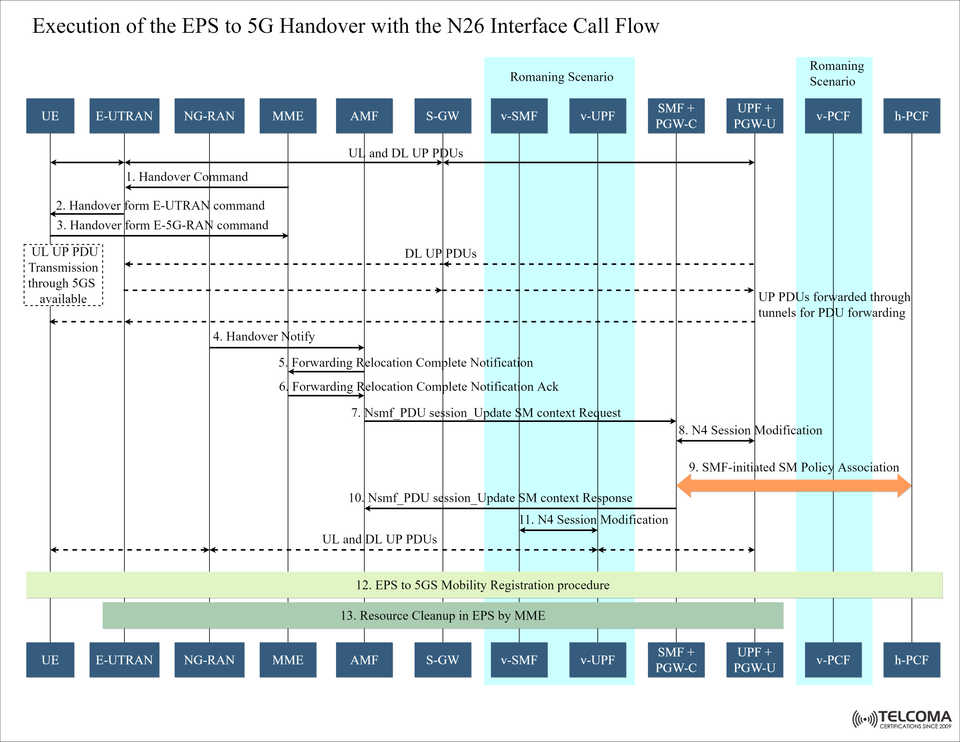

EPS to 5G Handover with N26 Interface: A Closer Look at Call Flow Steps
With 5G rolling out, maintaining smooth transitions between LTE (Evolved Packet System – EPS) and the 5G Core (5GC) is super important for keeping services uninterrupted. One of the main ways to make this work is through the EPS to 5G handover via the N26 interface.
This article breaks down the call flow steps for carrying out an EPS to 5G handover with N26 support. We’ll look at it based on a detailed diagram, keeping it clear for telecom experts while also accessible for those who are advanced learners.
Overview of N26 Interface in 5G Migration
The N26 interface links the Mobility Management Entity (MME) from LTE/EPS to the Access and Mobility Management Function (AMF) in the 5G Core (5GC). It enables direct mobility context transfer between the LTE and 5G systems, which means we can skip a full re-registration and allow for quicker, seamless transitions.
Why N26 is Important
Cuts down on handover delay compared to fallback methods.
Ensures session continuity without changing the IP address.
Reduces signaling load during inter-RAT (Radio Access Technology) shifts.
Key Network Components in EPS–5GS Handover
As shown in the diagram, the main network components include:
UE (User Equipment): The mobile device moving from LTE to 5G.
E-UTRAN: The LTE radio access network.
NG-RAN: The new 5G radio access network.
MME: LTE’s mobility control entity.
AMF: The 5G mobility management function.
S-GW (Serving Gateway): LTE data anchor.
v-SMF & v-UPF: Virtualized SMF and UPF for roaming situations.
SMF + PGW-C: Functions for session and control in 5G.
UPF + PGW-U: User plane and packet gateway functions in 5G.
v-PCF / h-PCF: Policy control functions for visited and home networks.
Step-by-Step EPS to 5G Handover Call Flow (N26 Interface)
Here’s how the process unfolds, based on our diagram:
Step 1 – Handover Command
The UE gets a Handover Command from E-UTRAN to begin the shift towards NG-RAN connectivity.
Steps 2 & 3 – E-UTRAN to E-5G-RAN Command
During handover preparation, E-UTRAN starts the move to the 5G radio environment (E-5G-RAN).
Step 4 – Handover Notify
E-UTRAN informs the MME that the UE is on its way to NG-RAN.
The network sets up for dual-plane forwarding to avoid any packet loss.
Steps 5 & 6 – Forwarding Relocation Complete Notification & Acknowledgment
Confirmation comes that data forwarding paths between LTE and 5G anchors are established.
This means DL UP PDUs (Downlink User Plane Protocol Data Units) are all set to go.
Step 7 – Nsmf PDU Session Update SM Context Request
The SMF updates the session management context for the UE to show the new 5G access.
Step 8 – N4 Session Modification
The UPF tweaks session management parameters for how packets get forwarded.
Step 9 – SMF-Initiated SM Policy Association
Policy rules (like QoS, charging, prioritization) are reassessed based on the new access type.
Steps 10 & 11 – PDU Session Update & N4 Modification
The SMF sends out the updated session response.
The N4 interface between SMF and UPF gets updated for 5G routing.
Step 12 – EPS to 5GS Mobility Registration Procedure
The UE successfully registers its mobility in the 5GC without doing a full NAS re-registration, all thanks to N26.
Step 13 – Resource Cleanup in EPS by MME
Old LTE resources are freed up to enhance network efficiency.
How N26 Enhances Handover Performance
Without N26:
The UE would have to deregister from LTE and fully register with 5G, which can lead to higher latency.
The IP session might reset, which can disrupt real-time services like VoIP and gaming.
With N26:
The session context shifts directly from MME to AMF.
Latency can drop by up to 50% in real-world networks.
Service continuity is preserved.
Roaming Scenario in N26 Handover
In roaming situations:
The v-SMF (visited SMF) along with v-UPF manage local session control and user plane.
h-PCF (home PCF) continues to apply policy rules from the home network.
The N26 handover process stays mostly the same, but additional latency might pop up due to signaling across networks.
User Plane Data Forwarding During Handover
UL (Uplink) PDUs are sent through the 5GS path once it’s available.
DL (Downlink) PDUs are tunneled through the 5G path to ensure continuity.
This dual-plane forwarding helps to cut down on packet loss during the transition.
Key Benefits of EPS to 5G Handover with N26
Low Latency: Quicker than fallback options.
Seamless Experience: No changes to the IP address.
Optimized Signaling: Fewer NAS messages travel between networks.
Enhanced QoS: Real-time services stay uninterrupted.
Scalable for Roaming: Works in both home and visited networks.
EPS to 5G Handover Challenges and Considerations
While N26 brings speed and efficiency, implementing it does require:
Core Network Upgrade: Both LTE and 5G cores need to support N26.
Interoperability Testing: Vendors have to agree on how to implement the interface.
Roaming Agreements: These must include clauses for N26 support to ensure seamless mobility between different PLMNs.
Monitoring Tools: Real-time KPIs are essential to spot handover failures or packet loss.
Example Use Cases for N26 Handover
VoNR (Voice over New Radio) Continuity: Keeping calls alive during the transition from LTE to 5G.
5G Gaming Applications: Ensuring low latency even when coverage changes.
Enterprise Private Networks: Making sure sessions remain stable in areas with mixed coverage.
IoT Mobility: Smooth handover for connected vehicles and industrial IoT.
Summary Table of Call Flow Steps
StepActionKey Entities1Handover CommandUE, E-UTRAN2-3E-UTRAN to E-5G-RAN CommandE-UTRAN, NG-RAN4Handover NotifyMME5-6Relocation CompleteS-GW, UPF7Update SM Context RequestSMF8N4 Session ModificationUPF9SM Policy AssociationSMF, PCF10-11Update SM Context & N4 ModificationSMF, UPF12Mobility RegistrationAMF13EPS Resource CleanupMME
Conclusion
The EPS to 5G handover via the N26 interface is vital for the smooth coexistence of LTE and 5G. By allowing a direct context transfer between MME and AMF, it cuts down latency, keeps IP sessions intact, and enables real-time applications to function without a hitch.
For telecom operators, adopting N26 support isn’t just about better performance—it’s a strategic move to stay ahead in a world where users are transitioning to fully 5G environments.