
Ericsson Performance Optimizer Architecture: Automating Network Diagnostics and Optimization

The Ericsson Performance Optimizer Architecture: Automating Network Diagnostics and Optimization
In our highly connected world today, mobile networks need to adjust rapidly to various factors like changing traffic patterns, urban growth, new app launches, and shifting customer demands. For telecom operators, keeping network performance steady isn’t just about capacity anymore—it’s all about automation, efficiency, and smart technology.
A key player in this shift is the Ericsson Performance Optimizer (EPO) architecture. This framework is tailored to spot, analyze, and automatically fix network issues. By leveraging diagnostics, insights from machine learning, and specialized optimizers, this architecture minimizes manual work while enhancing network quality.
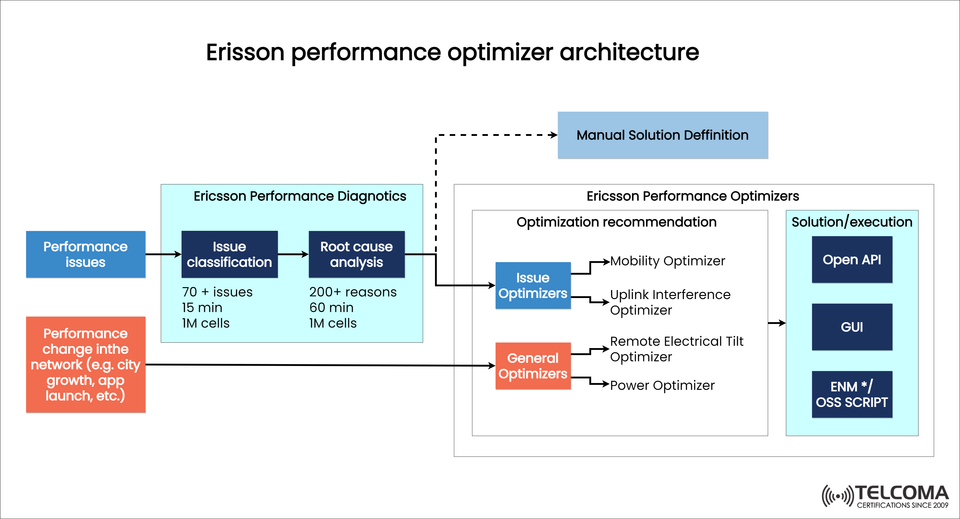
The diagram uploaded offers an in-depth view of how Ericsson’s Performance Optimizer functions. Let’s explore it step by step.
Why Network Optimization is Crucial in the 5G Era
As 5G networks roll out, operators are facing overwhelming complexity:
Higher cell density in cities.
Dynamic traffic loads from IoT, AR/VR, and video streaming.
Strict QoS (Quality of Service) demands from various industries.
Goals for energy efficiency tied to sustainability commitments.
Old-school manual optimization just can’t keep up with these growing demands. Operators are in need of AI-driven, automated optimization frameworks to stay ahead in the game.
This is precisely where the Ericsson Performance Optimizer architecture steps in.
A Look at the Ericsson Performance Optimizer
This architecture revolves around three main components:
Ericsson Performance Diagnostics – Detection of issues and root cause analysis.
Ericsson Performance Optimizers – Automated engines for fixing issues and general optimization.
Solution/Execution Layer – Various interfaces (like APIs, GUIs, scripts) that implement recommendations in real-time networks.
This flow guarantees that once an issue is detected, it can be analyzed, optimized, and executed with minimal manual input.
Step 1: Identifying Performance Issues and Network Changes
The process kicks off with performance issues in the network. These can include:
Call drops.
Handover failures.
Poor throughput.
Latency spikes.
Additionally, performance changes (like city growth, app launches, or seasonal traffic fluctuations) feed into the system.
Instead of waiting for major outages or user complaints, the optimizer keeps a close watch, continuously monitoring and categorizing these changes in almost real time.
Step 2: Ericsson Performance Diagnostics
This module serves as the brain for identifying issues within the system.
Issue Classification:
Addresses 70+ types of issues.
Processes data from 1 million cells in just 15 minutes.
Categorizes problems such as interference, congestion, or mobility-related issues.
Root Cause Analysis (RCA):
Pinpoints 200+ potential reasons for network problems.
Conducts RCA across 1 million cells in roughly 60 minutes.
Guarantees accurate identification of bottlenecks (like determining if poor uplink quality is due to interference or mobility settings).
This precision in diagnostics ensures the optimization process is targeted and effective, not just guesswork.
Step 3: Ericsson Performance Optimizers
After pinpointing the issue and its root cause, the system activates the Ericsson Performance Optimizers, which provide optimization recommendations.
These optimizers fall into two main categories:
a) Issue Optimizers
These are aimed at specific performance issues:
Mobility Optimizer: Improves handovers and cuts down on dropped calls.
Uplink Interference Optimizer: Reduces uplink noise for better throughput.
b) General Optimizers
These engines are for broader optimization to enhance network efficiency:
Remote Electrical Tilt Optimizer: Adjusts antenna tilt for better coverage.
Power Optimizer: Balances power usage, enhancing performance while being energy-efficient.
This modular approach to optimization ensures both specific solutions and overall enhancements.
Step 4: Solution & Execution Layer
To apply optimization recommendations seamlessly in the live network, Ericsson’s solution layer comes with three execution modes:
Open API: For integration with third-party systems and OSS platforms.
GUI: A user-friendly interface for operators to visualize and control.
ENM / OSS Script Execution: Allows direct automation through Ericsson Network Manager or OSS scripts.
This versatility lets operators tailor the system to fit their operational models, whether that’s fully automated or more hands-on.
Manual Solution Definition vs. Automated Optimization
The architecture also provides for manual solution definition. If operators want to apply specific policies or override auto-decisions, they can input solutions manually.
Still, the true power of Ericsson’s Performance Optimizer is in its scale of automation—reducing optimization time from days or weeks to just minutes.
Key Benefits of the Ericsson Performance Optimizer Architecture
- Speed and Scale
Handles data from 1 million cells in under an hour.
Significantly shortens issue detection and optimization cycles.
- Precision Diagnostics
Discovers 200+ root causes across many types of issues.
Guarantees optimization is based on solid RCA, not mere assumptions.
- Automation and Efficiency
Cuts down on manual network tuning.
Frees up engineering teams for more strategic planning.
- Energy Savings
The Power Optimizer and Tilt Optimizer contribute directly to energy-efficient operations.
- Improved User Experience
Mobility and interference optimizers lead to smoother connections, fewer dropped calls, and better throughput.
Ericsson Performance Optimizer in 5G Networks
5G networks, featuring massive MIMO, carrier aggregation, and dynamic spectrum sharing, are even trickier to manage compared to 4G. Ericsson’s architecture is particularly well-suited for 5G because:
It can manage multi-band, multi-layer networks.
It accommodates ultra-dense cell deployments.
It aligns with AI/ML-driven network automation strategies.
In short, it enables operators to achieve 5G-level performance without inflating operational costs.
Comparison: Traditional Optimization vs. Ericsson Performance Optimizer
Aspect Traditional Optimization Ericsson Performance Optimizer Issue Detection Manual KPIs, alarms Automated diagnostics (70+ issues)Root Cause Analysis Expert-driven, time-consuming AI-driven, 200+ root causes in 60 min Optimization Cycle Days to weeks Minutes to hours Execution Manual scripts/config changes Automated (API/GUI/ENM scripts)Scalability Limited to clusters1M cells simultaneously Efficiency Human-dependent Automated and data-driven
Future Outlook: From 5G to 6G
As we head toward 6G, optimizing performance will become even more essential due to:
AI-native networks that can self-learn.
Extreme densification with thousands of small cells per urban area.
New performance metrics like holographic communication quality or sub-millisecond latency.
Ericsson’s optimizer architecture lays the groundwork for self-optimizing networks (SON) that will support 6G.
Conclusion
The Ericsson Performance Optimizer architecture signifies a major shift in how we manage networks. By automating issue classification, root cause analysis, optimization, and execution, it enables operators to provide high-quality connectivity at scale.
From diagnosing over 70+ issues in 15 minutes to optimizing 1 million cells in real time, Ericsson’s solution does more than keep networks up and running—it ensures they operate smarter, faster, and more sustainably.
For telecom experts and network planners, adopting these intelligent frameworks isn’t just a choice anymore—it’s the way forward for mobile networks.