
Ericsson’s Dual-Mode 5G Core Solution: Architecture, Features, and Network Benefits
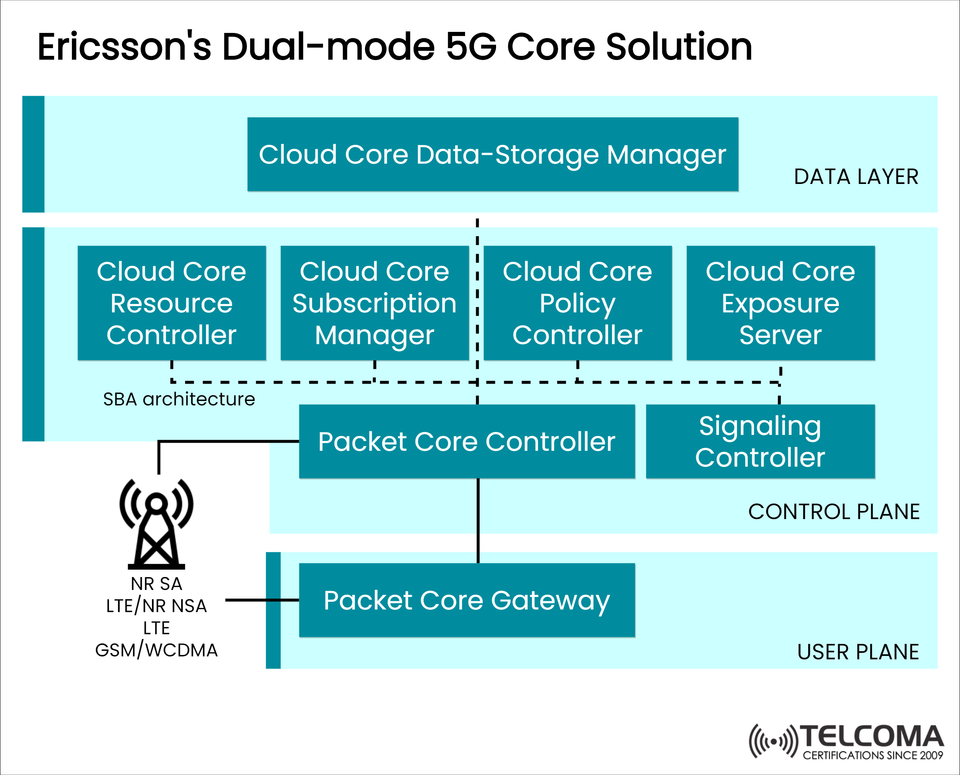

Ericsson's Dual-Mode 5G Core: Uniting LTE and 5G on a Single Platform
As telecommunications continue their evolution towards 5G Standalone (SA) systems and architectures, vendors such as Ericsson are leading the way in developing platforms that combine legacy and next-gen technologies. Brought into public discussion through industry conversations, Ericsson's Dual-mode 5G Core is a cloud-native architecture that can support both 4G (LTE, WCDMA, GSM) and 5G networks through its single core.
In this article, we will briefly take a look at the architecture, based on the image above, focusing on how Ericsson combines 5G Service Based Architecture (SBA) principles with their legacy support to produce a core that is flexible, scalable, and ready for the future.
What is Ericsson's Dual-mode 5G Core Solution?
Ericsson's solution is a multi-access, cloud-native core network:
- That supports 5G New Radio (NR) either in Standalone (SA) mode or Non-Standalone (NSA) mode
- That integrates with LTE, WCDMA and GSM networks
- That helps with a natural, cost-effective, transition to complete 5G Standalone
Core Layers of Ericsson's Dual-mode 5G Architecture
The architecture in the image, is characterized by 3 layers.
🗂️ 1. Data Layer - Manages centralized storage and access of data.
Cloud Core Data-Storage Manager
→ Manages subscriber, session and configuration data
→ Similar to the UDR (Unified Data Repository) in standard 5G SBA
🧠 2. Control Plane
In charge of network signaling, session control, policy enforcement, and exposure.
Component Function
Cloud Core Resource Controller Resource allocation reporting and network slicing
Cloud Core Subscription Manager Authentication and subscription administration
Cloud Core Policy Controller Quality of Service (QoS) and Policy decision enforcement
Cloud Core Exposure Server Exposing the network capabilities using APIs to third-party apps
Packet Core Controller Session management, mobility, and transport to user plane function (UPF)
Signaling controller Control signaling traffic and control flow of traffic between different network functions (NFs).
These control plane modules communicate using Service-Based Interfaces (SBIs) to create a complete Service-Based Architecture (SBA) compliant 5G Core.
🌐 3. User Plane
The user plane transmits and forwards user data.
Packet Core Gateway
→ The User Plane Function (UPF)
→ Routes traffic between access networks (NR, LTE, GSM, etc) and the data network
→ Supports the data plane for multiple access types (5G, 4G, 3G).
Radio Access Technologies Supported
The architecture supports multiple generations of mobile networks which are:
NR SA – 5G Standalone
LTE/NR NSA – 5G Non-Standalone
LTE – 4G
GSM/WCDMA – 2G/3G
This ensures backward compatibility and provide a means for operators to gradually modernize.
✅ Advantage:
Cloud-native by design: Containerized designs allow deployment on public or private clouds.
More efficient operational planning: Shared platform for more than one RAT provides lower operational costs
More agile: Dynamic scaling in real-time to meet demand
Simple migration pathway. Operators can migrate from NSA to SA networks with low-friction
Exposure built-in-Operators can deliver new services with an API exposure plus for enterprise, and IoT use cases.
Ericsson's solution versus traditional core
Feature
Traditional Core
Ericsson Dual-mode 5G core
Architecture
Monolithic
Cloud-native / SBA
RAT support
4G or 5G separately
4G and 5G in a single core
Scalability
Static
Dynamic and elastic
Service Exposure
Limited
Open APIs via exposure server
Migration Path
Expensive
Gradual, unified core upgrade
Conclusion:
Unified Core, Unlimited Potential
Ericsson's Dual-mode 5G core is an upgrade that's not only more than short-term technical upgrade, it opens the door directly into the future of mobile networks. Having LTE and 5G dual-mode capabilities combined into one cloud-native architecture offers operators agility, operational improvement, and use case possibilities around edge computing, private 5G, and network slicing
Deployment Considerations for Ericsson’s Dual-mode 5G Core
If you are a telecom operator and are thinking about deploying Ericsson’s Dual-mode 5G Core, you should recognize the important deployment considerations that come into play.
⚙️ Deployment Models:
• On-Premises Deployment:Applicable to MNOs with private infrastructure i.e. Governmental constraints.
• Telco Cloud (NFVI):Commits resources using virtual machines or containers on neutral, vendor-agnostic platforms(applications). For example Kubernetes.
• Public Cloud Deployment: This scenario is becoming more prevalent since it occurs where partnerships are formed between Ericsson and hyperscalers(i.e. AWS, Azure).
📶 Access Network Considerations:
Interworking with all access technologies:
• 5G NR SA (Standalone) is the ultimate and best scenario to support ultra-low latency.
• 5G NR NSA (Non-Standalone) enables you to use the legacy LTE core to build NR services.
• Legacy GSM/WCDMA/LTE is necessary to continue with coverage for the customer/business.
5G Use Cases Enabled by Ericsson’s Unified Core
Completing the picture, with SBA and multi-RAT, the Dual-mode Core is a platform for new services and revenue opportunities.
🚀 Some of the high-impact 5G use cases:
Use Case How Dual-Mode Core Enables It
Network Slicing Resource Controller provisions dedicated logical networks.
VoNR (Voice over NR) Integrate with IMS, supports NR SA.(End-End compression, Latency and XR)
IoT at Scale Policy/Subscription Manager can support millions of lightweight connections.
Private 5G Isolated deployments for enterprises and industries.
Edge Computing Localized Packet Core Gateways decrease latency .
Future's View: Where is Ericsson's Core Going
Ericsson's architecture was built for evolution. Here's what's next:
🔮 Looking Forward:
6G-Ready Architecture - AI-native / quantum-safe architecture
Advanced Analytics - NWDAF-like capabilities for predictive analytics
Full Open RAN and Cloud RAN compatible
Intent-based orchestration through AI/ML
Integration with NTN for global 5G deployments
Recommendations for Telecom Professionals
If you are assessing or deploying Ericsson's Dual-mode Core, here are some actionable steps that you can take:
📌 Actionable Recommendations:
Assess current EPC service capabilities to migrate to dual-mode core
Containerized NF services should be near the top of the priority list in order to build future capacity and infrastructure
Integrate robust API security into any 3rd party integrations and exposure layer
Prototype UPF running in an edge based configuration to enable low-latency service
Engage with cloud partners for use in hybrid or public deployment
One Core for All Generations
Ericsson's Dual-mode 5G Core is the future of mobile core, cloud-native, flexible and converged. Both 5G and legacy technology are supported natively as one platform allowing the operator the agility and control necessary to improve time-to-market, reduce costs, and begin allowing for new monetization models.