
Ericsson’s IoT Connectivity Segments with 5G NR, NB-IoT, and Cat-M: Powering Industry Digitalization
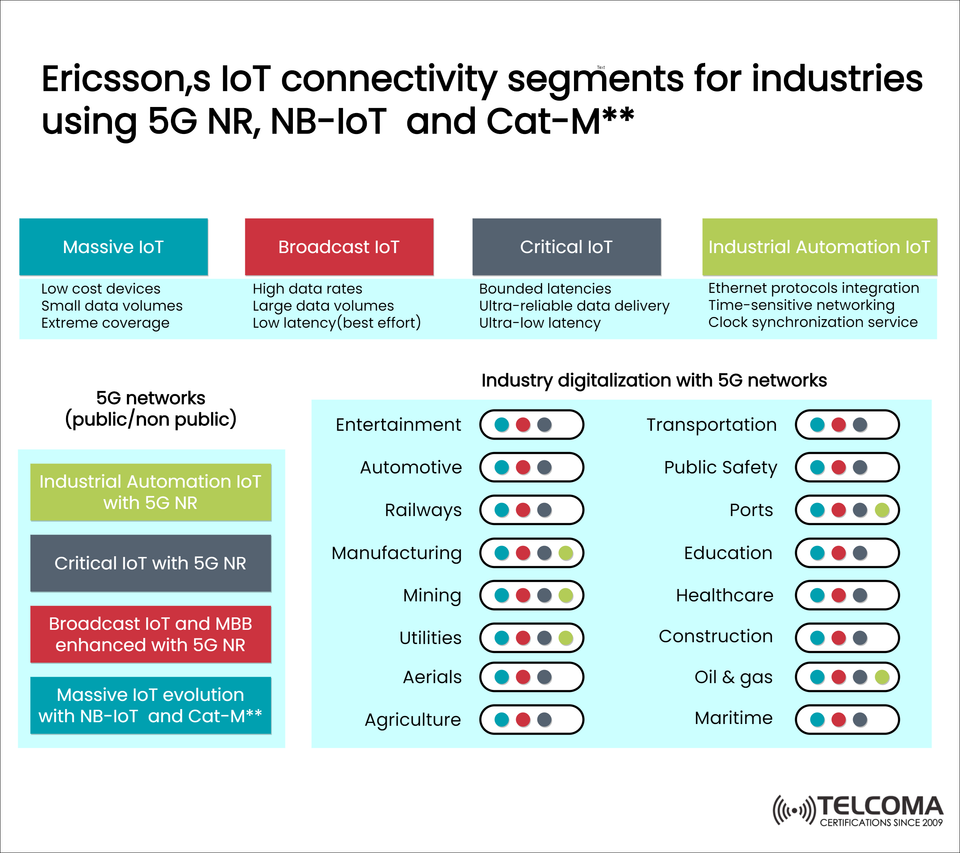

Ericsson’s IoT Connectivity Segments for Industry Digitalization
In the era of 5G, Internet of Things (IoT) connectivity has advanced from simple machine-to-machine (M2M) communication to a sophisticated network fabric that operates on an industrial scale. Ericsson breaks down industrial IoT connectivity into four main segments, each catering to different technical and business requirements. The segments, supported by 5G NR, NB-IoT, and Cat-M, play a crucial role in enabling Industry 4.0, smart cities, and the next generation of digital infrastructure.
- Massive IoT: Scalable, Low-Cost Connectivity
Definition:
Massive IoT is about linking a huge number of inexpensive devices that don’t send much data but need extensive coverage.
Key Features:
Affordable devices for scalability.
Minimal data payloads perfect for sensors and trackers.
Wide coverage in rural areas, indoors, and in hard-to-access spots.
Enabling Technologies:
NB-IoT (Narrowband IoT) for low-power, wide-area connectivity.
LTE-M / Cat-M1 for mobile capabilities and voice.
Use Cases:
Smart meters for utilities.
Sensors that monitor environmental conditions.
Agriculture IoT to keep track of livestock and crops.
- Broadcast IoT: High-Volume Data Distribution
Definition:
Broadcast IoT is designed for applications that need high data rates and large volumes of data with minimal latency, usually on a “best effort” basis.
Key Features:
High throughput for multimedia distribution.
Effective one-to-many communication setups.
Low latency for updates that need to happen quickly.
Enabling Technologies:
5G NR eMBB (enhanced Mobile Broadband) for video and data-heavy applications.
Improved multicast/broadcast protocols for cellular networks.
Use Cases:
Firmware updates for connected devices and vehicles.
Safety alerts and information sharing.
Live event streaming to mobile users.
- Critical IoT: Ultra-Reliable, Low-Latency Links
Definition:
Critical IoT is designed for situations where latency and reliability are absolutely crucial. It supports mission-critical services in automation, transportation, and healthcare.
Key Features:
Guaranteed latency—a maximum delay is promised.
Ultra-reliable data delivery (99.999%+ reliability).
Very low latency (as little as 1 ms with 5G URLLC).
Enabling Technologies:
5G NR URLLC for consistent performance.
Network slicing to ensure dedicated resources.
Use Cases:
Remote surgeries using 5G.
Control systems for autonomous vehicles.
Industrial robotics that require precise control.
- Industrial Automation IoT: Time-Sensitive Networking
Definition:
This segment combines industrial Ethernet protocols with cellular networks to address the needs of factory automation, robotics, and process control.
Key Features:
Integration of Ethernet protocols to work with existing systems.
Time-sensitive networking (TSN) for reliable communication.
Clock synchronization services for coordinated operations.
Enabling Technologies:
5G NR with TSN support for industrial settings.
Private 5G (non-public networks) for secure local control.
Use Cases:
Smart factories with interconnected machines.
Predictive maintenance in manufacturing processes.
Coordinated Automated Guided Vehicles (AGVs).
5G Networks: Public and Non-Public Deployment Models
Ericsson's framework acknowledges that IoT connectivity can be provided through:
Public 5G networks for extensive coverage and mobility.
Non-public networks (NPNs) for private, secure use within factories, campuses, or ports.
Mapping Segments to 5G Capabilities:
Industrial Automation IoT → Best suited for 5G NR in private setups.
Critical IoT → Needs specific URLLC slices whether on public or private 5G.
Broadcast IoT → Enhanced through eMBB on public 5G.
Massive IoT → Evolved using NB-IoT and Cat-M alongside 5G.
Industry Digitalization with 5G: Sector-by-Sector Impact
The visual representation shows how these four IoT segments relate to different industries:
Industry Massive IoT Broadcast IoT Critical IoT Industrial Automation IoT Entertainment
✅Automotive
✅Railways
✅Manufacturing
✅Mining
✅Utilities
✅Aerials
✅Agriculture
✅Transportation
✅Public Safety
✅Ports
✅Education
✅Healthcare
✅Construction
✅Oil & Gas
✅Maritime
Insights:
Nearly every industry requires various IoT segment types, highlighting that no single IoT solution can meet all needs.
Industrial Automation IoT is especially relevant in fields like manufacturing, ports, and mining.
Critical IoT plays a vital cross-industry role in terms of safety, control, and reliability.
How 5G NR, NB-IoT, and Cat-M Complement Each Other
NB-IoT: Ideal for massive IoT with low bandwidth requirements, extensive coverage, and long battery life.
Cat-M: Provides mobility and low-latency for moderate data rates.
5G NR: Encompasses the range from eMBB to URLLC and TSN, allowing for broadcast, critical, and industrial IoT.
Combined Strategy:
Operators and businesses can create a multi-tier IoT architecture—leveraging NB-IoT/Cat-M for widespread sensors, and using 5G NR for high-performance, low-latency applications.
Conclusion: Building the IoT-Driven Digital Economy
Ericsson’s classification of IoT connectivity into Massive IoT, Broadcast IoT, Critical IoT, and Industrial Automation IoT offers a solid framework for aligning network capabilities with industry-specific demands.
The integration of 5G NR, NB-IoT, and Cat-M forms a versatile toolkit for delivering everything from large-scale sensor networks to vital industrial automation.
For telecom professionals and enterprise decision-makers, grasping these segments is key to:
Maximizing network investments by matching capabilities with industry needs.
Crafting scalable solutions that can adapt with future 3GPP updates.
Facilitating true Industry 4.0 transformation through connectivity.
As 5G continues to develop, and we look towards 5G-Advanced, these IoT categories will become even more specialized—paving the way for 6G’s AI-native, context-aware networks. The future of connected industries will be modular, interoperable, and extremely reliable—and it all begins with an understanding of the connectivity segments that are driving today’s deployments.
The Role of Ericsson’s IoT Segments in the 5G and Beyond Roadmap
Splitting IoT into categories like Massive, Broadcast, Critical, and Industrial Automation IoT isn’t just a marketing gimmick—it’s closely linked to how 3GPP standards have evolved from Release 12 all the way to Release 19 and beyond.
Key 3GPP Milestones Relevant to IoT
Release 13-14: Standardized both NB-IoT and LTE-M.
Release 15: Launched the first phase of 5G NR, with an emphasis on eMBB and the initial capabilities for URLLC.
Release 16: Advanced URLLC features, support for TSN, and enhancements for private 5G.
Release 17: Updated NB-IoT/LTE-M within the context of the 5G core; added support for satellite IoT.
Release 18 (5G-Advanced): Focused on better AI/ML for network optimization, introduced RedCap (Reduced Capability) devices, and improved broadcast capabilities.
Release 19: Expected to delve into features that prepare us for 6G, advanced industrial automation, and hyper-reliability in multi-access.