
ETSI NFV Reference Architecture Explained: Components and Functions

Understanding the ETSI NFV Reference Architecture: Components and Functions
As telecom networks are pushed to become more flexible, scalable, and cost-effective, there’s a shift happening towards network virtualization. Traditionally, telecom relied on specialized hardware, which kept innovation and scalability in check. Here comes ETSI’s Network Functions Virtualization (NFV)—a standards-driven method that virtualizes network functions, separates them from hardware, and allows operators to roll out services more quickly and efficiently.
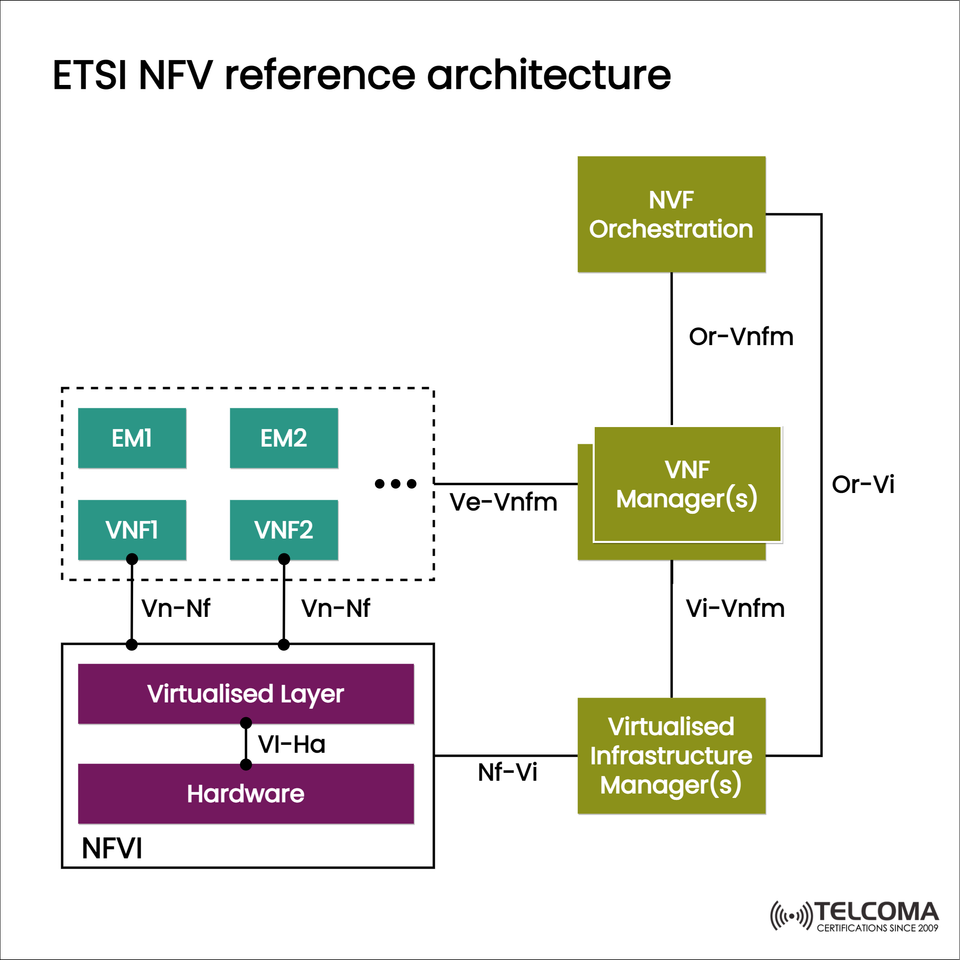
The ETSI NFV reference architecture (check out the diagram above) lays the groundwork for NFV implementation on a global scale. This article will take you through the architecture’s essential building blocks, interfaces, and management layers, aiming for clarity along with technical accuracy.
What is NFV?
Network Functions Virtualization (NFV) is a game-changer in the telecom world, substituting dedicated hardware devices (like routers, firewalls, and EPC nodes) with software-based network functions running on standard commercial hardware.
Benefits of NFV include:
Lower CAPEX and OPEX since it ditches specialized hardware.
Quicker deployment of new network services.
Improved scalability with resources that can be tapped on demand.
More flexibility thanks to centralized and distributed deployment models.
The ETSI NFV reference architecture serves as a blueprint that guarantees consistency and interoperability across various vendors and operators.
Key Components of ETSI NFV Reference Architecture
The architecture is organized into three primary domains, each playing a vital role:
NFVI (Network Functions Virtualization Infrastructure)
VNFs (Virtualized Network Functions) and EMs (Element Managers)
MANO (Management and Orchestration)
Let’s dive deeper into each one.
- NFVI: Network Functions Virtualization Infrastructure
The NFVI is the backbone of NFV, providing the environment where VNFs function.
Hardware Layer: This includes COTS servers, storage, and networking devices. Unlike traditional telecom gear, this is non-proprietary hardware, lessening reliance on exclusive solutions.
Virtualization Layer: This sets up a virtualized environment by abstracting hardware resources. It comprises hypervisors (like KVM and VMware ESXi) and container runtimes, taking charge of allocating virtual compute, storage, and network resources to VNFs.
Interfaces (Vi-Ha, Nf-Vi):
Vi-Ha: Oversees communication between the hardware and virtualization layer.
Nf-Vi: Links the NFVI with the management systems.
Together, the NFVI guarantees that physical resources are shared efficiently among multiple VNFs.
VNFs and Element Managers
Virtualized Network Functions (VNFs) are the software counterparts to traditional network functions. A few examples include:
Virtual Evolved Packet Core (vEPC)
Virtual Firewall (vFW)
Virtual IMS (vIMS)
These VNFs run in the NFVI environment and are managed by:
Element Managers (EMs): Each VNF might come with an EM to oversee lifecycle operations like configuration, fault management, and performance monitoring. EMs communicate with the VNF Manager (VNFM) through set interfaces.
VNFs’ flexibility allows operators to instantly scale and terminate services in response to traffic needs.
- MANO: Management and Orchestration
The MANO framework is the brain behind NFV architecture and consists of three main components:
NFV Orchestrator (NFVO):
Takes charge of orchestrating network services across multiple VNFs.
Manages service lifecycle management, resource allocation, and network automation.
Interfaces: Or-Vnfm (to VNFM) and Or-Vi (to VIM).
VNF Manager(s) (VNFM):
Handles the lifecycle of individual VNFs, covering instantiation, scaling, and termination.
Works closely with EMs for specific tasks.
Interfaces: Ve-Vnfm (to VNFs/EMs) and Vi-Vnfm (to VIM).
Virtualized Infrastructure Manager(s) (VIM):
Manages NFVI resources like compute, storage, and networking.
Provides resource abstraction to the VNFM and NFVO.
Examples include OpenStack, VMware vCloud Director, and Kubernetes (for CNFs).
In unison, MANO guarantees end-to-end service delivery and optimization across a diverse vendor landscape.
ETSI NFV Reference Architecture Interfaces
The architecture’s coherence relies on standardized interfaces that ensure interoperability and modularity.
Key Interfaces:
Vn-Nf: Connects VNFs and NFVI.
Ve-Vnfm: Links VNFs/EMs and VNF Managers.
Or-Vnfm: Bridges NFV Orchestrator and VNFM.
Or-Vi: Connects NFV Orchestrator and VIM.
Vi-Vnfm: Links VIM and VNFM.
Nf-Vi: Connects NFVI and VIM.
These interfaces enable plug-and-play integration, making it easier to combine VNFs, infrastructure, and management components from various vendors.
Advantages of ETSI NFV Reference Architecture
Standardization: Encourages vendor interoperability.
Service Agility: New services can be deployed faster.
Cost Efficiency: Lower hardware expenses thanks to shared resources.
Scalability: Resources can be allocated on demand.
Automation: The MANO framework supports zero-touch operations.
ETSI NFV Reference Architecture vs. Traditional Networks
Feature Traditional Networks NFV with ETSI Architecture Hardware Proprietary appliances COTS hardware Deployment Static and slow Dynamic and fast Scalability Limited Elastic and automated Cost High CAPEX & OPEX Reduced CAPEX & OPEX Management Vendor-specific Standards-based, multi-vendor
This transition represents a fundamental shift in how telecom networks are designed and run.
Real-World Applications of NFV
5G Core Networks: Virtualized EPC and IMS help speed up 5G rollouts.
Enterprise Services: Things like virtual firewalls, WAN optimization, and VPNs.
IoT Enablement: Scalable VNF deployment for a massive number of IoT devices.
Edge Computing: VNFs can be deployed at the edge for low-latency applications.
Thanks to NFV, operators can create new revenue opportunities while simplifying their operations.
Conclusion
The ETSI NFV reference architecture is a crucial piece in the telecom industry’s journey from rigid, hardware-based networks to flexible, software-driven ecosystems. By clarifying the roles of NFVI, VNFs/EMs, and MANO, and standardizing the interfaces that connect them, ETSI ensures global compatibility and scalability.
For telecom experts, getting a grasp on this architecture is key to navigating today’s network evolution. NFV not only fuels 5G deployments but also lays the groundwork for future advancements like cloud-native 6G networks, edge intelligence, and AI-driven orchestration.
As networks continue to evolve, the ETSI NFV architecture provides the essential framework for building programmable, automated, and efficient telecom systems for the future.