
Evolution of 5G and 6G Spectrum Bands: Frequency Ranges, Capacity, and Coverage Explained

Exploring the Shift from 5G to 6G Spectrum: Moving from MHz to THz Frequencies
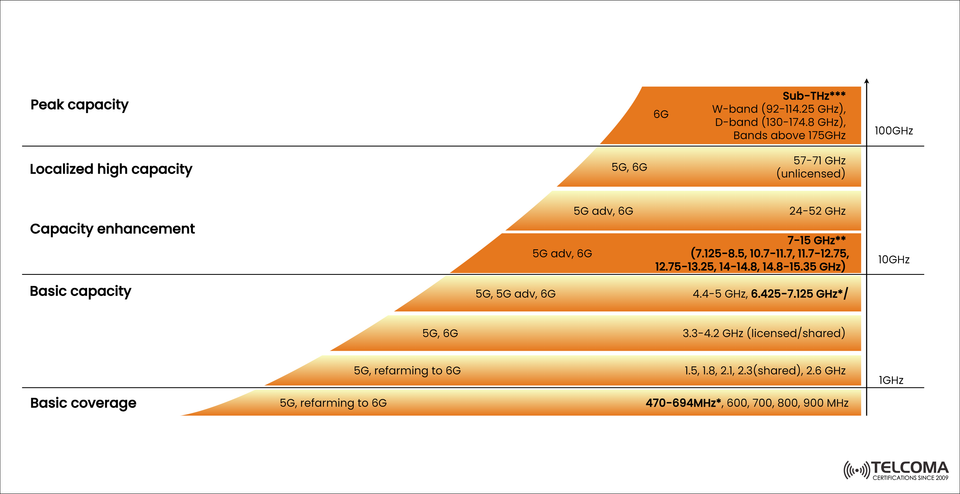
The transition from 5G to 6G isn't just about faster speeds — it’s really a complete overhaul of how we use the spectrum. The graphic above illustrates the frequency spectrum roadmap for 5G, 5G Advanced (5G Adv), and 6G, highlighting how different frequency ranges offer different capacities and coverage levels.
In simple terms, as we shift to higher frequencies, we gain capacity and data rates but lose out on coverage and penetration. This balancing act influences how telecom companies design and roll out their networks, aiming for both broad coverage and super-fast localized areas.
The Base Layer: Fundamental Coverage Bands
At the bottom of the spectrum hierarchy are the basic coverage bands, crucial for ensuring wide-area connectivity. These frequencies generally fall below 1 GHz.
Frequency Range Usage Technologies Key Features470–694 MHz Traditional broadcast, re-farming for mobile5G, future 6GGreat penetration and coverage600, 700, 800, 900 MHz Cellular communication5G, re-farming to 6GLong-range coverage, perfect for rural areas
These lower frequency bands have the longest wavelengths, which helps signals travel further and easily penetrate structures. They provide the essential coverage, but their restricted bandwidth means data speeds aren’t that fast. So, they form the foundational layer for both 5G and the upcoming 6G networks.
Adding Capacity: Basic and Enhanced Capacity Bands
As networks evolve, more mid-band spectrum comes into play to strike a balance between coverage and capacity. These frequency ranges work best for suburban and urban settings, where data demand is high but wide coverage is still important.
Basic Capacity Bands (1–10 GHz)
This category includes:
1.5 GHz, 1.8 GHz, 2.1 GHz, 2.3 GHz (shared), 2.6 GHz
3.3–4.2 GHz (licensed/shared)
4.4–5 GHz
6.425–7.125 GHz (future allocation)
Applications:
Used for 5G and 5G Advanced deployments.
Offers moderate to high data rates with suitable coverage.
Best suited for smart cities, industrial IoT, and connected mobility.
The mid-band spectrum (3.3–7.125 GHz) acts as the workhorse for 5G, providing a nice mix of speed and range. Looking ahead to 6G, there's a plan to push this up to 7.125 GHz for even more capacity.
Capacity Enhancement Bands (7–52 GHz)
To handle rising user demand, we need higher frequencies, which include:
7.125–8.5 GHz
10.7–11.7 GHz
11.7–12.75 GHz
12.75–13.25 GHz
14–15.35 GHz
24–52 GHz (mmWave)
These bands, often labeled as millimeter-wave (mmWave) spectrum, provide huge bandwidth, allowing for multi-gigabit speeds. They're vital for:
Crowded locations like stadiums and airports.
Private 5G networks for big businesses.
Edge computing areas.
That said, these high-frequency signals can struggle with coverage and easily get blocked by things like walls and trees. So, they’re typically used in localized setups with small cells or beamforming tech.
Localized High Capacity: The Cutting Edge of Ultra-Broadband
With the growing need for real-time, data-heavy apps like AR/VR, autonomous systems, and holographic communication, even higher frequencies are being considered. This level, dubbed localized high capacity, ranges from 57–71 GHz (unlicensed band) — often called the V-band.
Key Characteristics:
Extremely high bandwidth (multi-gigahertz channels).
Perfect for hotspots, campus networks, and short-range backhaul.
Capable of ultra-low latency and high throughput.
Both 5G Advanced and 6G are set to leverage these frequencies for ultra-localized high-performance scenarios, complementing lower-band connectivity.
Peak Capacity: The Sub-THz Era of 6G
At the pinnacle of the spectrum hierarchy is the Sub-Terahertz (Sub-THz) range — seen as the ultimate goal for 6G. These frequencies, from 92 GHz to over 175 GHz, will transform wireless capabilities.
Sub-THz Frequency Bands:
W-band: 92–114.25 GHz
D-band: 130–174.8 GHz
Bands above 175 GHz
Features and Perks:
Incredible data rates (possibly exceeding 100 Gbps).
Ultra-low latency, perfect for real-time uses like holographic telepresence and digital twins.
High spatial resolution, great for sensing and imaging.
Support for AI-native networks, allowing smart and adaptable communication links.
The Sub-THz spectrum is key to bringing 6G’s vision of “connected intelligence” to life, enabling seamless interaction between humans and machines, along with fully autonomous systems.
Spectrum Evolution from 5G to 6G
Spectrum Tier Frequency Range Primary Use Technology Basic Coverage470–900 MHz Wide-area coverage5G, re-farming to 6GBasic Capacity1–7 GHz Balanced speed and coverage5G, 5G Adv, 6GCapacity Enhancement7–52 GHz High data rates5G Adv, 6GLocalized High Capacity57–71 GHz Ultra-high throughput (short range)5G, 6GPeak Capacity (Sub-THz)92–175+ GHz Extreme speed, ultra-low latency6G
This evolution showcases how each new generation builds off the existing framework. 6G won’t completely replace 5G but will enhance it, merging sub-THz frequencies with AI-equipped, cloud-native formats.
Challenges and Considerations in High-Frequency Deployment
Though higher frequencies hold the promise of vast capacity, they also present some technical hurdles:
Propagation Loss
Sub-THz waves face significant path loss, which means we’ll need advanced beamforming, reconfigurable intelligent surfaces (RIS), and a lot of small cells.
Hardware Limitations
Creating effective transceivers, antennas, and power amplifiers at sub-THz frequencies is both challenging and pricey.
Spectrum Regulation
Harmonizing and allocating global spectrum for 6G requires cooperation among international regulatory bodies like ITU and 3GPP.
Energy Efficiency
Working at these high frequencies can ramp up power consumption. So, energy-efficient network design is a big focus for 6G research.
The Future: Merging AI and Sensing into 6G Spectrum Use
6G networks won’t just focus on communication; they’ll also bring in sensing, computing, and AI. Using Sub-THz frequencies allows networks to sense their surroundings, which improves localization accuracy and security. With AI-driven spectrum management, frequencies can be dynamically allocated based on real-time conditions and demand.
Future applications like metaverse connectivity, remote surgery, autonomous transport, and industrial automation will depend on this blend of communication and intelligence.
Conclusion
The shift from 5G to 6G spectrum represents a new chapter in wireless communication — from basic coverage in sub-GHz bands to peak capacity in sub-THz frequencies. Each frequency tier serves a unique purpose in balancing coverage, capacity, and performance.
As we move forward with 6G research, telecom engineers and policymakers need to address the challenges related to spectrum efficiency, energy optimization, and global harmonization. The end goal is to create a network ecosystem that not only connects people but also empowers machines, cities, and entire industries with unmatched speed and intelligence.