
Evolution of Full Duplex Communication in 5G NR: From Release 18 to Release 19 and Beyond

The Evolution of Full Duplex Communication in 5G NR: From Release 18 to Release 19 and Beyond
The 5G landscape is changing quickly, pushing the limits of how we use spectrum, cut down on latency, and ramp up throughput. One of the biggest advancements in this journey is the launch of Full Duplex (FD) communication. This allows for simultaneous uplink (UL) and downlink (DL) transmissions on the same frequency.
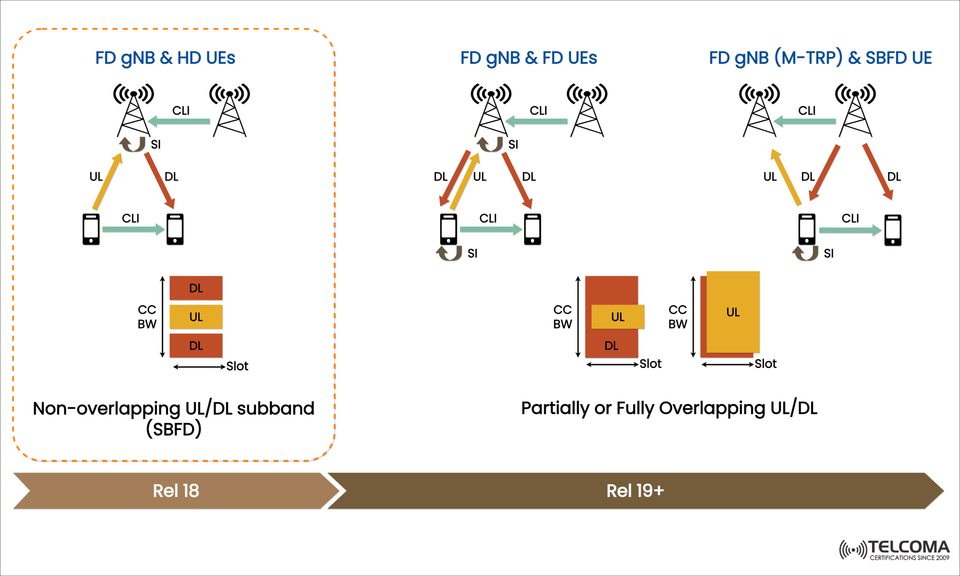
The image shared shows a clear progression from Release 18 (Rel-18) to Release 19 and beyond (Rel-19+), emphasizing how Full Duplex (FD) and Half Duplex (HD) systems develop together to achieve top-notch 5G efficiency.
Background: Duplexing in Wireless Communication
Duplexing in wireless communication deals with how uplink (data going from user to base station) and downlink (data going from base station back to user) are organized over time and frequency.
The main duplexing methods are:
Frequency Division Duplex (FDD): Uses separate frequency bands for UL and DL.
Time Division Duplex (TDD): Shares the same frequency band between UL and DL, but uses different time slots for each.
Full Duplex (FD): Allows UL and DL to happen at the same time on the same time-frequency resources.
While FDD and TDD have been common in LTE and the early stages of 5G, Full Duplex seeks to double spectrum efficiency by supporting simultaneous UL and DL transmissions—bypassing the limitations of traditional duplexing methods.
Understanding the Image: The Shift from Rel-18 to Rel-19+
The diagram is split into two main phases:
Release 18: Features non-overlapping UL/DL subbands (SBFD).
Release 19+: Showcases partially or fully overlapping UL/DL (FD communications).
These highlight the industry's gradual move towards true full-duplex operation in both network nodes (gNBs) and user equipment (UEs).
Release 18 – Non-overlapping UL/DL Subband (SBFD)
In 3GPP Release 18, the emphasis is on Subband Full Duplex (SBFD), where uplink and downlink utilize separate subbands within the same carrier bandwidth (CC BW).
Key Components in Rel-18 Setup:
FD gNB (Full Duplex base station)
HD UEs (Half Duplex User Equipment)
Here’s how it operates:
The gNB works in full duplex mode, meaning it can transmit (DL) and receive (UL) simultaneously.
On the other hand, the UEs work in half duplex, allowing them to either transmit or receive at any moment, but not both.
The UL/DL subbands are non-overlapping, which helps reduce interference.
Mechanisms and Signals:
SI (Self-Interference): Interference caused by a node’s own transmission, which needs to be suppressed for FD operations.
CLI (Cross-Link Interference): Interference that occurs between uplink and downlink transmissions across various nodes or UEs.
The diagram shows these dynamics with arrows indicating UL, DL, SI, and CLI paths.
Technical Characteristics:
Bandwidth separation: Each UL/DL pair works in distinct subbands.
Spectral efficiency gain: Moderate (in comparison to TDD), as simultaneous transmissions are limited.
Interference management: Handled through careful subband allocation.
This setup serves as a stepping stone—introducing FD concepts at the base station level without needing full FD UEs.
The image presents two new configurations that show this advancement:
FD gNB & FD UEs
FD gNB (M-TRP) & SBFD UEs
FD gNB & FD UEs: True Full Duplex Communication
In this configuration, both the base station (gNB) and user equipment (UE) are full duplex-capable.
This means:
UL and DL transmissions happen at the same time within the same carrier component bandwidth (CC BW).
UL and DL can be partially or fully overlapping in both frequency and time domains.
Key Features:
Simultaneous UL/DL: Allows for real-time, two-way communication on the same resources.
Self-Interference Cancellation (SI): Advanced algorithms for SI suppression let transmit and receive signals coexist.
Cross-Link Interference (CLI) Control: Improved coordination among UEs and gNBs minimizes interference during simultaneous UL/DL links.
Benefits:
Higher spectral efficiency: Nearly doubles utilization compared to TDD/FDD.
Lower latency: Gets rid of UL-DL switching delays.
Simplified resource scheduling: Dynamic spectrum sharing becomes more straightforward.
Challenges:
Hardware complexity: Needs advanced transceiver designs for SI suppression.
Network synchronization: Requires tight coordination to avert CLI.
FD gNB (M-TRP) & SBFD UEs: Multi-TRP and Semi-Full Duplex Integration
Here, the gNB employs a Multi-Transmission and Reception Point (M-TRP) configuration, supporting FD operations at the network side, while UEs work in SBFD mode.
This approach enables multiple TRPs to coordinate overlapping UL/DL flows—ensuring:
Smooth coordination between distributed antennas.
Better spatial diversity and interference suppression.
Enhanced link reliability even with half-duplex UEs.
The rightmost part of the diagram illustrates overlapping UL/DL data blocks, showing shared frequency-time resources under the Rel-19+ standards.
The Role of Interference Management
Effective interference management is crucial for the success of full duplex. Two main interference types are:
Self-Interference (SI): Happens when a transceiver’s output leaks into its receiver path. This can be reduced using both analog and digital cancellation strategies.
Cross-Link Interference (CLI): Occurs between devices transmitting and receiving in nearby frequency bands. This is handled through coordinated scheduling, spatial beamforming, and power control.
Spectral Efficiency and Performance Impact
With full-duplex technology, the potential performance boosts are significant:
Throughput improvement: Up to 2× spectral efficiency under ideal conditions.
Latency reduction: Simultaneous UL/DL means no scheduling gaps.
Energy efficiency: Less time spent transmitting for the same data volume.
Enhanced reliability: Especially in MIMO and Multi-TRP setups.
These gains align perfectly with the goals of 5G Advanced (5G-A) and 6G—setting the stage for ultra-low-latency, high-throughput applications like XR (Extended Reality), autonomous systems, and the tactile Internet.
Real-World Applications and Use Cases
Industrial Automation: Real-time management of robotic systems with feedback loops that run simultaneously.
Autonomous Vehicles: Uplink telemetry and downlink control signaling occurring at the same time.
Immersive XR Streaming: Two-way data exchange for haptic feedback.
Edge Computing Integration: Continuous UL/DL synchronization for AI inference.
As devices and infrastructure embrace full duplex capabilities, these applications are set to become stronger and more responsive.
Conclusion
The shift from 3GPP Release 18 to Release 19+ represents a pivotal evolution in 5G NR duplexing technology. Moving from non-overlapping subbands (SBFD) to fully overlapping UL/DL full-duplex operation opens up new possibilities for spectral efficiency and reduced latency performance.
With the incorporation of FD gNBs, FD UEs, and cutting-edge interference management, 5G networks are paving the way for 6G-ready full-duplex communication—allowing true real-time, intelligent, and seamless wireless interactions across all domains.
In short, Full Duplex 5G goes beyond just doubling capacity—it’s all about redefining how networks operate, adapt, and communicate in the moment.