
Evolution of LTE Data Transfer Capabilities: From LTE to LTE-A Pro

The Journey of LTE Data Transfer: From LTE to LTE-A Pro
Telecommunications tech has seen some amazing changes in the last ten years, especially when it comes to data transfer capabilities. Long Term Evolution (LTE) has progressed into LTE-Advanced (LTE-A) and then into LTE-Advanced Pro (LTE-A Pro), meeting the growing needs for high-speed internet, IoT, streaming, and essential communications.
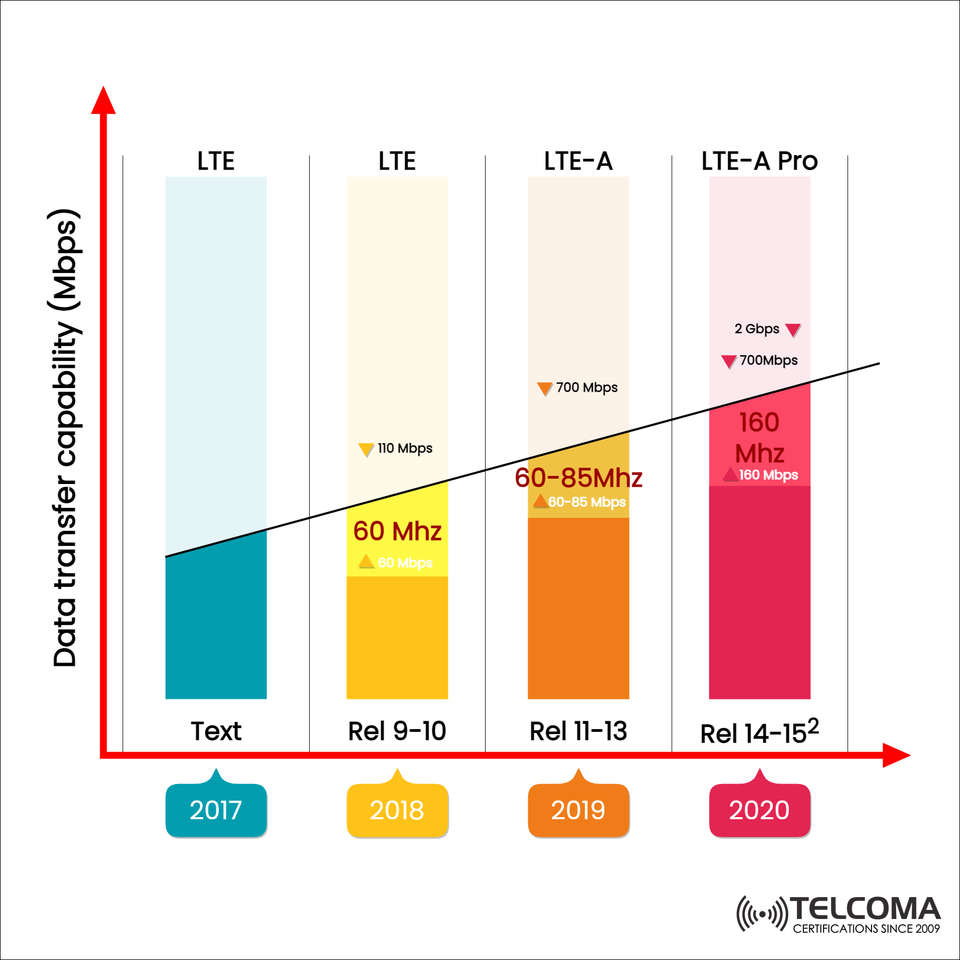
The image shared shows how this development unfolded, illustrating the bandwidth growth, throughput improvements, and the various releases (Rel 9–15) that influenced LTE's journey. In this post, we’ll dive into how LTE transitioned from basic data rates to multi-gigabit speeds and set the stage for 5G.
Quick Overview of LTE Evolution
Here’s a summary table of key LTE evolution milestones based on the image:
| Standard | Release Year | Bandwidth | Peak Data Rate |
| LTE Text | 2017 | -- | -- |
| LTE (early) | Rel 9–10 | 2018 | ~60 MHz | ~60–110 Mbps |
| LTE-Advanced | Rel 11–13 | 2019 | 60–85 MHz | ~700 Mbps |
| LTE-Advanced Pro | Rel 14–15 | 2020 | ~160 MHz | 700 Mbps – 2 Gbps |
This timeline highlights how spectrum aggregation, carrier aggregation (CA), and advanced modulation techniques played a big role in boosting speeds.
LTE (Text / Early Stage – Pre-Rel 9)
Before any major upgrades kicked off with 3GPP Release 9, LTE laid down the groundwork for high-speed packet access by introducing:
OFDMA (Orthogonal Frequency Division Multiple Access): Improving downlink transmission.
SC-FDMA (Single Carrier Frequency Division Multiple Access): For uplink, which helps keep device power use low.
Basic spectrum usage: Small bandwidth with fair throughput.
During this initial phase, LTE set up a framework for future growth, but it had limited peak speeds compared to today’s standards.
LTE Rel 9–10 (2018): Building the Foundation
3GPP Release 9 and 10 marked the real start of LTE enhancements.
Key Features Introduced:
Carrier Bandwidth: About 60 MHz.
Peak Throughput: Between 60 Mbps and 110 Mbps.
Improved MIMO (Multiple Input Multiple Output): Better spectral efficiency.
Dual-Layer Transmissions: Enhancing throughput under good radio conditions.
By this stage, LTE became commercially viable, delivering significant upgrades over 3G and enabling early 4G features like HD video streaming and VoIP.
LTE-Advanced (Rel 11–13, 2019): A Significant Leap
By 2019, with the rise in demand for data-heavy applications like 4K video streaming, IoT connections, and online gaming, there was a need for stronger solutions. That’s where LTE-Advanced (LTE-A) came into play, introduced with 3GPP Releases 11–13.
Key Enhancements in LTE-A:
Carrier Aggregation (CA): Merged multiple spectrum blocks (60–85 MHz effective bandwidth).
Upgraded Massive MIMO: Supporting higher-order MIMO setups.
Peak Data Rate: Increased to around 700 Mbps.
Better Interference Management: For urban areas with high density.
Support for Heterogeneous Networks (HetNets): Integrating small cells for better coverage.
This phase shifted LTE from being just “faster internet” to becoming a solid platform for advanced mobile broadband services.
LTE-Advanced Pro (Rel 14–15, 2020): Prepping for 5G
By 2020, as the industry prepped for 5G, LTE had to stay relevant for operators heavily involved in 4G infrastructure. That’s when LTE-Advanced Pro (LTE-A Pro) came onto the scene.
Key Features of LTE-A Pro:
Massive Carrier Aggregation: Effective bandwidth grew to 160 MHz.
Peak Throughput: Ranging from 700 Mbps to 2 Gbps.
256-QAM (Quadrature Amplitude Modulation): Boosted spectral efficiency.
Licensed Assisted Access (LAA): Using unlicensed spectrum for added capacity.
IoT Enhancements: Backing for NB-IoT and LTE-M to connect billions of IoT devices.
Improved Energy Efficiency: Making networks more cost-effective to run.
LTE-A Pro acted as a bridge to 5G, providing nearly 5G speeds while utilizing the existing LTE framework.
What Drove LTE Evolution
The leap from LTE to LTE-A Pro wasn’t just about securing more spectrum; it relied on several key innovations:
Carrier Aggregation (CA): The technique of merging fragmented spectrum bands.
Higher Modulation Orders: Transitioning from 64-QAM to 256-QAM.
MIMO Progression: From 2x2 MIMO in early LTE to configurations like 8x8 in LTE-A Pro.
Better Scheduling Algorithms: Maximizing the use of radio resources.
Small Cell Integration: Enhancing capacity in hotspots.
Energy-Efficient Networking: Aligning with green telecom initiatives.
These advancements made LTE not just faster but also more scalable and efficient.
LTE Evolution: What It Means for Users and Operators
Benefits to Users:
Speedy Internet: Smooth 4K/8K streaming and low-latency gaming.
Enhanced Coverage: Thanks to small cell rollouts and HetNets.
Increased Reliability: Networks that can handle high traffic effectively.
Benefits to Operators:
Future-Proof Investments: LTE-A Pro facilitates a gradual shift to 5G.
IoT Integration: New market opportunities with LTE-M and NB-IoT.
Higher ARPU (Average Revenue Per User): Through premium high-speed data offerings.
LTE-A Pro as a Bridge to 5G
Even though LTE-A Pro provided gigabit-class speeds, it wasn’t merely about the speed. It laid the groundwork for 5G’s ultra-reliable low-latency communication (URLLC) and massive machine-type communication (mMTC).
Key impacts include:
Showcasing the potential of spectrum sharing (both licensed and unlicensed).
Setting up RAN architectures for network slicing.
Boosting IoT scalability, an essential requirement for 5G.
So, LTE-A Pro can be seen as the final step in LTE evolution before we fully embrace 5G.
Challenges in LTE Evolution
Despite its achievements, the evolution of LTE had its hurdles:
Spectrum Scarcity: Carrier aggregation needed access to multiple bands.
Device Compatibility: Phones needed updated chipsets to utilize LTE-A features.
Cost of Deployment: Upgrading infrastructure required significant investment.
Latency Issues: Although improved, latency still didn’t match 5G goals.
Wrapping It Up
The journey of LTE from basic LTE to LTE-A Pro showcases the telecom industry’s drive for greater speeds, better efficiency, and wider connectivity.
LTE Rel 9–10 laid the groundwork, achieving ~60–110 Mbps.
LTE-A (Rel 11–13) upped the bandwidth and reached ~700 Mbps.
LTE-A Pro (Rel 14–15) stretched LTE to its max, hitting up to 2 Gbps and setting the stage for 5G.
For telecom professionals, this evolution highlights the importance of carrier aggregation, advanced MIMO, and spectrum efficiency in shaping mobile broadband. For users, it means faster and more dependable services.
As we step into the 5G age, LTE-A Pro will continue to play a crucial role in the network ecosystem, ensuring that the investments in LTE keep offering value while helping transition to next-gen networks.