
Evolution of Traditional Base Station Architecture: From Black Box to O-RAN and Cloud-Native RAN
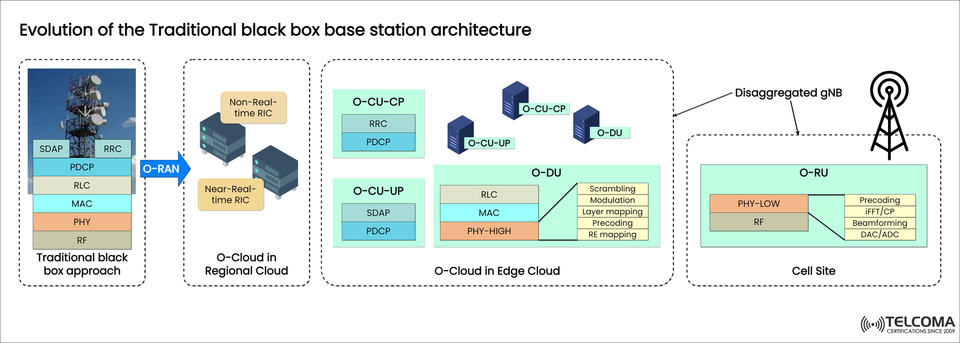

Evolution of the Traditional Black Box Base Station Architecture
Telecom networks are really changing. Those old proprietary, hardware-locked base stations that supported 3G and 4G are now being reshaped by Open Radio Access Network (O-RAN) principles—bringing in openness, cloud-native setups, and AI-driven optimization.
The diagram uploaded shows this shift clearly—from a monolithic black box RAN to a disaggregated, cloud-based O-RAN architecture made up of modular functional units like O-CU, O-DU, and O-RU.
Let’s break down this evolution step by step and see why it’s crucial for the 5G and 6G era.
Traditional “Black Box” Base Station: The Closed Era
In older networks (2G, 3G, and early 4G), base stations were essentially proprietary black boxes. Each vendor—be it Nokia, Ericsson, or Huawei—delivered integrated systems that combined both hardware and software.
Key Characteristics:
Vendor Lock-in: Operators had to rely on one vendor for all hardware and software.
Limited Interoperability: Gear from different suppliers couldn’t easily connect.
Hardware-dependent Upgrades: Scaling or upgrading meant costly, vendor-specific hardware.
Static Architecture: There wasn’t much flexibility in launching new services or optimization features.
Architecture Layers:
The traditional setup included:
RF (Radio Frequency): Deals with analog/digital signal transmission.
PHY (Physical Layer): Handles modulation, coding, and channel estimation.
MAC, RLC, PDCP, SDAP, RRC: Protocol layers that take care of scheduling, data segmentation, and signaling.
These functions all ran on dedicated hardware at the cell site, making for a tightly coupled, rigid system.
The Need for Openness: Enter O-RAN
As 5G demands low latency, high bandwidth, and massive IoT connectivity, those traditional base stations started to feel like a bottleneck.
Operators wanted an open, interoperable, and software-defined RAN, which led to the development of O-RAN (Open Radio Access Network)—a framework created by the O-RAN Alliance aimed at standardizing interfaces and encouraging vendor diversity.
O-RAN Objectives:
Disaggregation: Split hardware and software functions.
Virtualization: Run RAN components as cloud-native apps.
Intelligence: Bring in AI-driven network optimization via RAN Intelligent Controllers (RICs).
Openness: Allow multi-vendor interoperability using open interfaces like F1, E2, A1, and O1.
This shift in architecture is reflected in the image—moving from a single integrated black box to a cloud-distributed, software-centric architecture.
Disaggregation Explained: The Three Key Units
With O-RAN, the traditional base station (gNB) is broken down into three logical parts:
Unit | Full Form | Location | Main Functions
O-CU (Centralized Unit) | Handles higher layer functions | Regional cloud | RRC, SDAP, PDCP
O-DU (Distributed Unit) | Manages real-time lower layers | Edge cloud | RLC, MAC, PHY-high
O-RU (Radio Unit) | Executes RF and PHY-low functions | Cell site | RF, precoding, beamforming, iFFT/CP
Functional Split:
O-CU-CP (Control Plane): Deals with signaling (RRC, PDCP).
O-CU-UP (User Plane): Manages data (SDAP, PDCP).
O-DU: Processes real-time tasks like scheduling and modulation.
O-RU: Converts digital signals to analog (and vice versa) for over-the-air transmission.
This modular approach lets operators deploy, scale, and upgrade each part independently.
Cloudification: The O-Cloud Advantage
As you can see from the image, O-RAN brings in the O-Cloud, a cloud infrastructure layer that hosts the O-RAN software components.
Types of O-Cloud:
Regional Cloud (O-CU layer):
Hosts O-CU-CP and O-CU-UP.
Works with Non-Real-Time RIC for AI/ML policy decisions.
Edge Cloud (O-DU layer):
Hosts the O-DU, located near the cell site to keep latency low.
Collaborates with Near-Real-Time RIC for dynamic resource optimization.
This cloud-native RAN method guarantees elastic scalability, automation, and AI-driven performance optimization.
RIC: The Intelligence Layer of O-RAN
At the core of O-RAN’s innovation is the RAN Intelligent Controller (RIC)—a key component that empowers programmability and intelligence in the network.
RIC Components:
Non-Real-Time RIC:
Lives in the service management and orchestration (SMO) layer.
Operates on timescales of seconds to hours.
Utilizes AI/ML models for long-term optimization (like energy saving, interference management).
Near-Real-Time RIC:
Located closer to the O-DU.
Functions in 10 milliseconds to 1 second.
Manages real-time tasks like traffic steering, handovers, and load balancing.
RIC Benefits:
Reduces network congestion.
Enhances user experience through predictive analytics.
Allows third-party “xApps” and “rApps” for tailored optimization.
RIC basically transforms RAN from a static system into a self-optimizing network (SON).
Inside the Disaggregated gNB: Functional Breakdown
The far right section of the diagram illustrates how the disaggregated gNB functions across the O-CU, O-DU, and O-RU domains.
O-CU Layer:
Control Plane (O-CU-CP):
Functions: RRC and PDCP.
Manages signaling, session control, and mobility management.
User Plane (O-CU-UP):
Functions: SDAP and PDCP.
Handles user data and Quality of Service enforcement.
O-DU Layer:
Functions: RLC, MAC, PHY-HIGH.
Tasks: Scheduling, HARQ, coding, and modulation.
Supports scrambling, precoding, and resource element mapping.
O-RU Layer:
Functions: PHY-LOW and RF.
Manages real-time radio transmission, beamforming, and analog-to-digital conversions.
Performs iFFT/CP, precoding, and DAC/ADC tasks at the cell site.
This functional disaggregation allows flexible deployment across cloud layers, all while keeping ultra-low latency.
Advantages of O-RAN and Cloud-Native RAN
Key Benefits for Operators:
- Vendor Interoperability
Open interfaces let equipment from various vendors work together.
Lowers CAPEX and OPEX by avoiding vendor lock-in.
- Cloud Agility
Network functions operate on virtual machines or containers.
Operators can deploy functions where needed (regional, edge, or cell site) in a dynamic manner.
- AI and Automation
RIC enables real-time optimization using AI/ML technologies.
Networks become adaptive—responding to congestion, interference, and energy usage on their own.
- Cost Efficiency
Standardized hardware can replace specialized equipment.
Software updates can prolong hardware lifespan.
- Scalability and Flexibility
Fast deployment of new services or small cells with containerized setups.
Supports a variety of 5G use cases—like enhanced mobile broadband, URLLC, and mMTC.
Challenges in Implementing O-RAN
Despite the many benefits, moving from traditional RAN to O-RAN carries some challenges:
Integration Complexity: Making sure everything works well between vendors.
Timing Synchronization: Keeping ultra-low latency across all parts.
Security: Open interfaces can create new vulnerabilities.
Performance Overheads: Virtualization might add latency if not managed well.
Ecosystem Maturity: Some O-RAN solutions are still being worked out in terms of standards.
Telecom companies are tackling these issues through testing frameworks, multi-vendor interoperability labs, and AI-driven orchestration.