
Evolution to Transport for 5G Mobile Networks: Fronthaul, Backhaul, and Beyond

The Shift in Transport for 5G Mobile Networks
5G is so much more than just faster internet—it’s about building a fully integrated, scalable, and flexible system that can cater to a variety of needs, from massive IoT applications to ultra-reliable low-latency communications. At the heart of this system are transport networks, which link access, cloud, applications, and management into one seamless experience.
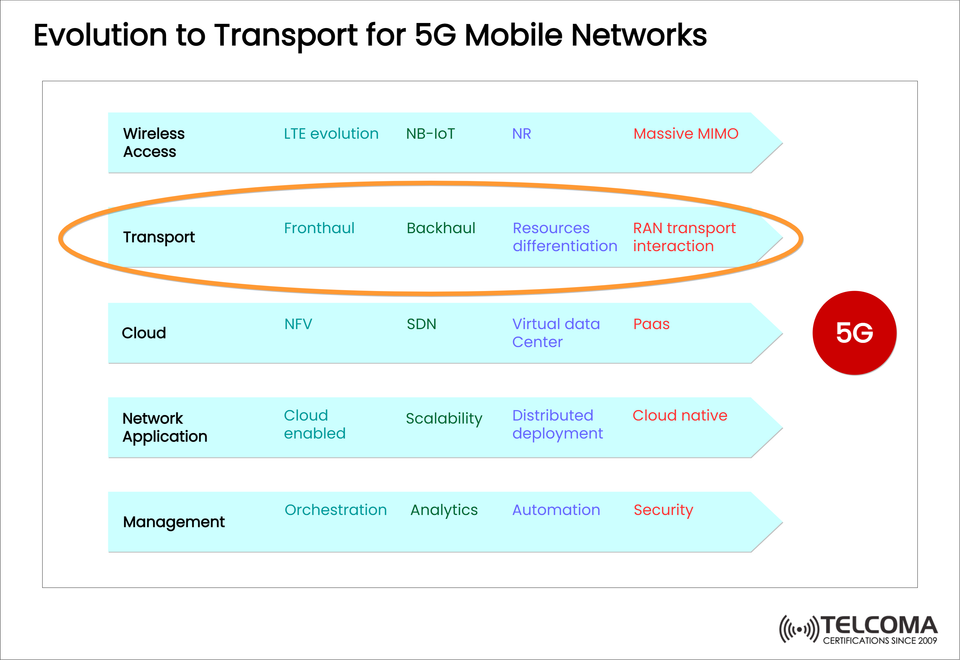
The framework we’ve shared shows how transport is evolving to meet the requirements of 5G mobile networks, establishing it as the backbone that facilitates smooth communication between Radio Access Networks (RAN), cloud infrastructure, and network applications.
In this blog, we’ll dive into each layer of this architecture and shed light on how transport interacts with fronthaul, backhaul, resource management, cloud systems, and orchestration to turn 5G into a reality.
The Importance of Transport in 5G
In mobile networks, transport acts as the connector between the wireless access side (like radio) and the core and cloud applications.
For 5G, this area needs to adapt to handle:
High bandwidth demand driven by 5G NR (New Radio) and Massive MIMO technology.
Ultra-low latency crucial for applications like AR/VR, V2X, and autonomous systems.
Dynamic resource allocation to meet the varied needs of different network slices.
Cloud-native deployment, where VNFs (Virtual Network Functions) and CNFs (Cloud-native Network Functions) depend on fast, reliable connections.
This shift changes transport from a static channel to an intelligent, adaptable network structure.
Wireless Access: What’s Driving Changes in Transport
The top tier of our framework showcases the advancements in wireless access that impact transport networks:
LTE Evolution: Sets the groundwork by enhancing data throughput and reducing latency.
NB-IoT: Brings extensive connectivity for low-power, wide-area devices.
5G NR (New Radio): Enables flexible spectrum usage, higher mmWave frequencies, and dynamic bandwidth allocation.
Massive MIMO: Boosts spectrum efficiency but also leads to a significant increase in data traffic that needs transporting.
These innovations in access call for strong and scalable transport solutions that can handle the unprecedented levels of throughput and differing quality of service (QoS) requirements.
Transport: The Interplay of Fronthaul, Backhaul, and RAN
This layer is pivotal in the 5G setup. Our framework identifies four key transport pillars:
- Fronthaul
Links Remote Radio Units (RRUs) with Distributed Units (DUs) or Centralized Units (CUs).
Needs to provide very low latency (typically under 100 µs) alongside high capacity.
Technologies in use include CPRI/eCPRI, Ethernet, and WDM.
A major challenge here is moving large amounts of data while ensuring consistent performance.
- Backhaul
Connects the RAN (DUs, CUs) to the 5G Core (5GC).
Must handle high throughput (multi-Gbps) while maintaining moderate latency.
Options range from microwave, fiber, and IP/MPLS transport.
Must efficiently and securely manage network slicing traffic.
Resource Differentiation
5G transport networks need to distinguish between different traffic types:
eMBB (enhanced Mobile Broadband) → high bandwidth.
URLLC (Ultra-reliable Low-latency Communication) → strict latency requirements.
mMTC (massive Machine-Type Communication) → scalability over bandwidth.
Enablers for this include segment routing, QoS enforcement, and SDN-based policies.
- RAN Transport Interaction
In 5G, the RAN and transport are closely linked—there's active coordination.
Transport systems now interact dynamically with RAN for:
Resource allocation.
Slice-aware scheduling.
Latency-sensitive routing.
This integration guarantees that radio performance isn’t held back by transport bottlenecks.
Cloud Integration: Blending Virtualization with Transport
The cloud layer of the framework emphasizes the partnership between transport and virtualization:
NFV (Network Function Virtualization): Allows for virtualized network functions that need flexible transport solutions.
SDN (Software Defined Networking): Offers centralized control over transport paths.
Virtual Data Centers: Require high-speed, reliable interconnections across different regions.
PaaS (Platform-as-a-Service): Supports the quick deployment of network applications, needing adaptable transport.
In this scenario, transport’s role extends beyond just moving packets; it must also support service agility by working closely with cloud controllers and orchestrators.
Network Applications: Embracing Cloud-Native Flexibility
The network application layer showcases how applications leverage transport:
Cloud-enabled services: Over-the-top (OTT) applications, enterprise solutions, and video streaming.
Scalability: Transport networks should scale smoothly to adapt to changing demands.
Distributed deployment: MEC (Multi-access Edge Computing) calls for distributed transport connections.
Cloud-native applications: Microservices-driven apps demand high flexibility and API-driven transport.
This layer illustrates why transport needs to evolve towards application-aware networking, ensuring that SLAs (Service Level Agreements) are upheld.
Management Layer: Ensuring Orchestration and Security
The last layer focuses on management, which is crucial for keeping 5G transport operations running smoothly:
Orchestration: Automates service provisioning across fronthaul, backhaul, and cloud connections.
Analytics: Tracks real-time transport performance to catch issues early.
Automation: Utilizes AI/ML to adjust routing and resources on the fly.
Security: Defends against transport-level threats like DDoS, spoofing, and data interception.
Without efficient management, managing the complexity of 5G transport would overwhelm operators.
Comparing Transport Across Generations
| Aspect | 4G Transport | 5G Transport (Evolved) |
| Fronthaul | Limited, CU-DU mostly co-located | Critical, with flexible splits |
| Backhaul | Primarily IP/MPLS | Ultra-high throughput, slice-aware |
| Resource Handling | Best-effort QoS | Differentiated per service type |
| RAN-Transport Relation | Independent | Integrated, dynamic coordination |
| Cloud Role | Minimal (EPC-centric) | Central, NFV/SDN-driven |
| Management | Manual/partial automation | Orchestration, AI/ML automation |
The Importance of Transport Evolution
Even though transport might not be visible to end users, how it evolves plays a big role in how effectively 5G can deliver:
Fast broadband for consumers.
Reliable mission-critical services for healthcare, defense, and industry sectors.
Support for massive IoT in smart cities and businesses.
If transport doesn’t evolve, the promises of 5G performance could crumble under network pressure.
Conclusion
The transition to transport for 5G mobile networks marks a significant change. It’s no longer just a passive connection; transport has transformed into an intelligent, service-aware, and cloud-integrated structure.
With fronthaul, backhaul, resource differentiation, and tight coordination with RAN, transport guarantees that 5G networks can meet their performance goals. Coupled with cloud-native architectures, orchestration, and automation, transport truly stands as the unsung hero of the 5G era.
For those in telecom and tech enthusiasts, grasping this evolution is essential—not just to understand how 5G operates now, but to gear up for the upcoming 6G landscape, where these foundations will further evolve.