
Evolution to Zero-Touch Operations (ZTO): The Future of Autonomous Telecom Networks

Zero-Touch Operations (ZTO): Shaping the Future of Automated Telecom Networks
The telecom sector is experiencing a significant shift. With networks becoming increasingly complex due to 5G, IoT, and cloud-native systems, relying on manual operations just doesn’t cut it anymore. That’s where Zero-Touch Operations (ZTO) steps in — it’s all about advanced automation that allows networks to be self-configuring, self-healing, self-optimizing, and self-protecting.
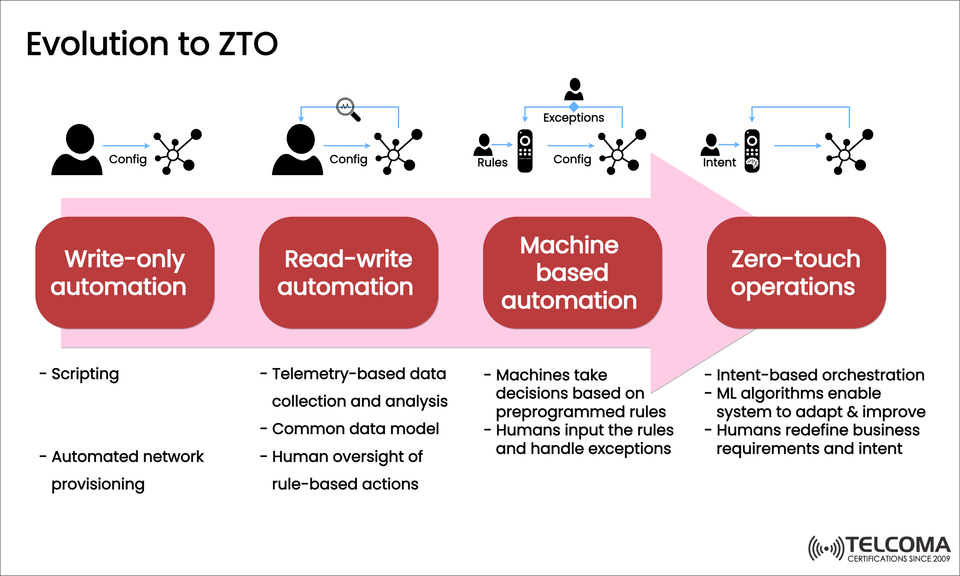
The diagram shared shows the evolution towards ZTO, highlighting four major automation stages:
Write-only automation
Read-write automation
Machine-based automation
Zero-touch operations
Each stage signifies a leap in technology, pushing telecom networks closer to fully autonomous, AI-driven systems that need minimal human involvement.
Write-Only Automation: Kicking Off Network Automation
The journey in telecom automation begins with write-only automation, which is about basic scripting and task execution. At this point, human operators write scripts to set up network devices, sending commands without getting automated feedback.
Main Features:
Manual scripting: Engineers create and run scripts for network configuration and provisioning.
Limited feedback: Systems don’t have telemetry or awareness of their status; there’s no way to check if changes worked as intended.
Automated provisioning: Some tasks are automated, but they’re mostly static and don’t adapt in real-time.
Challenges:
Prone to human errors and misconfigurations.
Time-consuming and resource-heavy.
Not scalable in large, distributed telecom settings.
This phase was a crucial move away from manual command-line operations, but it still relied heavily on human oversight and the need for manual fixes.
Read-Write Automation: Gaining Awareness with Telemetry
Next up is read-write automation, which introduces intelligence into automation systems through data gathering and feedback loops. Networks start to “sense” their own state via telemetry, allowing for some automated operational decisions.
Key Features:
Telemetry-based data collection: Systems collect real-time performance and fault data from network elements.
Common data model: Standardizing information makes it easier to analyze and respond based on rules.
Rule-based automation: Operators define “if-then” rules for automatic responses to certain conditions.
Human oversight: Engineers keep an eye on system outputs and sign off on major corrections.
Benefits:
Better visibility into network performance.
Faster detection and response to faults.
A solid step towards predictive operations.
Read-write automation bridges the gap between simple scripting and smart decision-making by introducing closed-loop feedback. This allows systems to monitor outcomes and tweak operations within set parameters.
Machine-Based Automation: Shifting to Machine Decisions
The third phase, machine-based automation, takes a turn from human-driven scripts to machine-led decisions. Here, automation systems start using predefined rules and data-driven logic to autonomously handle most operational scenarios.
Key Aspects:
Preprogrammed decision engines: Machines operate based on established policies and rule sets.
Human role: Engineers set the rules and deal with exceptions or anomalies.
Early AI and ML integration: Basic machine learning helps spot patterns and suggest optimizations.
Operational Perks:
Less human workload: Machines take care of routine tasks, freeing people for more complex problem-solving.
Consistency and reliability: Automated rule enforcement ensures uniform configuration and compliance.
Speedy response times: Systems can react to network events in milliseconds rather than minutes or hours.
Machine-based automation marks a significant turning point — networks start operating proactively rather than reactively. The human role shifts from operator to supervisor or policy architect, focusing on the logic of automation rather than the devices themselves.
Zero-Touch Operations (ZTO): The Era of Autonomous Networks
With Zero-Touch Operations, we reach the final stage where networks achieve autonomy through intent-based orchestration and AI/ML-driven adaptability. At this stage, human involvement is kept to a minimum — operators mainly define business intents, and the network handles the technical actions on its own.
Core Principles of ZTO:
Intent-Based Orchestration (IBO): Operators set high-level goals (like “keep latency under 10ms for video services”), and the system figures out how to achieve them.
AI/ML algorithms: Machine learning continuously fine-tunes network configurations and predicts issues before they arise.
Closed-loop automation: Feedback loops allow the system to detect, decide, and act without manual intervention.
Redefined human oversight: Instead of configuring devices, humans concentrate on refining business requirements and intent definitions.
Key Benefits:
Autonomous operations: Networks self-configure, heal, and optimize.
Agility and adaptability: Systems can adjust to real-time changes in demand, traffic, or network topology.
Operational efficiency: There’s a marked drop in manual workload and operational costs.
Resilience: Predictive analytics help avoid outages before they can happen.
ZTO represents the future of telecom — a self-driving network that’s capable of learning, reasoning, and evolving.
The Role of AI and Machine Learning in ZTO
AI and ML are crucial to Zero-Touch Operations, turning static rule-based systems into adaptive, context-aware engines that can improve themselves over time.
Applications in ZTO:
Anomaly detection: Spotting network issues before they impact users.
Predictive maintenance: Anticipating failures and initiating proactive repairs.
Dynamic optimization: Adjusting configurations based on real traffic patterns.
Policy learning: Continuously improving automation rules through reinforcement learning.
By harnessing these technologies, telecom operators can create Cognitive Autonomous Networks (CAN) — systems that not only act autonomously but also keep learning continuously.
How ZTO Changes Telecom Operations
Moving to Zero-Touch Operations transforms the telecom landscape in several ways:
- Operational Transformation
Gets rid of repetitive manual tasks.
Reduces mean time to repair (MTTR).
Enhances SLA compliance through predictive insights.
- Economic Impact
Lowers OPEX thanks to automation and less human involvement.
Boosts CAPEX efficiency through better resource utilization.
- Service Innovation
Paves the way for quicker rollout of 5G slices and tailored enterprise solutions.
Facilitates dynamic service orchestration in multi-cloud and edge setups.
- Workforce Evolution
Engineers shift from manual operators to automation architects.
The focus transitions from executing tasks to strategy, analytics, and AI governance.
Challenges in Reaching ZTO
Despite the bright prospects, there are hurdles on the road to ZTO:
Integrating data across legacy and cloud-native systems can be tricky.
Ensuring security in fully automated environments is essential.
Achieving interoperability across different vendor platforms.
Cultural shifts are needed as teams adapt to automation-focused workflows.
To tackle these challenges, telecom operators should embrace open frameworks (like ETSI MANO, TM Forum ODA) and AI governance models that promote transparency and control.
Final Thoughts
The move towards Zero-Touch Operations signals a major shift in telecom — from a human-driven approach to autonomous, intent-based orchestration. By leveraging telemetry, machine learning, and intent-focused automation, operators can create networks that are not just faster and more intelligent, but also self-sustaining. In this 5G era and beyond, ZTO isn’t just a goal — it’s an ongoing journey towards smart networks that can think, learn, and act independently.