
Extensible 5G Architecture for Autonomic Networking: A Layered Framework for Intelligent Connectivity
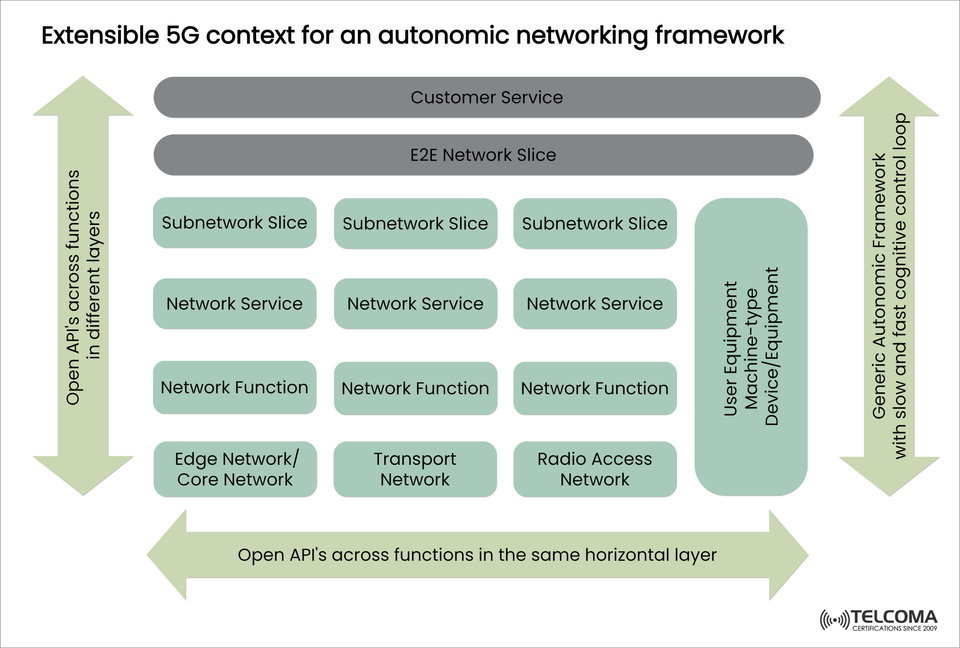

Extendable 5G Context for an Autonomic Networking Environment
As the need for smart, self-managing 5G networks continues to grow, the area of autonomic networking will emerge as key to the evolution of telecommunications. Using the diagram above, we highlighted a layered model that encompasses customer services, slices, and infrastructure. Each layer is facilitated by slow and fast cognitive loops and open APIs.
In this post, we will unpack the architecture, clarify what each layer does, and illustrate how open interoperability and cognitive automation position the future of 5G networking.
🧠 What does Autonomic Networking in 5G mean?
We're generally describing a self-managing network framework that can configure, monitor, optimize, and self-heal with little to no human intervention. In the context of 5G, autonomic networking is necessary:
To enable ultra-reliable low-latency communication (URLLC)
To scale IoT and machine-type communication (mMTC)
To ensure service-level agreements (SLA) across slices and across domains
🔍 Architectural Breakdown: The Layers and Roles
The image shows a horizontal and vertical extension of the 5G environment, where each layer has its own significance and relationship with other layers:
- Customer Service Layer
The top layer where services consumed by customers are defined.
The layer where customer-facing E2E slice can interface with to ensure service delivery.
Each service is influenced by quality of service expectations of the customer and SLA compliance.
End to end network slice layer
Refers to an end to end service slice that supports all the way through access transport to core.
Caters directly to customer services and is autonomously orchestrated.
- Subnetwork Slice Layer
Decomposes E2E slices into interoperable regional or functional domain manageable slices.
Supports service provisioning in units that are modular and scalable.
- Network Function Layer
Houses both physical network elements (PNFs) and virtual network elements (VNFs, CNFs).
Routing, session management, and load balancing functionally exist here.
- Infrastructure Layer
Basically, components include:
Edge Network/Core Network
Transport Network
Radio Access Network (RAN)
Provides connectivity, latency optimizations, and bandwidth delivery.
- User Equipment / M2M Devices
Includes, smartphones, IoT devices, sensors, gateways.
Provides connectivity to network functions with a wireless protocol.
Cognitive Loops for Autonomic Control
Slow Cognitive Loops
Support long term optimizations, policy based adaptation, and analytics.
For Example: Re-configuration of routing policies based on usage patterns weekly.
Fast Cognitive Loops
Provide real-time responsiveness, mobility, and failure detection.
For Example: Automatic handover in terminals within milliseconds during a call while moving.
🧩 How This Framework Enables Flexibility in the Network
Feature Benefit
Layered Slice Management Allows service granularity and modular upgrades
Cross-Domain APIs Yields vendor-neutral service orchestration
Cognitive Control Loops Provides tools for reactive and proactive automation
User-Centric Design Allows dynamic service adaptation to user and device profiles
🌍 Real-Life Use Cases
✅ Smart City Networks
Support city-wide surveillance, transport coordination and emergency response using adaptive subnetwork slices.
✅ Industrial IoT
Consume network services suitable for robotic automation and real-time analytics in manufacturing.
✅ Connected Vehicles
Leverage ultra-low latency RAN slices, and AI-based decision making in core networks to create safe mobility solutions.
🛠️ Recommendations for Telecom Operators
Leverage Open API Standards (TM Forum, ETSI)
Develop Slice-Aware Monitoring Solutions
Enable Real-Time Sharing of Data Across Layers
Automate Using Closed Loop AI Workflows
Simulate and Test Cognitive Decisions Continuously
🧭 Conclusion:
Creating Self-Driving Futures through 5G
The extensible 5G context for autonomic networking should not simply be regarded as a framework or technical solution. Instead, it must be viewed as a strategic capability that assists and enables telecommunication infrastructure to be self-optimizing, resilient and adaptive. For telcos, the ability to embrace open APIs, layered slicing, and cognitive loops can create very powerful capabilities that fulfill the promises of 5G and beyond.
🔮 Future Vision: Automonic Networks Post 5G
Moving toward 6G and next, autonomic networking will be even more critical. Key themes are:
- AI-Native Network Management
Placement of AI/ML directly into network functions and orchestration layers.
Predictive maintenance, intelligent resource allocation, dynamic SLA management.
- Zero-Touch Provisioning (ZTP)
Total automation of service deployment without manual on-site configuration.
Drive by policy engines and digital twin simulation.
- Distributed Cloud and Edge Computation
Real time decision-making moves closer to the user via multipoint edge computing (MEC).
Allows fast loops for latency-sensitive applications such as AR/VR and autonomous driving.
- Cross-Domain Slicing and Multi-Tenant
Slices that can span public and private networks.
Allows B2B vertical customers to run on shared infrastructure while ensuring strong isolation is established.
🧰 Integration Suggestions for the Telecom Engineer
If you're looking to take advantage of the extensible 5G autonomic framework to create a better aligned approach to network operations, you might consider these tips:
🔧 Infrastructure Expression
Build a modular network routing architecture based upon CNFs and microservices.
Once again, consider compatibility with open source frameworks (e.g., ONAP, O-RAN).
🔐 Security Considerations
Provide zero trust architecture (ZTA) across all API endpoints and slices.
Require real-time anomaly detection using AI-based monitoring.
📚 Resources and Readings
3GPP TS 28.530-28.558 -- Network Slicing Management Architecture
ETSI ZSM – Zero-touch Service Management Framework
ONAP -- Open Network Automation Platform
O-RAN Alliance specifications -- Open RAN specs
ITU-T Y.3000 series -- Future network and autonomics
📌 Summary Table - Key Concepts at a Glance
Layer/Function Brief description
Customer Service user-facing services; SLA definitions
E2E Network Slice cross-domain service slices
Subnetwork Slice domain-specific (e.g., RAN, Core)
Network Service logical services (QoS, mobility, security)
Network Function executable VNFs, CNFs, PNFs
Infrastructure Layer physical and virtual networks (RAN, transport, core)
Control Loops cognitive loops (slow = analytics, fast = real-time control)
Open APIs interfaces for automation and communication between layers
🏁 Conclusion
The extensible 5G autonomic networking framework is much more than a technology— it represents a fundamental shift in how networks are built, operated and scaled. Through the implementation of cognitive control loops, open APIs, and purposefully designing for autonomy, telecom operators will realize:
Faster service innovation
Improved operational performance
Unprecedented network agility
The future of telecom is self-aware, adaptive and open, and the time to start building it is now.