
Extensible 5G Autonomic Networking Framework: Architecture, Slices, and Open APIs

🌐 Introduction: The Next Step in 5G Network Intelligence
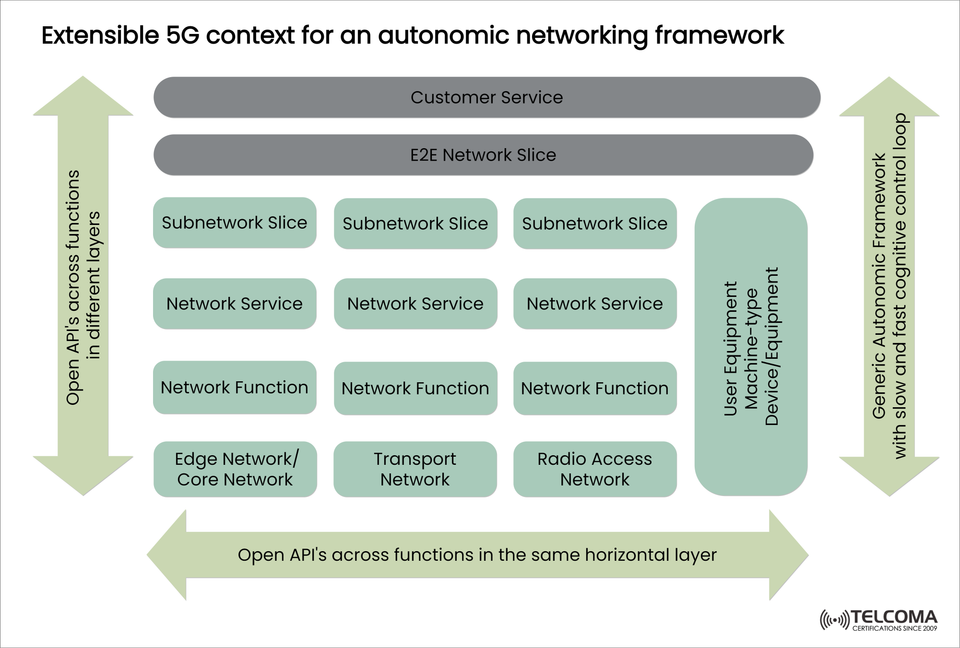
5G is more than just an upgrade in speed; it's a fundamental shift toward autonomic networking where the networks themselves manage, heal, and optimize with little human intervention. The image above shows a layered architectural view of how 5G networks can be designed for intelligent processes through extensibility via abstraction and open APIs.
Let's decode "virtuous" for engineers and technology enthusiasts looking to understand the architecture what would build true autonomic networks using 5G.
🧠 What is an Autonomic Networking Framework?
An autonomic networking framework seeks to:
Automate network slice lifecycle management
Self-Configuration, Self-healing, Self-Optimizing
Leverage systems with closed-loop feedback of AI/ML driven activity
Support service-specific behavior via open, modular, extensible interfaces
This allows the Telco to address specific evolving needs for services ranging from enhanced mobile broadband (eMBB), massive IoT, ultra-high reliable low latency communication (URLLC).
🧱 Layered Architecture of Extensible 5G Autonomic Networks
The architecture is characterized by multiple vertical and horizontally layered layers made interoperable via open APIs, abstracted, and extensible via APIs.
📊 Two High-level Architectural Layers:
Layer Functions
Customer Service Captures customer service-level requirements from enterprises and/or individual customers
E2E Network Slice Represents a full logical slice across all network domains
Subnetwork Slice Logical slices in RAN, transport, or core elements
Network Service Chain of virtualized (or physical) network functions to produce a certain result
Network function VNFs, CNFs, or PNFs (such as a firewall, UPF, or AMF)
Infrastructure Domains Includes RAN, Transport, and Core/Edge domains
User Equipment Layer Endpoints from smartphones, IoT devices and sensors
🔁 API-based Interactions: Vertical & Horizontal Extensibility
This model relies on open API interactions that occur:
Vertically, between layers (e.g., customer service and slice manager)
Horizontally, in the same layer (e.g. cross-domain coordination between RAN and transport slices)
The openness of the API provides:
Vendor-neutral integrations
Flexible orchestration in multi-domain environments
Increased programmability and service agility
🧠 Cognitive Control Loop: Automation in Action
The Generic Autonomic Framework is designed to utilize:
Slow loop: For policy updates, analytics, and SLA tuning
Fast loop: For real-time decision-making and anomaly resolution.
These feedback loops are based on:
AI/ML models
Telemetry and KPI
Dynamic intent-based triggers
This, in turn, makes it possible for zero-touch provisioning, fault recovery, and optimization of network components to happen in real time.
🔍 Why This Inductive Framework Matters to Telcos
By implementing this extensible framework, telcos can:
Provide SLA-backed slices for verticals like healthcare, manufacturing, and autonomous vehicles.
Reduce operational expenses through automation and closed loops of assurance
Flexibly scale accross 5G and beyond, including hybrid and multi-cloud ecosystems.
✅ Conclusion: Building Smarter, Extensible 5G Networks
The extensible 5G autonomic networking framework represented in this architecture display the future potential of programmable, adaptable, intelligent networks. Layered abstraction, openness through APIs, and autonomy through the development of AI systems allows operators to meet changing customer demands and develop new revenue streams while minimizing human intelligence requirements.
📡 Real-world Use Cases of the 5G Extensible Autonomic Framework
The extensible 5G autonomic networking architecture is not just a theoretical model, it is being deployed now in real-world use-cases across various industries.
- Smart Manufacturing (Industry 4.0)
Need: Low latency communcation and real time analytics across robots and sensors.
Solution: Dedicated subnetwork slices for the pieces of equipment on the factory floor, supported by APIs and cognitive control loops.
Outcome: Autonomous error management generating improvements to operational efficiencies and reduced downtime. - Telemedicine & Remote Surgery
Need: Ultra-reliable, low-latency networks for video and telemetry.
Solution: AI-driven assurance with fast loops monitoring slice behaviour and reallocating resources in real time.
Outcome: Safe, seamless communication between healthcare equipment and specialists.
- Connected Vehicles & V2X
Need: High throughput and low latency in dense urban networks.
Solution: Edge slicing with open APIs coordinating radio access and transport layers.
Outcome: Safe navigation and reliable data exchange for autonomous vehicles.
🛠️ Key Enablers in the Framework
This extensible 5G model relies on the following technologies and concepts:
🔑 1. Open APIs
Enable layered modular communication
Facilitate vendor interoperability
Support cloud-native orchestration and automation
🔑 2. Network Slicing
Logical partitioning of a physical network in a customized way
Can support SLA-driven performance measures
Fully integrated across core, transport and RAN
🔑 3. AI/ML Integration
Anomaly detection; traffic prediction; real-time optimization
Supports intelligent feedback loops using cognitive analytics
🔑 4. Service Abstraction
Provides layered views to the relevant layer only;
Less complexity, and more flexibility
🧩 Side by Side Comparison for a Traditional Network and an Autonomic 5G Network
Feature Traditional Network Autonomic 5G Network
Control Manual Automated (AI/ML-driven)
Flexibility Fixed configuration Dynamic configuration based on network slicing
Operational efficiency Human-in-the-loop Zero-touch operations
Service customization One size does not fit all Individualized service
🧭 What is Next for Telcos?
Operators need to transition to an extensible autonomic framework, which involves:
Investing in orchestration platforms that have open APIs and sprotecting network slicing.
Making AI and ML accessible to support cognitive loops to support assurance and optimization.
Following cloud-native rules to capitalize on scalability and elasticity.
Standardizing interfaces across infrastructure and vendor systems.
Final Thoughts
The extensible 5G context for autonomic networking is not an epic thing to come — it is already an existential requirement for the digital transformation of telecom.
By structuring this layered, API-led, and AI-bettered framework telecom operators can:
Simplifying network operations
Deliver service-specific performance
Convert their 5G investments into verticalized monetized solutions
🏁 Conclusion
The Extensible 5G Context for Autonomic Networking represents a significant leap forward in the architecture, operation, and commercialization of modern telecom networks.
By structuring network functions into clearly defined layers along with:
- Open APIs for horizontal and vertical interaction - Autonomic behaviors driven by AI & ML - Layered service abstraction and slicing