
FDD vs TDD in Mobile Networks: Key Differences, Architecture, and Applications Explained

FDD and TDD Overview: The Foundation of Modern Wireless Communication
FDD (Frequency Division Duplex) and TDD (Time Division Duplex) are the main protocols for separating uplink (UL) communications and downlink (DL) communications between a mobile device and a base station in wireless communication systems.
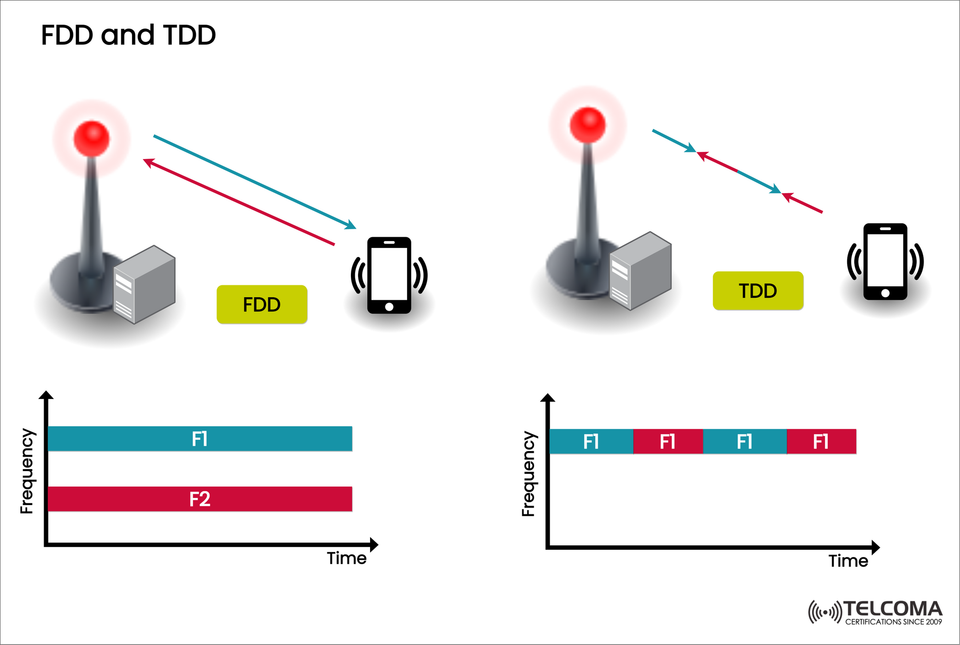
The image above depicts both duplexing schemes - as shown, FDD uses different frequency bands for UL and DL communications, while TDD shares the same frequency but allows transmission in time.
Both duplexing methods are key to mobile technologies like LTE, LTE-Advanced, and 5G NR, each being beneficial in a different way for the availability of spectrum, the intended purpose of deployment, and network planning.
Understanding Duplexing in Telecommunications
Before we get into detail about FDD and TDD we need to understand what duplexing is.
Duplexing is a method of separating uplink communication (from UE to base station) and downlink communication (from base station to UE).
At any given point in time, one direction of communication can transmit data, while the other direction will stay open for receipt of data, thereby preventing interference between the two directions and allowing for smooth two-way communications.
Duplexing can occur in cellular systems in two ways:
Frequency Division Duplex (FDD) and
Time Division Duplex (TDD)
So, let’s examine both in detail.
What is Frequency Division Duplex (FDD)?
FDD defines a duplexing technique where both uplink and downlink communication occurs at the same time, but different frequency bands.
How does FDD work?
In the diagram:
One frequency is allocated to uplink (F1).
Another frequency is allocated to downlink (F2).
These two frequency allocations are separated by a guard band to eliminate hard interference.
In the frequency-time diagram below the FDD diagram, both frequency allocation (F1 and F2) are in continuous use over time, allowing simultaneous bi-directional communication in real time.
FDD key characteristics:
Simultaneous transmission: uplink and downlink transmission happens at the same time on different frequencies.
Paired spectrum utilization: the spectrum is divided into a paired channel for UL and DL.
Predictable latency: ideal for continuous data flow, i.e., voice calls and video streaming.
High synchronization requirements: the base station and UE must ensure strict frequency separation.
What is Time Division Duplex (TDD)?
TDD operates in the opposite way, using the same frequency for uplink and downlink, but separating them by time slots.
How TDD Works
As indicated in the image:
Uplink and downlink are on the same frequency (F1).
Back-and-forth traffic occurs on a designated timing pattern.
The system alternates directions in a synchronized manner.
In a frequency-time graph seen under TDD, you can see alternating timeslots for uplink and downlink (showing F1 red and blue).
Key Features of TDD:
- One Frequency Use: One frequency band both UL and DL.
- Adaptive Allocation: UL and DL ratios can change based on demand.
- Simplified Spectrum Management: Easier way to deploy when paired spectrum is not available.
- Timing Synchronization Key: Must have precise network timing synchronization to maintain isolation.
FDD vs TDD: A Technical Comparison
Feature FDD (Frequency Division Duplex) TDD (Time Division Duplex)
Spectrum Usage Uses two separate frequency bands (paired spectrum) Uses a single frequency band (unpaired spectrum)
Transmission Method Simultaneous uplink and downlink Alternating uplink and downlink in time slots
Guard Band Required to prevent cross-channel interference Not required
Applications and Use Cases
FDD Networks
FDD is ideal for scenarios with balanced uplink and downlink traffic, such as:
Voice calls
Legacy LTE and 3G networks
Rural or suburban deployments where paired spectrum is available
Common FDD Bands:
LTE Band 1 (2100 MHz), Band 3 (1800 MHz), Band 7 (2600 MHz), Band 20 (800 MHz)
Benefits of Each Duplexing Mode
Benefits of FDD
Real-time transmission suitable for voice and low-latency applications.
Reliable link quality at high mobility (e.g., highways).
Mature ecosystem with strong device support.
Benefits of TDD
Better spectrum efficiency because it does not require paired channels.
Dynamic uplink-downlink allocation that can adapt to modern data traffic.
Less expensive to deploy, especially if spectrum is limited.
Simple antenna design (because duplexer is not required).
Drawbacks of FDD and TDD
FDD Drawbacks
Requires double the spectrum due to uplink and downlink pairing.
Guard bands can reduce spectral efficiency.
Spectrum cost increases due to pairing requirements.
TDD Drawbacks
Requires precise synchronization in the cells to avoid interference.
Under high mobility (e.g., fast-moving vehicles), the performance can suffer.
There is an insignificant latency penalty to switch between downlink and uplink.
FDD vs TDD in 4G and 5G
In LTE (4G):
Both FDD-LTE and TDD-LTE are part of the 3GPP Release 8 standard.
FDD-LTE is popular in Europe and North America.
TDD-LTE was adopted in Asia (i.e., China Mobile, India's Airtel, etc.) due to the availability of unpaired spectrum.
In 5G NR:
TDD is the preferred option for mid-band and high-band (FR1 & FR2) because TDD allows flexible allocation of resources while supporting higher data throughput.
Hybrid Deployment: FDD-TDD Aggregation
Modern LTE-Advanced and 5G networks are able to aggregate FDD and TDD carriers, which results in a higher throughput. This capability is called FDD-TDD Carrier Aggregation (CA) — meaning that the data flows via both forms of duplexing simultaneously.
For a Use Case:
FDD Band 1 (2100 MHz) + TDD Band 41 (2500 MHz)
This pairing provides higher download speeds and better utilization of the spectrum.
When facing the choice of FDD or TDD
When network operators begin planning their framework for their spectrum, they consider the following considerations:
- Available spectrum (paired or unpaired)
- Traffic patterns (symmetrical vs. asymmetrical)
- Deployment environment (rural vs urban)
- Cost and complexity of equipment
In general;
FDD is better for coverage-based environments.
TDD is better for capacity-based, density enhanced environments, such as cities.
Conclusion
FDD and TDD have their own equal importance in the mobile communication space today. FDD is still the technology of choice for many of the traditional networks, providing stable and consistent performance and coverage. TDD leads the charge too, as it generally provides a more flexible standard, following into the evolution of 5G and beyond. It is not FDD vs TDD, it is deployment strategy using one not taking away the other.