
Federated Learning in Edge Cloud: Architecture, Workflow & 5G Use Cases
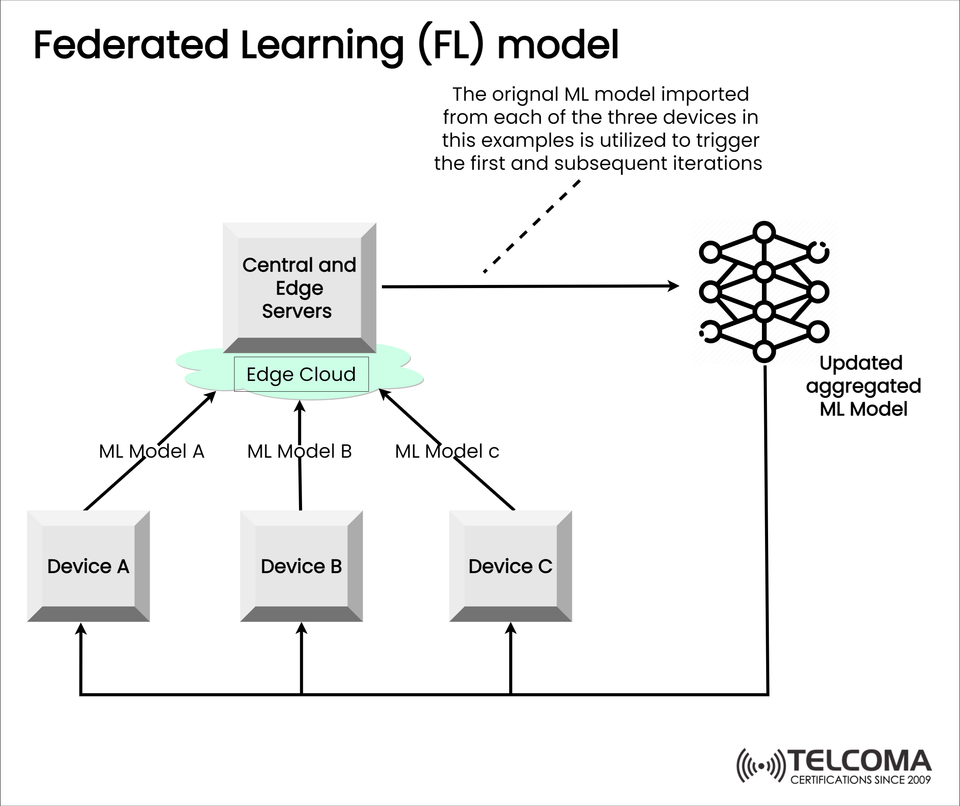

🧠 Getting Optimized with Federated Learning in 5G and Edge Networks Federated Learning (FL) is a decentralized machine learning paradigm that allows AI model training on devices in a distributed manner without the need to transfer raw data to centralized servers. This is particularly relevant in 5G edge computing environments where privacy of data, low latency, and real-time insights are important. The image provided depicts a standard Federated Learning architecture that includes edge devices, cloud components, and central aggregation processes.
🔁 Federated Learning (FL) Workflow
The diagram shows the type of multi-step iterative process, as presented with the following layers:
🔹 Step-by-Step Architecture:
Component Function
Devices A, B, C are a subset of a decentralize network Collect and prepare local data (pre-processed) and on-device train each ML model (A, B , C)
Edge Cloud Acts as a computing layer provider between devices and core
Central, Edge Servers Receive data from devices
Model An updated ML model which integrates weights from deep learning prior data from A, B, C is sent back
🔐 The Federated Learning Need and Importance in 5G and Telecom
✅ Privacy-Preserving AI
-The raw data is never transmitted off the device
-GDPR, provincial data sovereignty regulations are therefore respected
📡 Optimized for 5G Networks
Make use of high bandwidth and ultra low latency of 5G to quickly synchronize models.
🧩 Scalability
Easily scaled across thousands of user devices or IoT nodes.
🔍 Important Benefits of Federated Learning
Data Privacy: Sensitive user data stays local.
Bandwidth Efficiency: Only model weights are sent, limiting the use of network resources.
Personalization: User and device context to create specific local models.
Model Generalization: Aggregated models from different sources improve from diversity.
💼 Examples of FL Applications in Telecom and Edge AI
Domain Example Application
Smartphones Keyboard prediction, voice assistants, user behavior modeling
Healthcare Across hospitals for collaborative patient diagnosis
IoT & Smart Cities Traffic analysis, energy grid optimization
Telco Networks Predictive maintenance, anomaly detection in RAN/CN
🛠️ Best Practices for Federated Learning Implementation
Use secure aggregation protocols to protect the model from inversion attacks.
Establish model compatibility across heterogeneous devices at the edge.
Implement continuous learning pipelines to allow real-time updates.
Alignment with orchestration layers like NFV MANO and OSS to manage the lifecycle.
🧩 Compatibility with 5G Architecture
FL is seamlessly integrated within the Service based Architecture (SBA) of 5G networks and ideal when combined with:
MEC (Multi-Access Edge Computing) for local inference.
Network Slicing for be able to assign dedicated resources to FL tasks.
Security Architecture for guaranteeing model weights are secure.
Conclusion
Federated Learning represents a significant advancement for AI pervasively at the edge, especially in 5G environments. By facilitating model training from distributed source of data, without impacting user privacy, FL enables closer to real-time intelligence, optimal operational functioning, and safe processing of data.
In terms of the role of telecommunications professionals, combining FL with 5G edge will allow innovative workloads be developed offering personalized services, automated smart jobs, while keeping privacy concerns at the forefront, accelerating networks to an AI-native world.
Security and Trust Models
Federated Learning enhances use cases by improving privacy. However, there are further security frameworks that will always be encouraged. Frameworks include,
Homomorphic Encryption - a cryptographic protocol which allows you to use data while it is encrypted without having to decrypt it.
Secure Multi-Party Computation (SMPC) - a technique which ensures no single party (server) can recreate training data.
Differential Privacy - the technique of adding noise to model updates to not allow for the discovery of a single data point.
These approaches and techniques will be paramount when considering telecom grade FL application to sensitive user data and networks.
Performance Metrics of FL in Edge Networks
When applying FL to networks there are several KP offerings, include KPI examples for the 5g environment
Metrics Description
Model Accuracy How effective was the aggregate model performance across all nodes
Latency How long did it take to update the model between each round of training
Communications Overhead What was the available bandwidth for exchanging model weights
Device Participation Rate The number of edge devices contributing to the training process.
📌 Checklist for Telecom Operators to Deploy Federated Learning
Below is a checklist to help telecom operators thinking about deploying FL at scale:
✅ Understand device compute power and storage capabilities.
✅ Deploy FL SDKs (e.g., TensorFlow Federated, PySyft)
✅ Connect with MEC platforms for executing models locally.
✅ Use secure API communication standards with TLS or VPNs.
✅ Consider lifecycle management through MANO/OSS.
🌐 Emerging Future Uses Cases: Federated Learning & 6G
Going forward, FL is viewed to be an innovation that's going to be essential for 6G because we expect to see:
Federated Reinforcement Learning (FRL) - informing automated network management decisions.
Cross-Silo Federated Learning - two or more telecom operators and data centres involved.
Hierarchal Federated Learning - second tier of incorporated edge-cloud capability.
🧭 Conclusion
Telcos can prepare for a future where telecom networks would become intelligent and are software-driven ecosystems. Federated Learning sits nicely in the spaces between AI, privacy, and edge computing to realize the full potential of user and network data in a secure, efficient, and real-time manner.
For operators, vendors, and AI engineers, Federated Learning represents more than just an innovation to adopt at this moment - it represents firms competitive imperative that operators should implement now to deliver exceptional user experiences in tomorrow's hyper personalized, data-conscience, and AI-ready 5G networks.
✅ Summary Table:
FL in Telecom
Aspect This will describe...
Goal Train AI models across decentralized assets without moving raw data
Edge Role Execute model training on the device level.