
From PNFs to CNFs: The Evolution of Telecom Network Functions Toward Cloud-Native Architecture
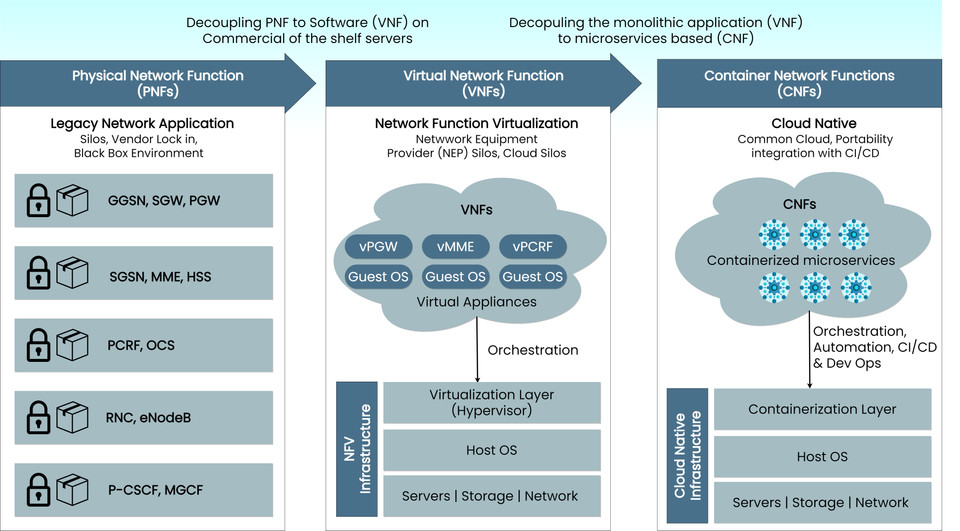

From PNFs to CNFs: How Telecom Network Functions Are Evolving to Cloud-Native Architecture
Telecom is going through a massive tech shift—one of the biggest in its history. As companies gear up for 5G and what comes next, there’s a real push for infrastructure that’s scalable, flexible, and automated. This is driving the move from Physical Network Functions (PNFs) to Virtual Network Functions (VNFs) and now even to Container Network Functions (CNFs).
This shift is changing how network services are set up and managed, opening up avenues for innovation and better efficiency. Let’s break it down step-by-step, looking at what each phase means and how this transition is helping to create true cloud-native telecom networks.
The Era of Physical Network Functions (PNFs)
Legacy Telecom: Hardware-Centric and Vendor-Locked
In the early days of telecom infrastructure, network functions were closely tied to specific hardware pieces known as Physical Network Functions (PNFs).
Each function—like the GGSN, SGW, PGW, SGSN, MME, HSS, PCRF, OCS, RNC, eNodeB, P-CSCF, and MGCF—was a dedicated hardware unit from a specific vendor.
Challenges of PNFs:
Silos and Vendor Lock-In: Each vendor had closed systems, making interoperability tough.
Black Box Environment: Operators had limited options for upgrading or tweaking functions.
Costly Upgrades: Scaling necessitated buying more physical equipment.
Slow Innovation: New services or upgrades often required lengthy planning and deployment times.
PNFs were reliable but pretty rigid, which caused inefficiencies as networks grew during the 3G and 4G periods.
The Shift to Virtual Network Functions (VNFs)
Virtualization: Decoupling Software from Hardware
To address hardware dependency, the industry leaned into Network Function Virtualization (NFV), which separates network functions from proprietary hardware and runs them as software on commercial off-the-shelf (COTS) servers.
This change kicked off the rise of Virtual Network Functions (VNFs). Instead of being tied to specific hardware, functions like vPGW, vMME, and vPCRF could operate on virtual machines.
Key Components of the VNF Architecture (as shown in the image):
NFV Infrastructure (NFVI): The foundational layer that includes servers, storage, and networking.
Host OS: The operating system that manages the hardware.
Virtualization Layer (Hypervisor): Allows multiple virtual machines to share the same physical hardware.
Virtual Appliances (VNFs): Each network function runs in its own virtual machine with a guest OS.
Orchestration: This automates the deployment, scaling, and management of VNFs.
Benefits of VNFs:
Reduced CAPEX and OPEX: No more need for specialized hardware.
Faster Deployment: Virtual appliances can be set up quickly.
Scalability: Can scale dynamically based on demand.
Improved Resource Utilization: Multiple VNFs can run on shared infrastructure.
Limitations of VNFs:
While VNFs added some agility, they were still quite reliant on monolithic software architectures. Each VNF needed its own operating system, making them resource-heavy and not very portable across cloud environments.
This limitation opened the door for the next leap—containerization.
The Cloud-Native Revolution: Container Network Functions (CNFs)
Decoupling Monolithic VNFs into Microservices
The latest advancement in telecom network functions is Container Network Functions (CNFs)—lightweight, microservices-based applications that run in containers instead of virtual machines.
In a CNF setup, traditional monolithic VNFs break down into containerized microservices that can be deployed, scaled, and updated independently.
Core Architecture of CNFs (as illustrated in the image):
Cloud-Native Infrastructure: Comprises physical servers, storage, and networking components.
Host OS: Manages system resources for the containers.
Containerization Layer (e.g., Docker, Kubernetes): Provides the environment for running and orchestrating containers.
CNFs: The network functions themselves consist of small, containerized microservices.
Orchestration & Automation: Tied into CI/CD pipelines, DevOps tools, and automation frameworks for continuous deployment and monitoring.
Advantages of CNFs:
Cloud-Native Agility: Built for cloud environments (public, private, or hybrid).
Microservices Architecture: Each function is modular, easily deployable, and scalable.
Lightweight and Portable: Containers share the same OS kernel, reducing overhead.
Automation and CI/CD: Supports continuous integration, testing, and delivery for rapid innovation.
Resilience and Self-Healing: Has built-in redundancy and fault tolerance with orchestration tools like Kubernetes.
Better Resource Efficiency: Containers use fewer resources compared to virtual machines.
Comparing PNFs, VNFs, and CNFs
Feature PNFs VNFs CNFs Architecture Hardware-based Software-based (Virtual Machines)Microservices-based (Containers)Deployment Manual, Hardware-Centric Automated via NFV Cloud-Native, Orchestrated Scalability Limited Moderate Dynamic & Elastic Resource Utilization Dedicated Hardware Shared Virtual Resources Shared Container Resources Upgrade Cycle Months Weeks Continuous (CI/CD)Automation Minimal Orchestrated Fully Automated Portability Vendor-locked Cloud-siloed Multi-cloud portable Performance Efficiency Low Medium High Operational Model Legacy NONFV Orchestration DevOps & Automation
Decoupling: The Driving Force Behind Each Evolution
Every step in this evolution showcases decoupling at a new layer of the network:
PNF → VNF: This was about decoupling hardware from software through virtualization. Telecom moved from specialized gear to generic, virtualized servers.
VNF → CNF: Here, we saw the decoupling of monolithic applications into microservices. Networks evolved from virtualized silos to cloud-native, automated ecosystems.
This decoupling enhances portability, efficiency, and speed of innovation—all crucial for 5G and edge computing.
CNFs in the 5G Era
Making the shift to CNFs is essential for 5G networks, where scalability, ultra-low latency, and high availability are must-haves.
Key Use Cases of CNFs in 5G:
Network Slicing: Setting up isolated network instances on-demand using containers.
Edge Computing: Getting CNFs closer to users for real-time applications.
Dynamic Service Chaining: Creating flexible service flows as needed.
Continuous Delivery of Network Services: Leveraging CI/CD pipelines to roll out updates seamlessly.
Orchestration platforms like Kubernetes and OpenShift further simplify the management of these containerized functions, ensuring top-notch performance, easy scaling, and quick recovery from faults.
Challenges in Transitioning to CNFs
Even with their advantages, CNFs bring a few new hurdles:
Cultural Shift: Moving from NFV to cloud-native requires a shift to DevOps practices.
Integration Complexity: Keeping everything interoperable between VNFs and CNFs can be tricky.
Security: Container setups need solid, multi-layered security measures.
Skill Gaps: There’s a need for engineers skilled in Kubernetes, microservices, and automation.
Telecom operators will need to tackle these challenges through strategic cloud partnerships, DevOps training, and gradual modernization.
Conclusion
The telecom industry’s journey from PNFs to VNFs to CNFs showcases a larger trend toward software-defined, cloud-native transformation.
PNFs gave us reliability but boxed us in.
VNFs brought flexibility through virtualization.
CNFs offer the agility, automation, and scalability we need for 5G and beyond.
By embracing cloud-native architectures and containerized microservices, telecom operators can unlock faster innovation cycles, better resource efficiency, and next-gen service agility.
The future of telecom is definitely cloud-native, and CNFs are key to making that happen.