
From Virtual Machines to Containers: The Evolution of Deployment Models in Telecom and Cloud
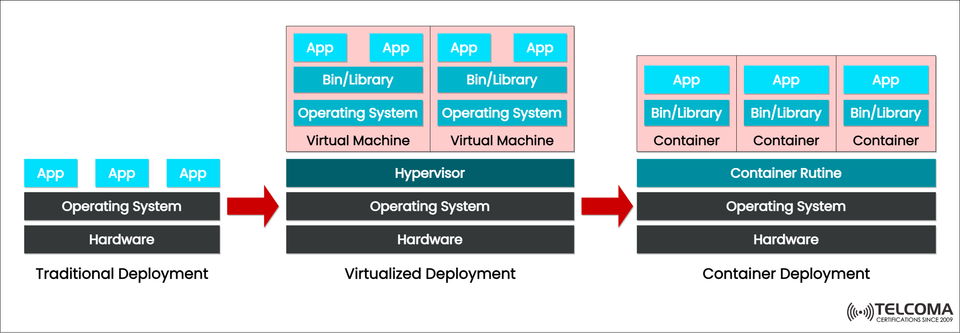

Evolution of Deployment Models: From Traditional to Containerized Architectures
The telecom and IT landscape is changing fast, and so is how we deploy applications. We've moved from bare-metal servers to virtual machines (VMs) and now to lightweight containers. Each of these phases marks a significant improvement in efficiency, scalability, and agility.
The image provided captures this shift well — showing Traditional Deployment, Virtualized Deployment, and Container Deployment stacked on top of each other. For anyone involved in telecom virtualization, 5G networks, or cloud-native environments like Kubernetes, understanding these models is crucial.
Let’s take a look at how we arrived here and why container-based deployment has become essential in today’s cloud and telecom framework.
Traditional Deployment: The Monolithic Era
Back in the early days of computing and networking, applications ran directly on physical servers. This setup, often called bare-metal or traditional deployment, tightly connected software to the hardware.
Architecture Layers
Hardware → Physical servers with CPU, memory, and storage.
Operating System (OS) → Installed straight on the hardware.
Applications → Operate on top of the OS, using its resources.
Challenges of Traditional Deployment
Resource Underutilization: Each server was dedicated to a single application, leading to wasted CPU and memory.
Scalability Limits: Adding new physical servers for scaling was slow and costly.
Dependency Conflicts: Different applications often required conflicting software libraries or OS versions.
Maintenance Downtime: Updating or rebooting the OS meant all hosted apps faced downtime.
Slow Deployment: Getting hardware and software set up could take days or even weeks.
This method was manageable when workloads were predictable. But as telecom networks grew and diversified, rigid infrastructures became bottlenecks.
Virtualized Deployment: The Age of Virtual Machines
Then came virtualization, introducing Virtual Machines (VMs). This model separated applications from the underlying hardware through a software layer called a Hypervisor (like VMware ESXi, KVM, or Hyper-V).
Architecture Layers
Hardware – Same physical servers as before.
Operating System (Host OS) – The main OS running on the hardware.
Hypervisor – A layer that creates and manages multiple VMs.
Virtual Machines (VMs) – Each VM comprises: * Its own Guest OS * Libraries/Binaries needed for its application * The Application itself
Benefits of Virtualization
Better Resource Utilization: Multiple VMs can share a single physical server.
Isolation: Each VM runs independently, reducing interference.
Flexibility: Quick provisioning and migration between servers.
Disaster Recovery: Virtual machines are easier to back up and replicate.
Virtualization transformed data centers and made cloud computing a reality. Telecom networks, especially with NFV (Network Function Virtualization), utilized VMs to run network functions like EPC, IMS, and firewalls on shared infrastructure.
However, Limitations Emerged:
Overhead: Each VM requires its own OS, which takes up considerable CPU, RAM, and storage.
Startup Time: Booting up a VM can take several minutes.
Inefficient Scaling: Deploying multiple VNFs often led to heavy resource duplication.
Complex Lifecycle Management: Keeping updates, patches, and scaling across multiple VMs became unwieldy.
These issues opened the door for containerization — a more agile, lightweight, and efficient option.
Container Deployment: The Cloud-Native Revolution
Containerization is the next evolutionary step in how we deploy applications. Instead of virtualizing hardware, containers focus on virtualizing the operating system itself.
Architecture Layers
Hardware
Operating System (Host OS)
Container Runtime (e.g., Docker, containerd, CRI-O)
Containers — Each contains: * The Application * Its necessary Libraries/Binaries
Unlike VMs, containers use the same OS kernel, making them super lightweight and quick to start.
Advantages of Container Deployment
- Lightweight and Fast
No need to boot a full OS for each instance.
Containers can launch in seconds instead of minutes.
- High Density
You can run dozens of containers on one VM or physical server, making the most of resources.
- Portability
A containerized app works the same way on any system — be it on-premises, in the cloud, or at the edge of the network.
- Rapid Scalability
Containers can scale up or down quickly, which is perfect for dynamic telecom workloads like VoLTE, IMS, or 5G Core functions.
- Simplified DevOps Integration
Containers fit well with CI/CD pipelines, allowing for ongoing delivery and microservices deployment.
- Efficient Lifecycle Management
Tasks like rollbacks, version control, and automated updates become more straightforward.
Comparing Deployment Models
Aspect Traditional Deployment Virtualized Deployment (VMs)Container Deployment Isolation None (Shared OS)Strong (Each VM has OS)Strong (Shared OS, isolated runtime)Boot Time Minutes Minutes Seconds Resource EfficiencyLowModerateHighPortabilityPoorModerateExcellentScalabilityHardware-boundVirtual resource-bound Cloud-native elastic Overhead High High Minimal Ideal Use Case Legacy monoliths NFV, traditional IT workloads Cloud-native, 5G, edge computing
This comparison clearly shows why containerization has become the backbone of modern telecom cloud infrastructures like 5G Core Network Functions, Open RAN, and Cloud-Native IMS.
As containers changed how applications function, managing thousands of them manually isn’t practical. That’s where Kubernetes (K8s) comes in — it’s an open-source orchestration platform that takes charge of container deployment, scaling, networking, and recovery.
In telecom networks:
Kubernetes manages Cloud-Native Network Functions (CNFs).
It enhances network slicing and edge computing by quickly deploying and isolating resources.
Service Meshes (like Istio) help manage communication between containers securely and efficiently.
By combining Kubernetes with containerized VNFs, operators can achieve near-zero downtime, faster upgrades, and dynamic scaling across their distributed network environments.
Why Telecom is Moving to Containers
Telecom operators face constant pressure to cut costs, improve agility, and roll out services quickly. Containers tick all those boxes:
Rapid Service Deployment: Deploy VNFs or CNFs immediately without waiting on VM setups.
Cloud-Native IMS and EPC: IMS features like CSCF, HSS, and SBC can operate as microservices now.
Edge and 5G Enablement: Containers support ultra-low latency and distributed computing at the network’s edge.
Automation and AI: Containers easily integrate with orchestration frameworks for AI-driven optimization.
Challenges in Container Adoption
Switching to containers comes with its own set of challenges:
Security Concerns: The shared OS kernel can increase vulnerabilities.
Stateful Applications: Managing state across multiple containers can get tricky.
Skill Gap: Teams need to adapt to DevOps, CI/CD, and cloud-native strategies.
Interoperability: Integrating with legacy VNFs and OSS/BSS systems requires careful planning.
Despite these hurdles, advancements in container security, service meshes, and hybrid orchestration platforms like ONAP and KubeVirt (which allows running VMs alongside containers) are addressing these issues.
Conclusion
The shift from traditional deployments to virtualized and now containerized architectures marks a significant technological leap in telecom and IT infrastructures.
While VMs have provided scalability and flexibility, containers deliver genuine agility, efficiency, and portability, positioning them as the backbone of cloud-native telecom networks, 5G Core, and edge computing.
In the end, containers aren’t just a passing trend — they represent the new foundation of modern telecom architecture, facilitating faster innovation, reducing costs, and ensuring resilient network operations in a cloud-first world.