
Function Migration from 4G to 5G: Layer-Wise Evolution Explained
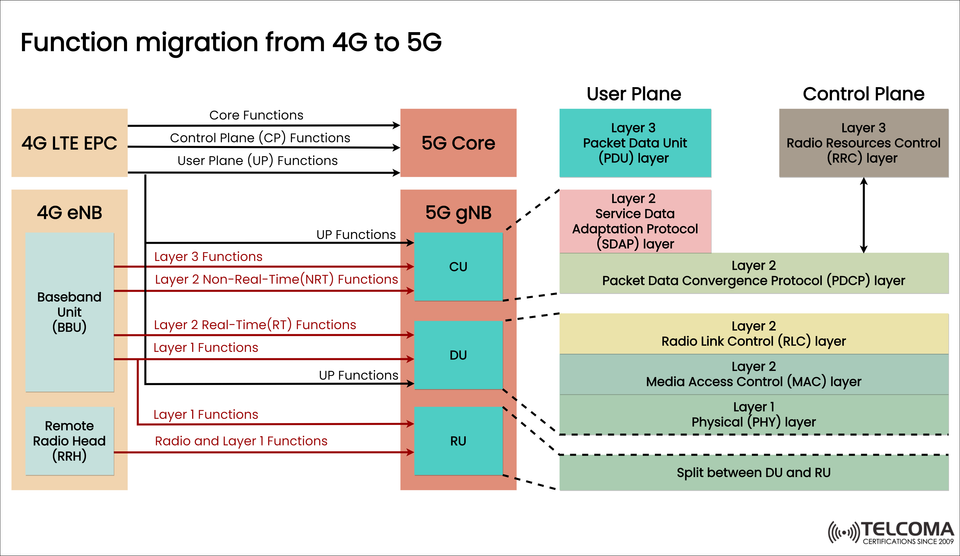

Functional Migration from 4G to 5G: A Review of Network Evolution
As the telecommunications sector shifts from 4G LTE to 5G New Radio (NR), understanding the functional migration of network layers is critical for professionals developing and optimizing next-generation networks. The blog article will address how each functional layer transitions from Layer 1 through Layer 3 across a set of 5G gNB (next-generation base station) components compared to its 4G eNB state.
The telecommunications sector will also see the opportunity for cloud-native deployment of functions enabled by the disaggregation of the Central Unit (CU), Distributed Unit (DU), and Remote Unit (RU) components into the 5G networks (which is essential for offering low-latency/high-throughput service).
📡 4G LTE Architecture: Baseband-Centric Functionality
Open image in New TabIn 4G LTE, the architecture of the base station (also known as the evolved NodeB or eNB) consists of:
Baseband Unit (BBU): Performs most of the signal processing and packet protocol stack functions (Layer 1 to Layer 3).
Remote Radio Head (RRH): RF operations and Layer 1 processing only.
Functional Distribution in 4G:
Layer 3: Entirely processed in the BBU (e.g., RRC functions).
Layer 2: Non-Realtime (MAC scheduling) at the BBU and Real-time (RLC, PDCP) by the BBU.
Layer 1: A combination of the remaining (BBU + RRH).
📶 5G NR Architecture: Disaggregated gNB with CU/DU/RU
5G introduces functional disaggregation by separating the base station (gNB) into 3 domains:
CU (Centralized Unit) - includes Layer 3 and non-real-time Layer 2 functions.
DU (Distributed Unit) - includes the real-time Layer 2 functions and some Layer 1 functions.
RU (Remote Unit) - implements the physical layer and handles radio transmission.
Functional movement from 4G vs 5G:
Layer 4G (eNB) 5G (gNB) Functional Transition
Layer 3 BBU CU Control Plane (RRC) (and) User Plane (PDU) performed in CU
Layer 2 Non-RT BBU CU As stated above, moved to CU - includes SDAP & PDCP
Layer 2 RT BBU DU RLC and MAC moved to DU
Layer 1 BBU & RRH DU & RU Physical functions are split between DU and RU.
🧠 User Plane vs Control Plane in 5G
5G architecture also allows a distinction in control and user planes which allows for scalable service orchestration and applications that require latency-sensitive service.
User Plane:
PDU Layer (L3) - Data transport layer (in CU)
SDAP Layer (L2) - maps QoS flows to data bearers.
PDCP (L2) - header compression and encryption.
RLC (L2) - retransmissions and error correction.
MAC & PHY (L2 & L1) - real-time scheduling and transmission (DU/RU).
Control Plane:
RRC (L3) - connection set-up, security, and mobility (in CU).
🧩 Why This Functional Migration Matters
The change from 4G to 5G isn't just a change in capability, it's a radical change in the structure and operation in which networks are designed and implemented.
Disaggregation of Functions Benefits:
Cloud-Native Deployment: The CU functions can be carried by centralized or edge data centers.
Resource Allocation Flexibility: The CU-DU can change as needed based on service demands.
Low Latency: Proximity of the DU and RU makes for immediate responsiveness.
Scalable Architecture: Functions can be scaled independently of other layers or functions at various locations and layers.
NBI Support for Network Slicing: More easily supported ability to isolate and manage specific vertical network slices (ex. health vs automative).
🔍 Summary Table: Layer Mapping from a 4G to 5G
Network Layer 4G Component 5G Component Planes Affected
Layer 3 BBU CU User & Control
Layer 2 (NRT) BBU CU User Plane
Layer 2 (RT) BBU DU User Plane
Layer 1 BBU + RRH DU + RU User Plane
🧭 Conclusion
The transition from 4G to 5G is not just a network upgrade, it is a paradigm shift toward modularity, virtualization, and the use of services. By off-loading and relocating many network functions from BBU to CU, DU, and RU, telecommunication networks have more options to prepare for the future and its potential innovations, such as AI-native orchestration, and 6G potential.
For the practicing telecommunications professional or architect, claiming ownership of the functional shift is paramount in creating and maintaining next-generation network infrastructure compliant with a hyper-connected world.
🏗️ Deployment Considerations
The change from 4G to 5G with modular functions (CU/DU/RU) presents a variety of distinct opportunities and challenges to mobile network operator (MNO) and service provider.
📍 Deployment Scenarios:
Centralized RAN (C-RAN):
The CU and DU function are located in a central data center while
the RU are at the cell site.
Most applicable in urban application with an abundance of fiber.
Distributed RAN (D-RAN):
The DU and RU would be co-located at the cell site.
The CU would exist at a regional or national level.
⚙️ Issues to be addressed:
Fronthaul Requirements: High-bandwidth, low-latency links from RU to DU are highly desired (usually eCPRI).
Synchronization: Precise time synchronization is paramount (using either GPS or IEEE 1588 PTP) between distributed units.
Interoperability: Vendor compliance is limited if open standards are not followed (e.g., O-RAN for CU/DU interoperability).
🔄 Operations and Lifecycle Management
Transitioning from a monolithic 4G eNB to a cloud-native 5G gNB requires modifications in:
- Network Operations (NetOps):
Transition from appliance-based, to software-defined infrastructure.
Increased need for DevOps, CI/CD pipelines for delivering updated network software.
- Service Assurance(NetSecOps):
Increased observability across the distributed layers.
AI/ML is included for predictive maintenance and anomaly detection.
- Orchestration (MANO Stack):
ETSI MANO, ONAP or proprietary orchestrator to manage VNF/CNF lifecycle.
Orchestration in real-time across RAN and Core will emerge with SDN controllers.
📈 Performance Improvements from 4G to 5G
The function split architecture brings real improvements to network performance and user experience.
Metric 4G LTE 5G NR Impact
Latency ~30-50 ms <1-10 ms Ultra-low latency apps enabled
Throughput 100 Mbps - 1 Gbps 10 Gbps+ Faster downloads, UHD streaming
Network Efficiency Fixed resource allocation Dynamic and slice-aware Improved spectral efficiency
Scalability Limited by hardware Cloud-native scaling Elastic service delivery