
Functional Network Segment of a 5G System and Application Deployment Alternatives
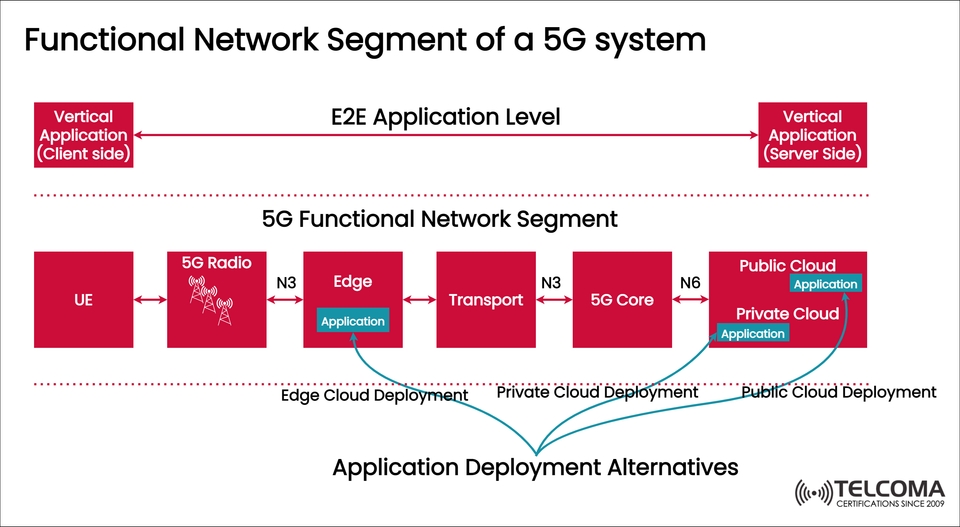

5G networks offer more than just faster internet; they're built to support a wide variety of applications, industries, and use cases. At the core of this functionality is the functional network segment of a 5G system, which connects the end-to-end (E2E) application level to the telecom infrastructure.
In this blog, we'll dive into the 5G functional network segment, discuss the roles of its key components, and explore the various deployment options—like edge cloud, private cloud, or public cloud. Grasping this structure is crucial for telecom experts and businesses looking to harness 5G for their transformation.
Understanding the Functional Network Segment of 5G
The diagram shows how a 5G system is organized into two main layers:
End-to-End Application Level
This spans from the client-side vertical application on the user's device to the server-side vertical application in the cloud or enterprise network.
It ensures that applications can communicate smoothly across the 5G infrastructure.
5G Functional Network Segment
This includes all the vital network elements that enable E2E application connectivity.
Each segment contributes to providing low latency, high bandwidth, and dependable connectivity.
Key Components of the 5G Functional Network Segment
Let’s break down each functional block from the diagram:
- User Equipment (UE)
This is the end-user device, like a smartphone, IoT sensor, or even an autonomous vehicle controller.
It’s responsible for starting communication and using the vertical applications.
- 5G Radio (RAN – Radio Access Network)
This provides wireless connectivity between the UE and the 5G core.
It takes care of spectrum efficiency, handovers, and radio resource management.
Interface: N3 connects the RAN to the 5G Core via the transport layer.
- Edge Segment
This hosts applications closer to the users to minimize latency.
It's perfect for real-time scenarios like autonomous driving, AR/VR, and industrial automation.
For instance, an AR gaming app set up at the edge cloud can deliver sub-millisecond response times.
- Transport Network
This serves as the high-speed backbone linking the RAN, edge, and 5G core.
It needs to be reliable and scalable, often using fiber optics, SDN, and slicing.
- 5G Core (5GC)
This is the heart of the 5G network.
It manages sessions, mobility, and security.
Handles interfaces like N6, which connects the core to data networks (both public and private cloud).
- Cloud Infrastructure (Private/Public)
Private Cloud: Set up within a company's premises for secure control over applications (think smart factories or healthcare systems).
Public Cloud: Provided by big names like AWS, Azure, or Google Cloud, offering scalability and global reach.
Both types host vertical applications that interact with the client side via the 5G network.
Application Deployment Alternatives in 5G
The image shows three possible ways to set up applications in a 5G ecosystem:
- Edge Cloud Deployment
Applications are launched at the network edge, close to the UE.
Best suited for:
Ultra-low latency applications
Real-time video processing
Autonomous vehicles
Industrial automation
Advantages:
Reduces latency
Enhances user experience
Efficient bandwidth use (since data is processed locally)
- Private Cloud Deployment
Applications reside in an enterprise-owned or dedicated cloud.
Best suited for:
Companies handling sensitive data (like finance or healthcare)
Workloads that are mission-critical
Advantages:
Better data security and privacy
More control over resources
Customizable based on enterprise needs
- Public Cloud Deployment
Applications run in hyperscaler-managed public clouds.
Best suited for:
Large-scale applications
Businesses needing global reach and collaboration
Startups or companies wanting scalability over total control
Advantages:
On-demand scalability
Lower infrastructure costs
Faster time-to-market
Comparative View of Deployment Alternatives
Deployment Model Latency Control Security Scalability Example Use Case Edge Cloud Very Low Medium High Moderate AR/VR Gaming, Autonomous Cars Private Cloud Low High Very High Moderate Smart Factories, Healthcare Public Cloud Moderate Low Medium Very High Global Collaboration Apps, OTT Services
The Importance of E2E Application Level
The end-to-end (E2E) application level makes sure applications work well across the 5G functional network segment.
This includes:
Client-side vertical applications on UE devices (like mobile apps and IoT sensors).
Server-side vertical applications hosted in edge, private, or public clouds.
Secure and reliable communication enabled by the underlying 5G framework.
Without this E2E connection, applications can't deliver the expected Quality of Service (QoS) and Quality of Experience (QoE) for their users.
Use Cases Enabled by Functional Network Segmentation
Smart Manufacturing (Private Cloud + Edge)
Robots and sensors rely on a private cloud for security.
Edge apps allow for real-time decision-making.
Healthcare (Edge + Private Cloud)
Remote patient monitoring uses secure private cloud data storage.
Edge deployment ensures quick response times for critical alerts.
Entertainment (Public Cloud + Edge)
Cloud gaming platforms benefit from public cloud scalability.
Edge deployments help provide responsive gaming experiences.
Autonomous Vehicles (Edge Cloud)
Real-time vehicle-to-infrastructure (V2X) communication demands ultra-low latency.
Edge deployment enables local processing of traffic and sensor data.
Challenges in 5G Functional Network Segments
Even though the system is flexible, telecom professionals have to tackle:
Latency vs. Cost Trade-offs: While edge deployments can boost performance, they can also be pricey.
Security: Using public clouds raises concerns about data safety.
Interoperability: Different deployment models need to work together seamlessly.
Scalability in IoT: With billions of devices, there's an unprecedented strain on transport and 5G core segments.
Conclusion
The functional network segment of a 5G system connects user devices, radio access, edge, transport, core, and cloud infrastructures to offer end-to-end application connectivity. By supporting various deployment options—edge, private cloud, and public cloud—5G allows sectors to optimize for latency, scalability, and security based on their specific needs.
For telecom experts and businesses, mastering this architecture is crucial for unlocking the full potential of 5G. Whether it's fueling smart cities, Industry 4.0, healthcare advancements, or immersive entertainment, the 5G functional network segment is the backbone for future digital ecosystems.