
General 5G Wireless Network Architecture: Components & Functions

5G, or the fifth generation of wireless communication technology, is changing how industries operate and setting new standards for connectivity. Unlike earlier versions, 5G isn't just about faster data speeds. It brings flexibility, scalability, ultra-reliability, and low-latency performance to the table. Its design is meant to accommodate a wide range of applications, from enhanced mobile broadband (eMBB) to massive IoT (mIoT) and ultra-reliable low-latency communication (URLLC).
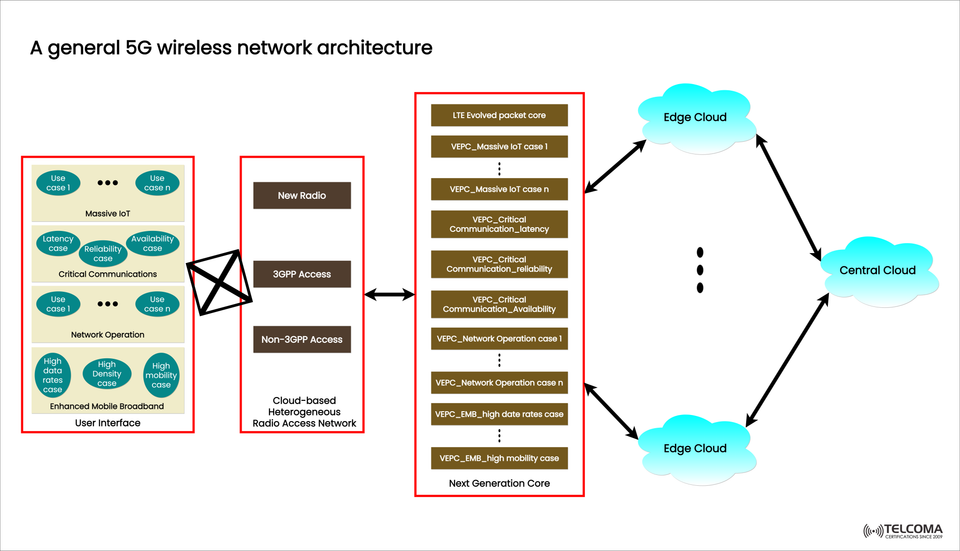
The image uploaded shows a general layout of a 5G wireless network architecture, highlighting how user interfaces, radio access networks, next-generation cores, and cloud infrastructures interact. This layered, modular framework allows 5G to adjust to different demands while ensuring strong, future-proof connectivity.
Core Components of the 5G Wireless Network Architecture
The architecture of 5G can be split into four main areas:
User Interface Layer
Cloud-Based Heterogeneous Radio Access Network (RAN)
Next Generation Core (NGC)
Edge and Central Cloud Integration
Let’s dive into each of these components.
- User Interface Layer
This is the layer where various applications and services connect to the network. It’s built to handle a wide array of use cases:
Massive IoT (mIoT):
Connects billions of affordable, low-power devices.
Applications: Smart homes, industrial IoT, environmental tracking, and smart cities.
Critical Communications (URLLC):
Focuses on low latency, high reliability, and availability.
Applications: Remote surgeries, self-driving cars, industrial automation, and emergency services.
Network Operation Use Cases:
Facilitates system-level functions like network slicing, traffic management, and quality of service optimization.
Enhanced Mobile Broadband (eMBB):
Targeted at delivering high data rates, high density, and mobility.
Applications: 4K/8K streaming, VR/AR, connected sports venues, and high-speed trains.
Overall, this layer helps make 5G adaptable by sorting requirements into specialized domains.
- Cloud-Based Heterogeneous Radio Access Network (RAN)
At the heart of wireless connectivity lies the Radio Access Network (RAN). With 5G, the RAN is cloud-based and heterogeneous, meaning it can smoothly integrate different technologies.
New Radio (NR): The dedicated 5G radio standard that delivers faster speeds, better spectral efficiency, and massive MIMO (multiple-input multiple-output) capabilities.
3GPP Access: Defined by the 3rd Generation Partnership Project (3GPP), these standardized access technologies ensure devices and networks work together well.
Non-3GPP Access: Covers Wi-Fi, satellite, and private networks. This integration gives users seamless connectivity, even in areas not covered by traditional telecom services.
Virtualizing the RAN in the cloud offers operators scalability, flexibility, and cost advantages, allowing for advanced applications like network slicing.
- Next Generation Core (NGC)
The Next Generation Core (NGC) acts as the brain for 5G, managing data, control signals, and special services. In contrast to 4G's monolithic core, 5G utilizes a service-based architecture (SBA) that’s cloud-native and modular.
Important elements shown in the image are:
LTE Evolved Packet Core (EPC): Ensures compatibility with 4G networks.
Virtualized EPC (VEPC) for Use Cases: Each application has its own specialized virtualized modules, such as:
VEPC for Massive IoT (case 1 to n)
VEPC for Critical Communication (focusing on latency, reliability, and availability)
VEPC for Network Operations
VEPC for eMBB (high data rates and high mobility)
This modular setup allows for efficient management of different types of traffic, enhancing both performance and security.
- Edge and Central Cloud Integration
A game-changing aspect of 5G architecture is its connection with cloud computing—especially edge cloud and central cloud.
Edge Cloud:
Positioned closer to the user.
Supports ultra-low latency and local data processing.
Ideal for real-time applications like autonomous driving, AR/VR, and critical IoT.
Central Cloud:
Contains powerful computing resources for large-scale analytics, AI, and orchestration.
Manages centralized control and policy enforcement.
Together, edge and central clouds create a distributed computing environment, helping networks balance speed, efficiency, and scalability.
Advantages of 5G Wireless Network Architecture
The layered approach of 5G offers numerous benefits:
Scalability: Manages billions of IoT devices and high-density urban areas.
Flexibility: Smoothly integrates both 3GPP and non-3GPP networks.
Performance: Ensures high throughput, low latency, and reliability.
Cloud-Native Efficiency: Virtualized functions lower costs and improve resource use.
Future-Proofing: The modular design makes it easier to upgrade to 6G and beyond.
Use Cases Enabled by 5G Architecture
Here are some practical applications made possible by this architecture:
Smart Cities: IoT-enabled streetlights, traffic management, and utilities.
Healthcare: Remote surgeries supported by ultra-reliable low-latency communication.
Entertainment: Cloud gaming and immersive AR/VR experiences with gigabit speeds.
Transportation: Connectivity for cars and communication in high-speed rail systems.
Industry 4.0: Automated factories utilizing massive machine-type communication.
Comparison: 4G vs. 5G Architecture
Aspect | 4G Architecture | 5G Architecture
Core Network | EPC (monolithic, hardware-centric) | NGC (service-based, cloud-native)
Access | Primarily 3GPP (LTE) | 3GPP + non-3GPP (Wi-Fi, satellite)
Latency | ~50 ms | As low as 1 ms
Scalability | Limited IoT support | Massive IoT with billions of devices
Cloud Integration | Minimal | Full integration with edge & central clouds
Use Cases | Mobile broadband | eMBB, URLLC, mIoT, network slicing
Future Directions in 5G Network Architecture
As the telecom sector heads towards 6G, the modular and cloud-native base of 5G will continue to evolve. Upcoming innovations may include:
AI-driven network optimization for smarter resource management.
Blockchain-enhanced security for decentralized trust.
Intelligent Reflecting Surfaces (IRS) to improve radio transmission.
Quantum-safe encryption to defend against future risks.
Conclusion
Overall, the general architecture of the 5G wireless network shows that this technology goes beyond simple speed increases. It creates a flexible, secure, and scalable ecosystem, from the variety of user interfaces to cloud-native cores and distributed cloud integration. This setup is prepared to tackle everything from smart cities to mission-critical scenarios.
For telecom professionals, having a solid grasp of this architecture is vital for the design, deployment, and optimization of 5G networks. As we move towards 6G, the core principles of this architecture will still underpin future advancements in wireless technology.