
High-band Utilization in 5G NSA: EN-DC vs NE-DC Explained

Understanding High-band Utilization in 5G NSA: EN-DC vs NE-DC
The launch of 5G networks depends on various deployment strategies to balance coverage, capacity, and costs. A key point here is high-band utilization, particularly in NSA (Non-Standalone) setups, where 5G NR operates alongside LTE.
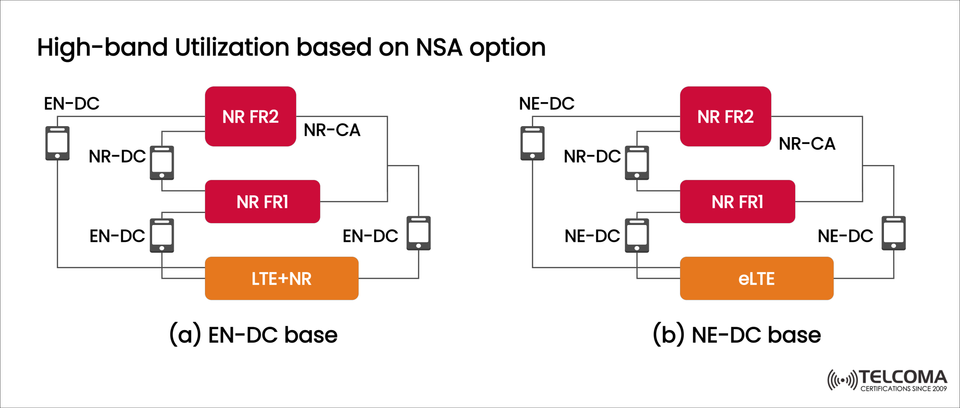
The image above shows how high-band utilization is accomplished through two main NSA options:
EN-DC base (E-UTRA NR Dual Connectivity)
NE-DC base (NG-evolved Dual Connectivity)
These structures determine the combination of low-band (LTE/eLTE) and high-band (NR FR1/FR2) spectrum resources to achieve faster speeds and reliable connections.
Grasping 5G NSA and Dual Connectivity
Before we delve into EN-DC and NE-DC, let's cover some basics.
What is NSA (Non-Standalone)?
NSA allows 5G NR (New Radio) to work together with 4G LTE.
LTE serves as the anchor for control signaling, while 5G NR provides high-capacity data channels.
This setup speeds up the 5G rollout without needing a full SA (Standalone) 5G core deployment.
What is Dual Connectivity (DC)?
Dual Connectivity allows a device (UE) to connect to two nodes at once:
A master node (anchor, typically LTE/eLTE or NR FR1).
A secondary node (adds extra capacity, usually NR FR2 or another NR).
This setup helps achieve higher throughput by leveraging different frequency bands.
High-band Utilization in 5G
High-frequency spectrum, especially mmWave (FR2), offers substantial bandwidth but limited coverage. Meanwhile, lower bands (FR1 and LTE/eLTE) provide wider coverage but less capacity.
To tackle this trade-off, 5G NSA makes use of carrier aggregation (CA) and dual connectivity (DC) to anchor coverage in low/mid bands while directing traffic to high bands.
That’s what the image illustrates with two NSA architectures: EN-DC and NE-DC.
EN-DC Base (E-UTRA NR Dual Connectivity)
On the left side of the diagram (a), we have the EN-DC base option.
How it Works
LTE (E-UTRA) acts as the primary anchor.
5G NR (FR1 or FR2) serves as a secondary connection.
The device connects to LTE first, then adds on NR carriers for more capacity.
Key Elements in the Diagram
LTE + NR Anchor: LTE ensures solid signaling, while NR boosts high-band capacity.
NR FR1 (sub-6 GHz): Provides better coverage than FR2 and supports mobility.
NR FR2 (mmWave): Delivers high throughput in concentrated areas but has limited range.
NR-CA (NR Carrier Aggregation): Combines multiple NR carriers (FR1 + FR2).
Advantages of EN-DC
Quick deployment using current LTE networks.
Provides a smooth transition from 4G to 5G.
Reliable fallback to LTE when NR coverage isn’t strong.
Challenges of EN-DC
Heavily relies on LTE as the anchor.
LTE’s limitations (like latency and control plane overhead) can hold back full 5G performance.
NE-DC Base (NG-evolved Dual Connectivity)
On the right side of the diagram (b), we find the NE-DC base option.
How it Works
eLTE (enhanced LTE) serves as the anchor, now more tightly integrated into the 5G core (NG core).
Both LTE and NR operate more effectively with better signaling.
Devices can connect to NR FR1 and FR2 while anchored on eLTE.
Key Elements in the Diagram
eLTE Anchor: More advanced version of LTE that integrates with the NG core.
NR FR1 and FR2: Both operate with higher efficiency compared to EN-DC.
NR-DC: Supports NR-to-NR dual connectivity (e.g., FR1 + FR2).
Advantages of NE-DC
Closer alignment with the 5G Core (5GC).
Less signaling overhead than EN-DC.
Better use of high-band spectrum (FR2).
Supports sophisticated NR features like dual connectivity without being totally reliant on LTE.
Challenges of NE-DC
Needs eLTE upgrades, so it can’t just use legacy LTE.
More complex network design and higher investment costs.
Comparing EN-DC and NE-DC
Here's a quick side-by-side comparison of how the two options vary:
Feature EN-DC Base NE-DC Base Anchor LTE eLTE (enhanced LTE)Core Network EPC (Evolved Packet Core)5GC (Next-Gen Core)Deployment Speed Faster, uses existing LTE Slower, needs upgrades High-band Utilization Limited, FR2 constrained Improved, FR2 better supported Control Plane LTE-centric NG Core integrated Future-readiness Transitional (NSA phase)Closer to SA readiness
Importance of High-band Utilization
Making good use of high-band spectrum is crucial because:
5G performance goals (like multi-Gbps speeds and ultra-low latency) rely on mmWave FR2.
Coverage limitations necessitate smart anchoring with LTE/eLTE and FR1.
Without dual connectivity, mmWave wouldn’t be practical in mobile scenarios.
NSA options like EN-DC and NE-DC ensure that users get both broad coverage and high speeds, easing the way for a smoother shift to 5G Standalone.
Real-world Applications
Urban Hotspots
EN-DC or NE-DC allows mmWave (FR2) to be deployed in crowded spaces like stadiums or airports.
LTE/eLTE ensures coverage while NR FR2 provides ultra-high throughput.
Rural Expansion
EN-DC uses LTE coverage and expands with NR FR1.
NE-DC brings improved integration with 5G Core for future-proof deployments.
Enterprise & Private 5G
NE-DC supports advanced dual connectivity for campus and industrial networks.
Ensures reliability (FR1) and performance (FR2).
Looking Ahead: Towards Standalone (SA) 5G
EN-DC is a temporary fix, aiming to fast-track 5G.
NE-DC is a more refined NSA option that aligns with the 5G Core, prepping networks for a full SA (Standalone) future.
Ultimately, networks will depend less on LTE/eLTE anchors, moving toward pure NR dual connectivity.
Conclusion
The diagram illustrates how high-band utilization in 5G NSA varies based on whether networks adopt EN-DC or NE-DC architectures.
EN-DC relies on LTE, enabling quick deployment but with limited high-band efficiency.
NE-DC leans on eLTE, integrating with the 5G Core, enhancing FR2 efficiency and future readiness.
For telecom operators, the decision between EN-DC and NE-DC hinges on:
Current LTE infrastructure
Speed of deployment vs. performance objectives
Investment strategy for migrating to 5G Core
All in all, both setups are vital for ensuring that 5G offers wide coverage, lightning-fast speeds, and a seamless user experience as networks transition to Standalone 5G.