
High-Level CI/CD Architecture in Telecom: Pipelines, Quality Gates & Deployment

Getting to Know CI/CD in Telecom
In today's telecom landscape, Continuous Integration (CI) and Continuous Deployment (CD) are essential for speeding up innovation and keeping services reliable. Telecom operators handle millions of subscribers and critical services, and the CI/CD pipeline helps them deliver updates faster, test thoroughly, and automate deployments across extensive infrastructures.
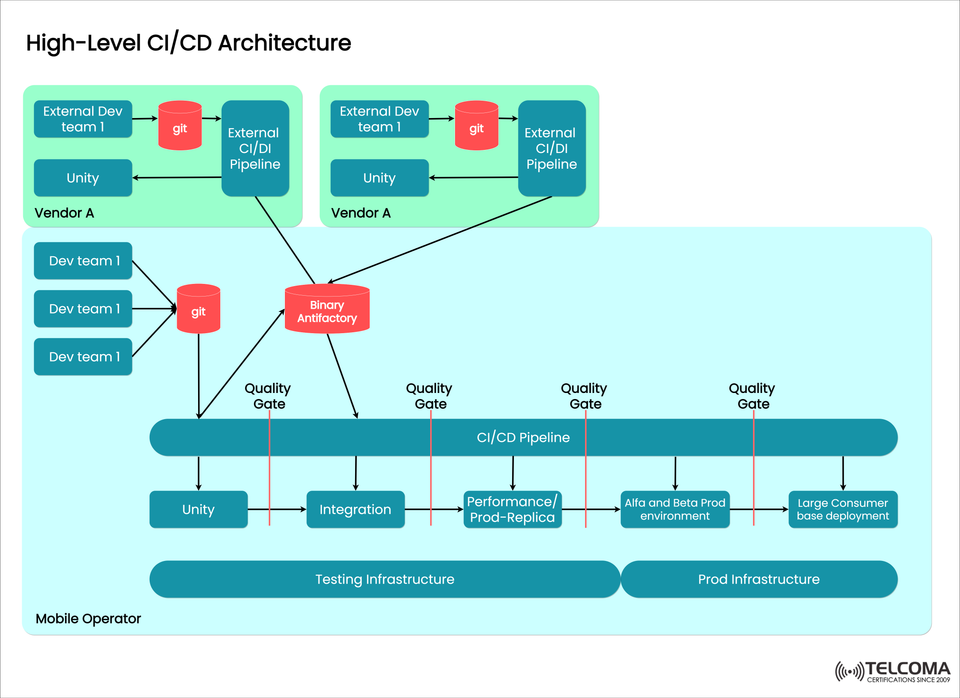
The diagram we've shared outlines a high-level CI/CD architecture that illustrates how internal development teams, outside vendors, and testing environments work together to push out stable software updates while passing through various quality gates.
Key Elements of the CI/CD Architecture
The CI/CD architecture in telecom is a multi-layered framework meant to integrate contributions from various stakeholders while ensuring software stability. Here’s a closer look:
- Development Teams
Internal Development Teams – Several dev teams focus on different software modules and push their code to a shared Git repository.
External Vendor Teams – Vendors also add their code through their own CI/CD pipelines, making it easier to integrate with the operator’s system.
This mixed approach supports both in-house and vendor innovation while keeping things standardized.
- Source Control (Git)
All code changes go into a Git repository, which acts as the single source of truth. Both the internal teams and external vendors submit updates here. This setup ensures:
Version control
Traceability of changes
Collaboration across distributed teams
- Binary Arti factory
Before the code enters the CI/CD pipeline, compiled binaries are kept in a Binary Arti factory. This repository:
Manages artifacts like packages, builds, and executables
Offers versioned storage
Serves as a checkpoint before testing or deploying the software
By keeping binaries isolated, the system avoids unnecessary rebuilds and allows for efficient testing and rollback.
- Quality Gates
The CI/CD pipeline includes several Quality Gates at crucial stages:
Unit Testing Stage – Checks individual components.
Integration Stage – Makes sure modules work well together.
Performance & Replica Stage – Tests performance in a production-like environment.
Pre-Production (Alpha/Beta) Stage – Provides an opportunity for testing close to actual usage.
Final Deployment Stage – Confirms readiness for widespread deployment to subscribers.
Each quality gate serves as a checkpoint, ensuring that only thoroughly vetted code moves forward.
- CI/CD Pipeline Flow
The CI/CD pipeline in telecom is laid out to transition software from development to large-scale deployment:
Unity & Unit Testing – The initial testing framework for functional checks.
Integration – Validates compatibility among various components.
Performance/Prod-Replica Testing – Mimics production loads in a controlled setting.
Alpha & Beta Testing – Early releases for internal and select users.
Large Consumer Base Deployment – Final rollout to millions of subscribers.
This structure guarantees that each build undergoes thorough automated and manual validations before going live.
- Testing and Production Infrastructure
Testing Infrastructure – A replica of the live network where code is tested against different scenarios.
Production Infrastructure – The live environment where final, stable code goes out to users.
This two-pronged setup helps maintain a clear separation between testing and real-world services.
Advantages of a High-Level CI/CD Architecture in Telecom
Adopting CI/CD in telecom networks offers numerous benefits:
Faster Time-to-Market – Regular updates get to customers quickly.
Enhanced Quality – Quality gates keep stability high and bugs low.
Scalability – Manages large subscriber bases through automation.
Vendor Collaboration – Encourages contributions from both internal and external teams.
Risk Mitigation – Rollbacks and artifact oversight minimize downtime.
Operational Efficiency – Automates repetitive tasks, freeing teams to innovate.
Summary Table of Architecture Flow
Stage Key Function Outcome Development Teams (Internal & Vendor)Code contributions Shared Git commits Git Repository Centralized source control Version management Binary Arti factory Stores builds and artifacts Efficient reuse and rollback Quality Gates Automated checkpoints Bug-free progression CI/CD Pipeline Stages Unit → Integration → Performance → Beta → Deployment End-to-end testing Testing Infrastructure Pre-deployment validation Safe experimentation Production Infrastructure Final live rollout Reliable consumer services
Real-World Impact for Telecom Operators
Telecom operators need to support 5G rollouts, IoT services, cloud-native apps, and network slicing. Without CI/CD pipelines, these complex operations could take ages. With automation:
Network Functions Virtualization (NFV) can get updates smoothly.
Cloud-native 5G Core functions (like AMF, SMF, UPF) can be patched without any downtime.
Consumer apps and services can be rapidly updated without disrupting service.
So, CI/CD isn't just another development strategy; it's a key driver for digital transformation in telecom.
Wrap-up
The High-Level CI/CD Architecture for telecom networks offers a structured, automated, and collaborative method for software delivery. With Git repositories, artifact management, vendor pipelines, and multiple quality gates, operators are well-equipped to roll out updates on a large scale.
By utilizing CI/CD, telecom operators can strike a balance between speed and reliability, leading to quicker service rollouts, smoother 5G adoption, and a better user experience.
For those in telecom, mastering CI/CD architectures is essential for future-proofing networks and staying competitive in a world focused on automation and cloud transformation.