
High-Level Overview of Synergized MEC Architecture in Virtualized Environments
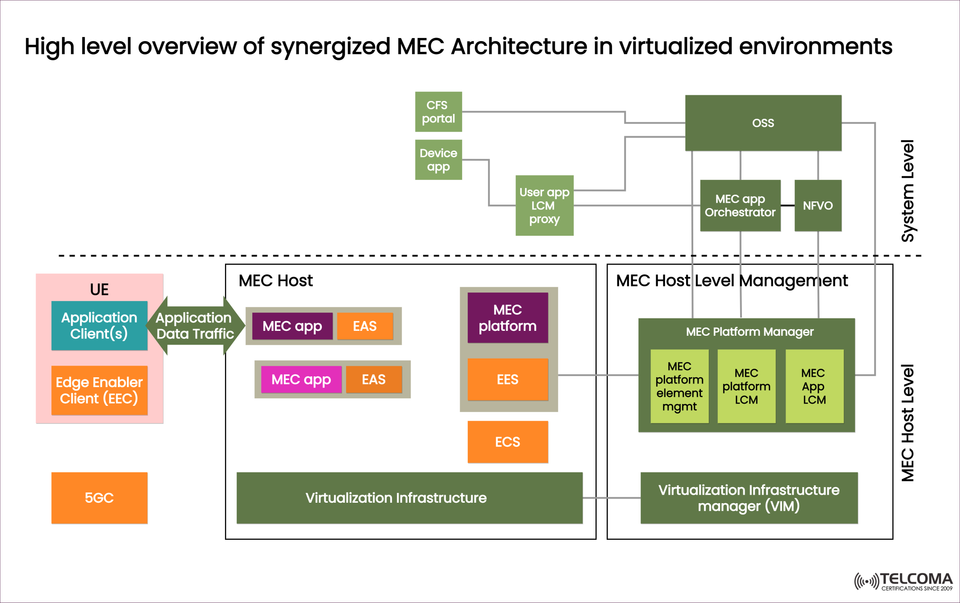

An Overview of Synergized MEC Architecture in Virtualized Settings
As 5G networks develop, there's an increasing need for ultra-low latency, fast data processing, and smooth edge connectivity. Multi-access Edge Computing (MEC) steps in as a key player by bringing computing power and storage closer to users. This blog takes a deep dive into the synergized MEC architecture in virtualized environments, outlining its components, various management levels, and how it meshes with virtualization infrastructure to boost performance in next-gen telecom networks.
What is Synergized MEC Architecture?
Synergized MEC Architecture combines Multi-access Edge Computing (MEC) with virtualized environments, like Network Functions Virtualization (NFV). This combination gives operators the flexibility to deploy and manage MEC applications smoothly across cloud-native and virtualized setups.
It ensures that edge computing functions—including MEC applications, platforms, and orchestration layers—work together seamlessly, enhancing scalability, interoperability, and efficient resource use across distributed network nodes.
In short, the synergized MEC serves as the operational backbone of 5G edge computing, making sure applications are delivered in real-time and network management is smart and efficient.
Understanding the Architecture Layers
The diagram provided breaks the architecture down into three main levels:
System Level
MEC Host Level
MEC Host Level Management
Let’s delve into each of these.
System Level: The Control and Orchestration Hub
At the peak, the System Level acts as the control, orchestration, and service management layer. It includes:
OSS (Operations Support System) – Takes care of operational processes, service assurance, and performance monitoring.
MEC App Orchestrator – Oversees MEC application deployments across various MEC hosts, ensuring resource allocation is done right and that lifecycle management (LCM) is efficient.
NFVO (Network Functions Virtualization Orchestrator) – Manages the orchestration of virtualized network functions (VNFs) and looks after the integration of MEC services within the broader NFV environment.
CFS Portal & Device App – Offer interfaces for configuration, service requests, and monitoring from a user or developer perspective.
User App LCM Proxy – Serves as a link between user-level applications and lifecycle management processes.
In summary, the system level ensures end-to-end orchestration across MEC hosts, aligning edge applications with virtualized infrastructure for smooth deployment and scaling.
- MEC Host Level: The Core Execution Environment
The MEC Host Level is where edge processing really takes shape. It contains the essential components that run MEC applications and handle data traffic between User Equipment (UE) and the 5G Core (5GC).
Key Components:
UE (User Equipment): Devices like smartphones, IoT sensors, or self-driving cars connect to the MEC environment via an Application Client or an Edge Enabler Client (EEC).
Application Client(s) cater to user applications needing low-latency access.
EEC facilitates communication between UE and the MEC platform.
Application Data Traffic: The two-way data flow between UE and MEC apps supports edge-driven data processing, cutting down on latency and lightening the load to the 5G Core.
MEC Host: This is the execution node for MEC applications and includes:
MEC App: Edge apps that perform localized processing (like video analytics, AR rendering, and IoT data filtering).
EAS (Edge Application Server): Delivers runtime support for MEC apps.
MEC Platform: Provides vital services (like DNS, traffic routing, and service discovery) for MEC applications.
EES (Edge Enabler Server): Facilitates communication between EECs and the MEC platform.
ECS (Edge Configuration Server): Manages configuration and policy settings.
Virtualization Infrastructure: The foundational layer that runs all virtualized resources, including compute, storage, and networking, that the MEC components rely on.
Together, these parts create a localized, low-latency setup for edge processing.
- MEC Host Level Management: The Intelligence Layer
The MEC Host Level Management ensures that MEC hosts are effectively managed, monitored, and maintained. It closely aligns with the NFV management and orchestration (MANO) framework.
Key Elements:
MEC Platform Manager: Central to host-level management, overseeing:
MEC Platform Element Management: Deals with the configuration and status of MEC platform elements.
MEC Platform LCM (Lifecycle Management): Manages the deployment, scaling, and shutdown of MEC platforms.
MEC App LCM: Concentrates on the lifecycle of MEC applications, including onboarding, scaling, and updates.
Virtualization Infrastructure Manager (VIM): Responsible for managing virtualized compute, storage, and network resources, providing orchestration interfaces for resource allocation and monitoring.
This management layer ensures smooth synchronization between MEC hosts and orchestrators, enabling automation, resilience, and elastic scaling across the MEC landscape.
Data Flow: From UE to Edge and Beyond
User Equipment (UE) kicks off a service request.
The Application Client and Edge Enabler Client (EEC) interact with the MEC platform using APIs.
Application Data Traffic is routed straight to the MEC Host, cutting down on latency.
MEC Apps handle data locally and deliver real-time responses.
The processed or filtered data might go to the 5G Core (5GC) for additional processing or analytics.
Orchestrators and OSS systems keep an eye on and manage the lifecycle and performance of MEC services.
Benefits of Synergized MEC in Virtualized Environments
Merging MEC with virtualization offers a bunch of benefits for telecom operators and businesses:
- Scalability and Flexibility
Virtualized environments make it easy to scale resources dynamically.
MEC applications can be deployed or shifted smoothly across different nodes.
- Reduced Latency
Processing data closer to users cuts down on round-trip delays.
This is crucial for real-time services like AR/VR, self-driving cars, and industrial automation.
- Efficient Resource Utilization
NFV and virtualization help make the best use of computing and network resources.
Multiple MEC instances can run on shared infrastructure.
- Simplified Management and Automation
Orchestrators and VIM provide centralized oversight and automation.
Lifecycle management streamlines operational tasks.
- Enhanced Security and Isolation
Virtualized layers enable network slicing and service isolation.
Each MEC host can apply security policies suited to specific application needs.
Use Cases Empowered by MEC Architecture
Use CaseDescriptionBenefitSmart ManufacturingReal-time monitoring of machinery using edge analyticsUltra-low latency decision makingAutonomous VehiclesLocalized computation for navigation and collision avoidanceReduced dependency on cloudAR/VR ExperiencesEdge rendering for immersive applicationsSmooth and responsive performanceIoT GatewaysAggregating and processing sensor data at the edgeEfficient data offloadingContent Delivery Networks (CDNs)Caching content closer to usersImproved streaming quality
How Virtualization Enhances MEC Integration
Virtualization technologies like Kubernetes, OpenStack, and containerized VNFs have become essential for MEC deployments. They ensure:
Portability across different hardware and edge nodes.
Automation through Infrastructure as Code (IaC).
Resilience thanks to fault-tolerant orchestration mechanisms.
The collaboration between MEC and virtualization creates a cloud-native edge that can support a variety of 5G and enterprise applications.
Conclusion
The Synergized MEC Architecture in Virtualized Environments marks a significant leap forward in telecom network design. By blending MEC capabilities with NFV and virtualization, operators can deliver ultra-low latency, high-performance, and scalable edge services.
From self-driving cars to immersive AR experiences, this architecture lays the groundwork for 5G-driven transformation—keeping intelligence and computation as close to users as possible.