
High Level RAN Architecture with Controller Layer for RAN Programmability

The 5G Radio Access Network (RAN) is built around agility, flexibility, and scalability. Unlike earlier generations that tied RAN closely to hardware, 5G brings in programmability through a controller layer that connects network applications with the core functions of the gNB (Next-Generation Node B).
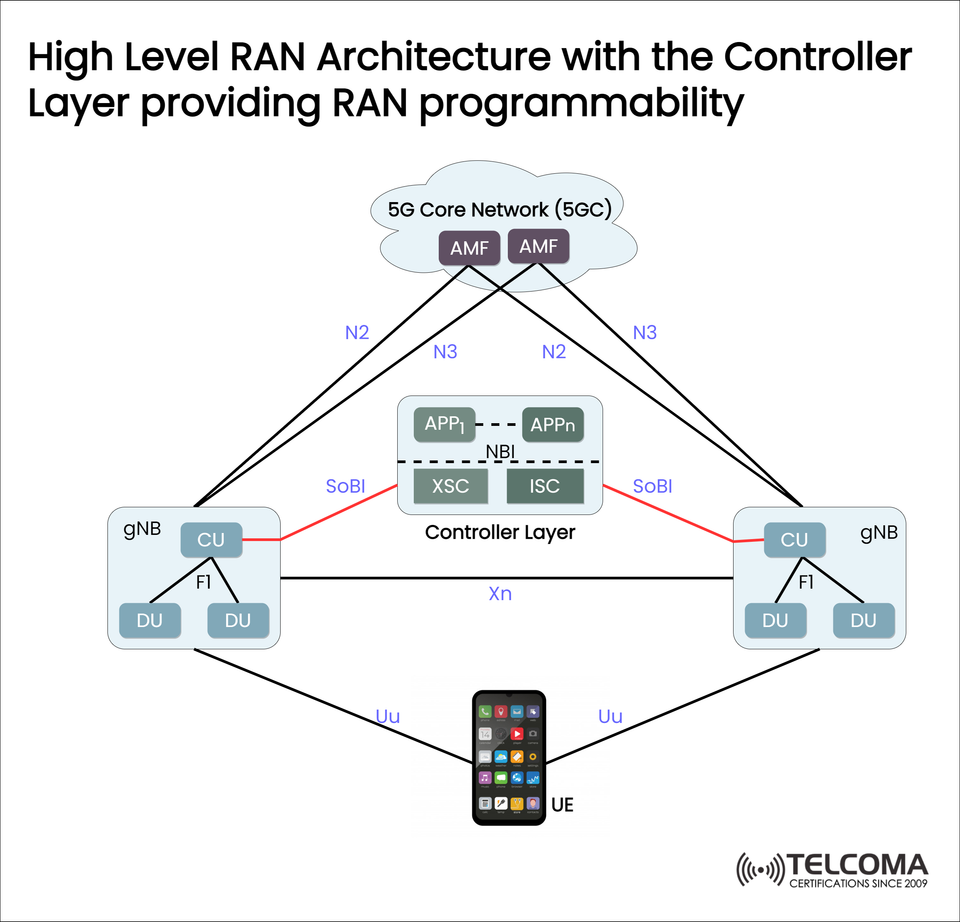
The diagram above illustrates the High-Level RAN Architecture featuring the Controller Layer, showing how components of the gNB (CU and DU) work together with a central controller to enable programmability and smarter network operations.
In this blog, we’ll dive into the functions of the CU (Central Unit), DU (Distributed Unit), UE (User Equipment), Controller Layer, and various interfaces (like Uu, N2, N3, Xn, SoBI, and NBI), and how they collaborate to provide advanced RAN programmability.
Evolution of RAN Towards Programmability
Traditional RANs were:
Rigid: Hardware and software stacks were tightly integrated.
Difficult to scale: Limited flexibility in features deployment.
Operator-dependent: Lacked automation or smart technology.
With the rise of 5G RAN programmability, operators can:
Dynamically manage network functions.
Roll out new apps through open interfaces.
Achieve real-time optimization using centralized intelligence.
Implement network slicing and offer different services.
Much of this programmability comes from the Controller Layer in the RAN structure.
Key Components in High-Level RAN Architecture
The diagram breaks down the following components:
- gNB (Next Generation Node B)
It’s like the eNodeB in 4G but enhanced for 5G.
Split into:
CU (Central Unit): Takes care of higher-layer functions like RRC, PDCP.
DU (Distributed Unit): Manages real-time tasks like MAC, RLC, and scheduling.
Connected through the F1 interface.
- UE (User Equipment)
This is the mobile device (smartphone, IoT gadget, AR/VR headset, etc.) that connects to the RAN using the Uu interface.
- 5G Core Network (5GC)
Contains functions like AMF (Access and Mobility Management Function).
Connects to the gNB via:
N2 Interface (for control-plane signaling).
N3 Interface (for user-plane traffic).
- Controller Layer
The intelligence center of RAN programmability.
Comprised of:
XSC (Cross-Slice Controller): Manages cross-slice coordination and orchestration.
ISC (Intra-Slice Controller): Oversees operations within a specific slice.
Applications (APP1…APPn): Offer services like optimizing mobility, managing QoS, or improving energy efficiency.
Provides APIs through the Northbound Interface (NBI) for easy integration of third-party apps.
Interfaces in RAN Architecture
The diagram showcases key interfaces that make communication seamless:
Uu Interface: Connects UE and gNB for radio links.
F1 Interface: Links CU and DU within the gNB.
Xn Interface: Connects different gNBs for handover and coordination.
N2 & N3 Interfaces: Serve as links between gNB and 5GC (control plane and user plane respectively).
SoBI (Southbound Interface): Connects gNB with the Controller Layer, allowing for programmability.
NBI (Northbound Interface): Lets outside applications influence RAN behavior through the Controller Layer.
Role of the Controller Layer in RAN Programmability
The Controller Layer functions as the brain behind the programmable RAN. Its roles include:
Centralized Management: Offers a unified view and control for multiple gNBs.
Programmability: Provides APIs (via NBI) so apps can dynamically control RAN operations.
Flexibility: Facilitates cross-slice (XSC) and intra-slice (ISC) functions for efficient network slicing.
Optimization: Adapts radio resources in real-time based on traffic demand, QoS, or mobility.
Automation: Cuts down on manual effort by automating network tasks.
Advantages of RAN Programmability
Flexibility in Service Delivery
Tailors to various use cases like IoT, eMBB (enhanced Mobile Broadband), or URLLC (Ultra-Reliable Low-Latency Communication).
Efficient Resource Utilization
Allocates spectrum and radio resources dynamically based on real demand.
Enhanced User Experience
Applications on the Controller Layer optimize handovers, lower latency, and maintain QoS.
Supports Network Slicing
Allows for independent programming of each slice to meet specific service needs.
Vendor Interoperability
Open interfaces like NBI and SoBI enable multi-vendor setups.
Example: RAN Programmability in Action
Think about a smart city setup with varying network needs:
Autonomous vehicles: Need ultra-low latency and stable connectivity.
IoT sensors: Create lots of low-throughput connections.
AR/VR applications: Require high bandwidth and minimal jitter.
Here’s how programmability helps:
The XSC guarantees smooth cross-slice management, keeping the vehicle and AR/VR slices distinct.
The ISC refines operations within each slice.
Applications (through NBI) can ask for real-time resource tweaks.
SoBI makes sure the controller can directly direct the gNB to implement these adjustments.
Comparison: Traditional RAN vs. Programmable RAN
Feature Traditional RAN Programmable RAN with Controller Layer Architecture Hardware-centric, static Software-defined, dynamic Scalability Limited High – supports multiple slices Flexibility Minimal High – programmable via APIs Resource Allocation Static Dynamic, real-time optimization Automation Manual Automated via Controller Layer
Deployment Scenarios
Operators have different ways to roll out the Controller Layer based on their strategy:
Centralized Deployment: The controller operates from a core data center.
Edge Deployment: The controller is closer to the edge for services that require low latency.
Hybrid Deployment: Mix of centralized and edge-based controllers.
Challenges in RAN Programmability
Even with its benefits, some challenges persist:
Integration Complexity: Working in a multi-vendor environment requires standardized interfaces.
Security Concerns: Open APIs (NBI) need protection against malicious apps.
Performance Overheads: The Controller Layer introduces extra processing that must be fine-tuned.
Evolving Standards: Keeping up with ongoing updates from groups like 3GPP and O-RAN Alliance requires alignment.
Future of RAN Programmability
Looking ahead, 6G RAN programmability will push these ideas further:
AI/ML-driven Controllers: Allowing for predictive network management.
Real-Time Slice Adaptation: Dynamically creating and discontinuing slices as needed.
Cross-Domain Integration: Connecting satellite, terrestrial, and non-terrestrial networks.
Open Ecosystems: Going more towards O-RAN standards for better compatibility.
Conclusion
The High-Level RAN Architecture with Controller Layer marks a significant evolution in mobile networks. By facilitating RAN programmability, operators can achieve flexibility, dynamic control, and automation—tailored for a variety of use cases, including IoT, smart cities, autonomous vehicles, and immersive experiences.
Having components like CU, DU, and gNB linked to a centralized Controller Layer along with open interfaces such as NBI and SoBI, transforms the RAN into an intelligent, programmable, and future-ready platform.